
Does Your Bathtub Have Seams?
Of course not. So why does the roof over your business?

🔲 The chemistry moved on years ago. The industry just kept selling the old stuff.
🔲 Tar, rubber, plastic, all panels stitched at edges. Every edge is a leak waiting for its turn.
🔲 Silicone is cheaper upfront. It's also slick, dirt-grabbing, and fights you at recoat. Silicone is silly.
🔲 Urethane and acrylic with fabric reinforcement, that's the backbone. That's the future.
🔲 A bathtub doesn't leak because there's nowhere for the water to get in. That's the whole idea.
Move Along. Unless Your Roof Has More Patches than Original Membrane.
Your panels are stitched at the edges. Every edge is a timer. The timer is already running.
We've been gluing sheets of material together and calling it a roof for a long time. Tar. Rubber. Plastic. Every one of them is just panels stitched at the edges, and every edge is a leak waiting for its turn.
Human intelligence is supposed to be increasing, at least in one area. The chemistry moved on years ago. We just kept buying the old stuff.
If you own a commercial building in Merrillville or anywhere across Northwest Indiana, that old stuff is probably still up there. And it is working against you in ways your maintenance team may not have named yet.
The Old Stuff. And Why We Kept Buying It.
A short history of flat roofing that nobody put in the sales deck.
Here is the story of how tar got onto American commercial roofs and stayed there for a hundred years.
Built-up roofing, layers of felt and hot tar, was the standard from the early twentieth century because it worked well enough and nothing better existed. Then rubber came. EPDM was a genuine improvement over tar in some ways, lighter, easier to install, better UV resistance. The industry sold it hard.
Then plastic came. TPO and its cousins entered the market in the 1990s as a cheaper alternative to PVC. Contractors loved the margin. Building owners got a lower line item on the invoice.
"tPo is cheaper!" But of course it is.
"Why so cheap?" Should be the reply.
And the answer, if anyone had asked it, was, because it's still just a panel. Still stitched at the edges. Still held together by adhesive with a timer on it. The material changed. The fundamental problem did not.
Every one of these systems, tar, rubber, plastic, shares the same design logic. Manufacture flat sheets. Overlap the edges. Bond the laps. Repeat across the roof surface. The result is a membrane with dozens of seams, each one a bond between two materials held together by a chemistry that has a defined service life.
When the chemistry expires, the seam opens. When the seam opens, the water finds it.
Building owners in Northwest Indiana have been getting that bill for decades. The only thing that changed was which material they were replacing this time.
The chemistry moved on years ago. The industry just kept selling panels.
Every major sheet membrane system, BUR, EPDM, TPO, PVC, is a panel-and-seam construction. The material differs. The failure mechanism is identical: adhesive bond degradation at the lap.
Why the Seams is Always the Weakest Point
It's not the membrane that fails. It's the line where two of them meet.

Here's the truth that doesn't show up in any contractor's presentation.
The membrane itself, the flat sheet between seams, is engineered to last. UV resistance, puncture resistance, thermal stability. Manufacturers spend real money on the membrane. What they don't spend money on is solving the seam. Because solving the seam means admitting the panel-and-lap design is the problem.
So the seam gets adhesive. Good adhesive. Rated adhesive. Adhesive that performs exactly as specified, under the conditions it was tested for, in a laboratory, at controlled temperatures, without Northwest Indiana's January thaws and July heat domes running it through forty-degree swings in a single week.
Every time your roof heats up and cools down, the membrane expands and contracts. The adhesive bonding the lap flexes. Each flex cycle wears it down a little more. Stack enough cycles over enough years, and in NWI's climate, you stack them fast, and the lap doesn't just lift. It opens.
The membrane didn't fail. The line where two membranes were stuck together failed.
That's not a defective product. That's physics. And physics doesn't care what the warranty says.
The membrane is engineered to last. The seam is engineered to be forgotten about. Those are different things.
Adhered seams on NWI commercial roofs degrade 30 to 40% faster than in stable climates due to thermal cycling frequency and amplitude. Standard warranty ratings do not account for NWI field conditions.
Still running panels and seams? Let's talk about what's next.
Call or text: (219) 529-1995 • PristineIndustrialRoofing.com • Serving Lake County, Porter County, and Southwest Michigan.
[Get a Free Commercial Roof Inspection]
No More Tar. No More Rubber. No More Plastic.
And no, we don't do silicone either.
So here's where we stand.
No more tar. No more rubber. No more plastic. The panel-and-seam era is over for any building owner who wants to stop replacing the same roof every fifteen years.
But there is one more material worth calling out by name, because it shows up in liquid coating conversations and deserves a direct answer.
Silicone is silly.
Silicone roof coatings have their advocates. They're liquid-applied, so they go on seamlessly. That part is true. But silicone is slick, it doesn't hold dirt, which sounds like a benefit until you realize it also doesn't hold the next coat. When it's time to recoat a silicone roof, you're fighting the surface. The adhesion between a new coat and an existing silicone surface is poor. Recoating becomes a major operation instead of a maintenance procedure.
Silicone also grabs dirt in the wrong places, at ponding areas and low spots, creating a surface that looks degraded long before it structurally is. And in NWI's industrial air environment, where the precipitation carries particulates from steel production and refinery operations, a dirt-retaining low spot is also a chemistry problem.
Urethane and acrylic are the answer. And here's why.
Urethane cures to a tough, flexible membrane with elongation values that handle NWI's thermal swings without cracking. Acrylic builds a bright, reflective surface that cuts cooling load and plays well with NIPSCO's summer demand. Both accept recoats without a fight. Both renew.
That's not a preference. That's a maintenance model.
Silicone is slick, it grabs dirt, and it fights you when it's time to recoat. Silicone is silly.
The Fabric is the Future.
What gives a liquid coating its backbone, and why it matters in this climate.
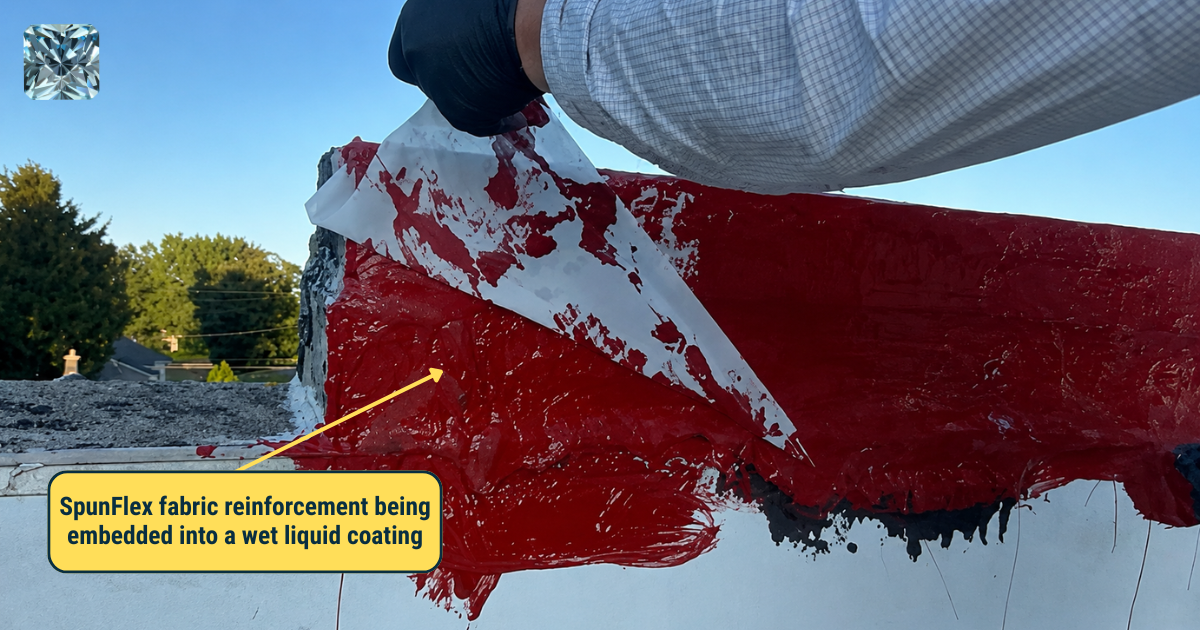
A liquid coating without reinforcement is a skin. It protects. It seals. But under mechanical stress, foot traffic, hail, wind-driven debris, thermal movement across a large surface, it's working alone.
A liquid coating with fabric reinforcement embedded in the wet layer is a composite. The fabric, typically polyester or fiberglass scrim, gives the cured system tensile strength it couldn't achieve on its own. Pull strength. Tear resistance. The ability to bridge over minor substrate irregularities without cracking.
Here's what that means in practice for a building in Merrillville or anywhere across Northwest Indiana.
When your roof surface hits one hundred and sixty degrees in a July heat dome and then drops thirty degrees overnight because a cold front came through, the coating moves. It expands. It contracts. Without reinforcement, that movement concentrates stress at whatever weak points exist, weak points, edges, low spots. With reinforcement, the fabric distributes the stress across the full surface. The system moves as one piece instead of as isolated zones of tension.
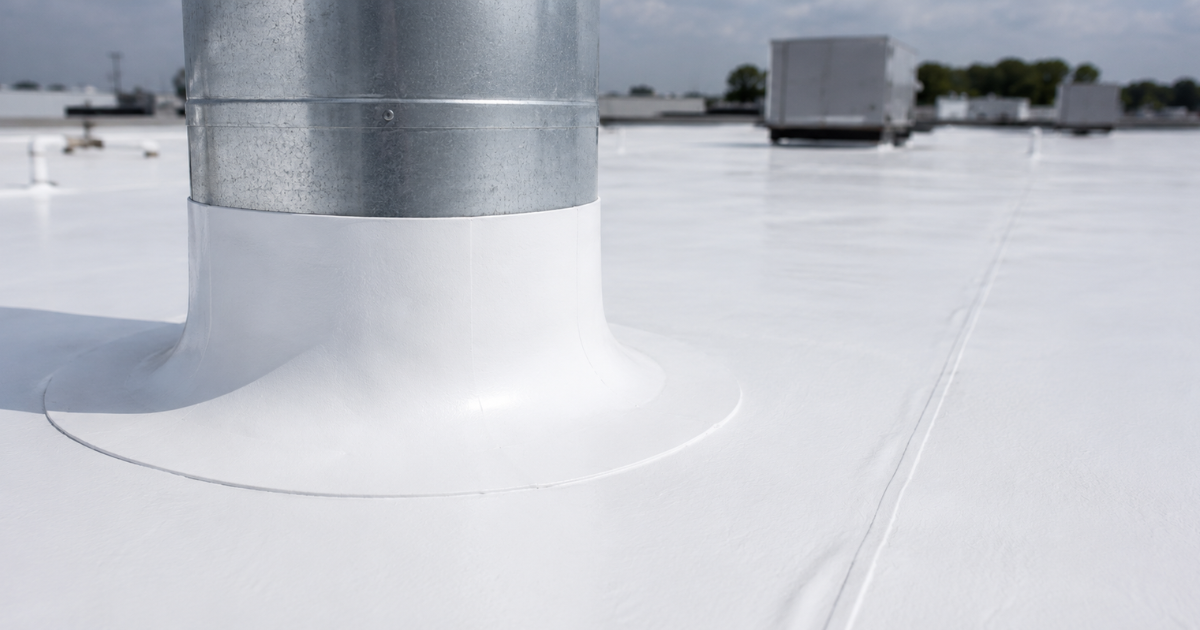
This is why the bathtub analogy holds. A bathtub is a single continuous surface with no seams, no lap edges, and no adhesive bonds to fail. When you embed fabric reinforcement into a liquid coating and apply it edge to edge, wall to wall, up the parapets, around every pipe sealing, you get the same geometry.
One surface. No edges. No seams.
The water has nowhere to start.
The fabric gives it a backbone, real tensile strength, so the skin flexes with your building through every hot day and cold night instead of tearing.
What the Chemistry Actually Does
Urethane vs. acrylic, which one, when, and why it matters for your building.
Not every building needs the same system. The chemistry has two primary tracks, and they're not interchangeable.
Urethane goes down first when moisture protection is the primary objective. It's the base coat in most Conklin system applications, dense, moisture-resistant, the layer that does the heavy waterproofing work. Urethane doesn't breathe. That's a feature. It creates a barrier. In a building where the existing membrane is dry, the deck is solid, and the insulation is recoverable, urethane locks that condition in.
Acrylic goes on top. It's the finish layer, highly reflective, UV-stable, and the coat that renews. Acrylic breathes slightly, which helps in buildings with some residual moisture vapor pressure from the interior. It's the layer that cuts the surface temperature, drops the cooling load, and gives you the NIPSCO savings conversation.
In a two-coat system with fabric reinforcement between the layers, you get the waterproofing of urethane, the reflectivity of acrylic, and the tensile backbone of the scrim, all in one continuous surface that cures to the substrate at a chemical level, not a mechanical one.
No discrete adhesive layer. No bond line to delaminate. No lap edge to lift.
The whole system is the seam. And the seam is the whole system. Which means there isn't one.
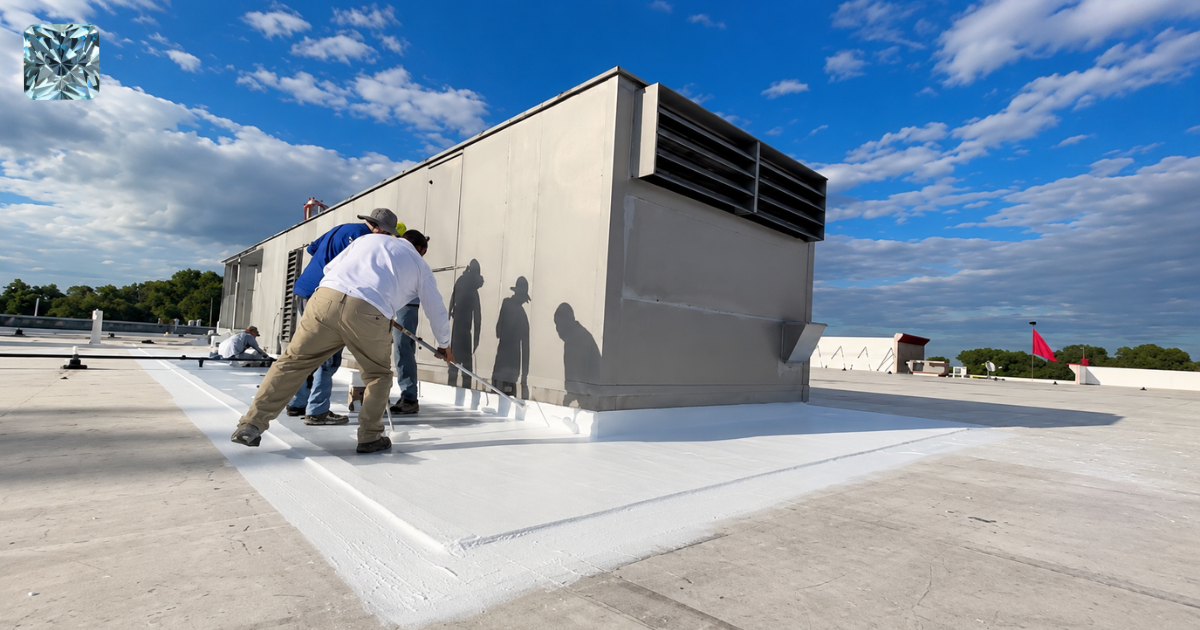
For building owners in Merrillville and across Northwest Indiana who have been watching the same roofing cycle repeat, install, patch, patch again, replace, this is what the exit looks like.
What a Building Owner in Merrillville Already Figured Out
The same building, two different futures.
A few years back we walked a commercial property in Merrillville. The owner had been on rubber EPDM for nineteen years. The laps had been patched twice in the last five. The seams around the pipe sealing were pulling. His insulation had saturation in three quadrants.
His first question was: how much to replace it?
We pulled core samples. We ran infrared. The deck was solid. One quadrant of insulation was unrecoverable, wet through, no R-value left. The other three were intact.
We removed the bad quadrant, replaced the insulation, and laid the Conklin system over everything else. Urethane base, fabric reinforcement, acrylic finish. Edge to edge. Wall to wall.
His replacement quote had been one hundred and eighty thousand dollars. His final invoice was sixty-two thousand.
His NIPSCO bills dropped the following Summer. His warranty reset. He hasn't had a maintenance call on that roof since.
He didn't need new panels. He needed to stop using panels entirely.
When the Old Systems is Too Far Gone for a Coating
Honesty first. Not every roof is a liquid candidate.
We're going to tell you the truth here because it's the only way this works.
If more than twenty-five percent of your insulation is saturated, coating over it seals the moisture in and accelerates damage from underneath. That's a worse outcome than doing nothing. We'll say so if that's what we find.
If the deck itself is compromised, rotted wood, corroded steel, deteriorated concrete, that has to be resolved before any surface system goes on top of it.
And if the existing membrane is so degraded that adhesion testing shows it won't hold a liquid system, the honest answer is a tear-off. We'll give you that answer if it's the right one.
What we won't do is sell you liquid chemistry as a cosmetic fix over a structural problem. That's not a business we want.
But in the majority of buildings we assess across Northwest Indiana, solid decks, recoverable insulation, membranes that are failing at their seams rather than through their core, the liquid system is the right call. The panels had a good run. The chemistry moved on.
Your building has a maintenance budget. It has a NIPSCO bill. It has a roof that was put down when panel-and-lap was the only answer anyone had.
There's a better answer now. It doesn't have seams. It doesn't have edges. And it doesn't keep sending you the same invoice every fifteen years.
The future of flat roofing is liquid. Let's talk about it.
Everything Your Roofer Should Have Told You Before You Bought Another Panel
1. Why is urethane or acrylic better than what's on my roof now?
Because what's on your roof now is a panel system, sheets bonded at the edges with adhesive that has a service life. When the adhesive fails, the seam opens. Liquid systems cure into one continuous membrane with no seams, no lap edges, and no adhesive bonds to fail. Different category of product entirely.
2. Why not silicone? It's liquid-applied too.
Silicone goes on seamlessly, which is the one thing it has going for it. But it's slick, poor adhesion to recoats, meaning your next maintenance cycle becomes a major operation. It retains dirt at ponding areas. And in NWI's industrial air environment, that dirt carries chemistry. Urethane and acrylic recoat cleanly. Silicone fights you. Silicone is silly.
3. What does the fabric reinforcement actually do?
It gives the cured coating tensile strength it couldn't achieve on its own, pull strength, tear resistance, the ability to distribute thermal stress across the full surface instead of concentrating it at weak points. Without reinforcement, a liquid coating is a skin. With it, it's a composite. The difference matters most in NWI's climate, where forty-degree temperature swings in a single week are normal.
4. Can the liquid system go over my existing EPDM or modified bitumen?
In most cases, yes, with a proper moisture assessment and adhesion testing first. If the existing membrane is structurally sound and the insulation beneath is not saturated, the Conklin system can be applied directly over it. We test before we recommend. No guesswork.
5. What's the difference between the urethane base coat and the acrylic finish?
Urethane is the waterproofing layer, dense, moisture-resistant, the primary barrier. Acrylic is the finish layer, reflective, UV-stable, and the coat that renews at maintenance intervals. Together with the fabric reinforcement, they form a composite system that waterproofs, reflects heat, and recoats without a fight.
6. How does the renewable warranty work?
The Conklin system carries a ten-year manufacturer warranty from the installation date. At renewal, we inspect the surface, apply a maintenance coat if the system qualifies, and the warranty resets. No forced replacement cycle. The same roof, maintained, can protect your building indefinitely.
The future of flat roofing is liquid. Let's talk about it.
Call or text: (219) 529-1995 • PristineIndustrialRoofing.com • Serving Lake County, Porter County, and Southwest Michigan.
[Get a Free Commercial Roof Inspection]
APPENDIX — SCIENCE SIDEBAR (FOR THE TECHNICAL READERS)
[Appendix A: The evolution of flat roofing chemistry]
[Appendix B: Silicone roof coatings, performance profile and failure modes]
[Appendix C: Urethane and Acrylic chemistry, performance properties]
[Appendix D: The renewable warranty, Financial structure and long term cost model]
[Appendix E: NWI industrial air chemistry and membrane degradation]
Read other blog:


We Love Conversations
 SoHelpful@PristineIndustrialRoofing.com