
Mechanical Fastening vs. Fully Adhered Flat Roofs: Which Method Actually Protects Your Building?
Why the Way Your Roof Membrane Is Attached Matters More Than the Membrane Itself. A Building Owner’s Guide to Installation Methods, Wind Uplift, Cost, and Long-Term Performance.
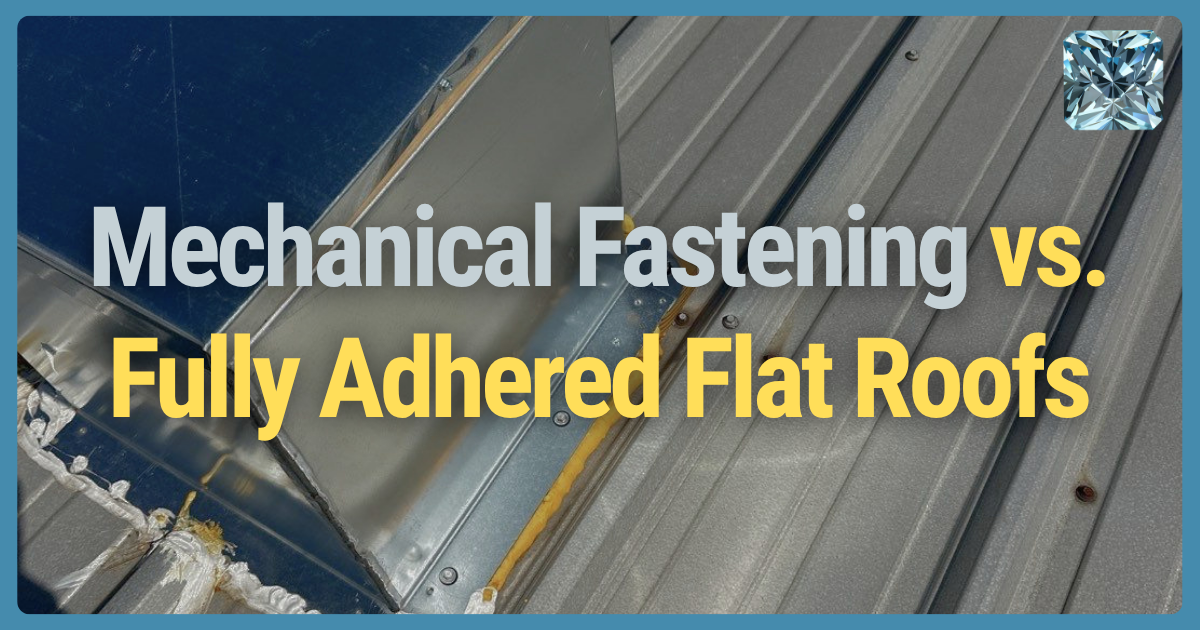
🔲 Two ways to attach a flat roof membrane: mechanically fastened (screws and plates bolted into the structural deck) or fully adhered (glued down with adhesive).
🔲 Mechanical fastening costs 20 to 30% less than fully adhered because construction adhesive is expensive and labor-intensive.
🔲 Mechanically fastened roofs resist hurricane-force wind because they are physically anchored to the building’s structural deck.
🔲 Fully adhered membranes can delaminate when moisture or condensation breaks the adhesive bond underneath.
🔲 Pristine Industrial Roofing mechanically fastens every Conklin Flexion 2.0 vinyl roof using American-made TruFast fasteners.
🔲 Corner and perimeter zones receive tighter fastener spacing (6 inches on center) because wind forces concentrate at the edges of every building.
Every Roof Starts at the Deck
When building owners shop for a new flat roof, they almost always start with the same three questions: What color is it? How long is the warranty? How much does it cost? Those are fine questions. But they skip the most important one: How is the membrane attached to my building?
The attachment method is the foundation of everything. It determines whether your roof survives a storm or peels off like a postage stamp in the wind. It affects your total project cost, your long-term maintenance burden, and whether your warranty is worth the paper it is printed on.
There are two primary methods for attaching a single-ply membrane to a flat commercial roof: mechanically fastened (bolted down with screws and plates) and fully adhered (glued down with construction adhesive). Both are used across the industry. Both have strengths. But they are not equal, and this article will show you exactly why.
Before we compare them, let us establish a shared vocabulary. The roof deck is the structural foundation of your roof, the steel, wood, plywood, or concrete surface that everything else sits on top of. Above the deck, you typically have insulation board (often called ISO board), and on top of the insulation sits the membrane itself. The membrane is the waterproof layer that faces the weather. The attachment method determines how the membrane and insulation connect to that structural deck.
This article is based on Conklin Company’s certified installer training materials, Factory Mutual (FM Global) wind uplift testing standards, ASTM D 6878 membrane specifications, and real-world installation experience from Pristine Industrial Roofing across Northwest Indiana.
How Mechanical Fastening Works
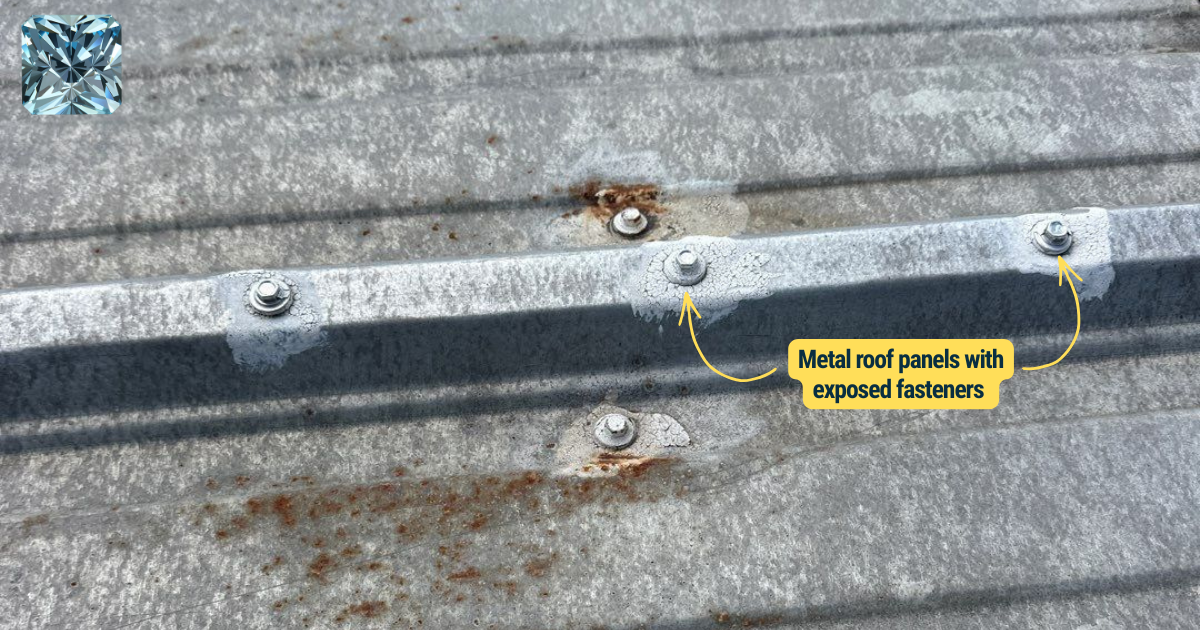
Mechanical fastening is exactly what it sounds like: heavy-duty screws driven through the membrane and insulation board directly into the structural deck below, held in place by barbed stress plates that grip the membrane tight against the insulation surface.
The fasteners used on Conklin projects are manufactured by TruFast (Altenloh, Brinck & Co., U.S., Inc.), 100% American-made products built with German cold-forming engineering expertise. These are not drywall screws from a hardware store. They are purpose-built roofing fasteners designed for specific deck types.
Steel decks (22, 20, or 18 gauge): TruFast #12 DP, #14 HD, or #15 EHD Drill Point Fasteners with stress plates. Minimum 1 inch of fastener extending through the top flute of the steel deck.
Wood and plywood decks: TruFast #10 TP Gimlet Point or #12 DP Drill Point Fasteners with stress plates. Minimum 1 inch embedment in plank deck or 1 inch through plywood.
Structural concrete decks: TruFast #14 HD Drill Point Fasteners, Tru-Spike, or Fluted Nail with stress plates. Pre-drilled holes at least half an inch deeper than needed.
Tectum, lightweight concrete, and gypsum decks: TruFast TL Fastener, a specialty non-pass-through design with exceptional pull-out strength. Pre-drilling required. Minimum 1.5 inch embedment.
The fastener pattern varies by zone on the roof. In the open field area (the middle of the roof), fasteners are spaced 12 inches on center. Around the perimeter of the building, spacing tightens to 6 inches on center. In the corners, where wind forces are strongest, fastener density increases further. This is not guesswork. These patterns are defined by Factory Mutual Loss Prevention Data Sheets 1-28 and 1-29, which establish wind exposure classifications for every building geometry and location.
The key advantage of mechanical attachment is absolute. The membrane is physically anchored to the structural deck. It is not affected by moisture, condensation, temperature changes, or adhesive degradation. Even if the ISO insulation board underneath were to delaminate from moisture exposure, the mechanical fasteners would still hold the membrane in place because they pass through the insulation and grip the deck directly.
How Fully Adhered Installation Works
Fully adhered installation uses construction adhesive to bond the membrane to the fiberglass-faced ISO insulation board underneath. The two approved adhesives for Conklin Flexion systems are Pliobond 9752 (solvent-based) and Pliobond 7008 (water-based). Each has different application rates, drying times, and temperature restrictions.
Solvent-based (Pliobond 9752): Applied with approved solvent-resistant paint rollers at a rate of approximately 50–70 square feet per gallon (2.0–2.5 Dry Mills, coated both sides). The adhesive must be tacky (produces strings when touched with a dry finger) before the membrane is rolled onto the coated surface. Drying time ranges from 1 to 3 hours depending on temperature and humidity.
Water-based (Pliobond 7008): Applied at a rate of approximately 165–175 square feet per gallon. Cannot be used on slopes greater than 2:12. Cannot be installed when temperatures will be at or below 40 degrees Fahrenheit within 24 to 48 hours of application and curing.
After the adhesive is applied, the membrane is carefully unrolled onto the surface without folds or wrinkles, then pressed firmly into place with a weighted foam-covered lawn roller, rolling in two directions to promote 100% adhesion.
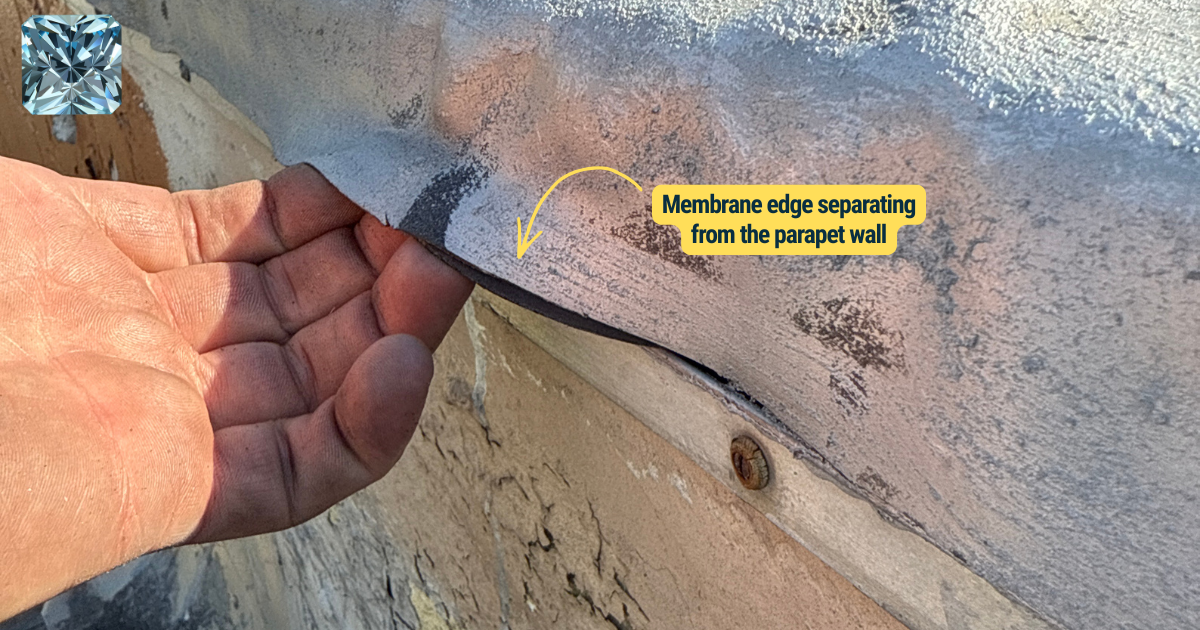
While quick and straightforward in concept, the fully adhered method has one serious vulnerability. If condensation forms underneath the membrane, which commonly happens due to improper ventilation of the roof deck, it will break down the adhesive bond and delaminate the ISO board. Once the membrane loosens, it becomes susceptible to wind blow-off. The results of a blow-off event are not limited to the membrane itself. Catastrophic wind uplift can destroy the insulation, expose the deck, and cause interior damage to the entire building.
The cost impact is also significant. Adhesive materials add roughly 20–30% to total material costs compared to mechanical fastening. Labor is more intensive because the installer must apply adhesive evenly, wait for proper tack, roll the membrane carefully, and work within temperature and humidity windows. Areas that cannot be fully completed in a single day’s operations must not be coated with adhesive, any film formation on the adhesive surface before the membrane is set will compromise the bond.

What Happens When Attachment Fails
The three material properties that determine whether a membrane withstands wind forces are breaking strength, elongation, and tear resistance. These translate directly into a roof system’s wind uplift rating, expressed as an FM (Factory Mutual) classification. FM 1-60 means the system can resist 60 pounds per square foot of upward wind pressure. FM 1-90 means 90 pounds per square foot. The higher the number, the more wind the system handles before failure.
For context, Conklin’s Outpost TPO 60 mil membrane (tested to ASTM D 6878) shows a breaking strength of 403 lbf in the machine direction and 373 lbf cross-machine, with tearing strength of 84 lbf (MD) and 126 lbf (CMD). These numbers well exceed the ASTM D 6878 minimums of 220 lbf breaking strength and 55 lbf tearing strength. That membrane has a puncture resistance of 275 lbs (FTMS 101C Method 2031) and passes ozone resistance testing at 2,000 cycles with no cracking.
But those material properties only matter if the membrane stays attached to the building. A fully adhered membrane with perfect material specs will still fail catastrophically if the adhesive bond breaks. A mechanically fastened membrane with the same material specs will stay in place because the physical connection to the structural deck remains intact regardless of what happens to the insulation layer.
Conklin’s Picture Frame perimeter fastening method places two half-strips of membrane around the entire building edge, with perimeter fasteners spaced a maximum of 12 inches apart. Full strips cover the main field with fasteners spaced as indicated by FM wind zone requirements. The installation sequence follows a numbered pattern (Detail 1-19) that ensures complete coverage with no gaps in wind uplift protection.
Why Pristine Mechanically Fastens Every Roof
Pristine Industrial Roofing’s standard specification calls for mechanically attached Conklin Flexion 2.0 vinyl membrane with TruFast fasteners on every project across Lake County and Porter County, Indiana. We do not default to fully adhered installation because the 20–30% increase in material cost does not translate into a proportional increase in performance. In most cases, it translates into increased risk.
When a project calls for higher wind resistance, due to building height, exposure, or local conditions, we increase fastener density rather than switching to adhesive. More fasteners per square foot in the field, tighter spacing at perimeters, and maximum density in corners. That is how you build a roof that survives.
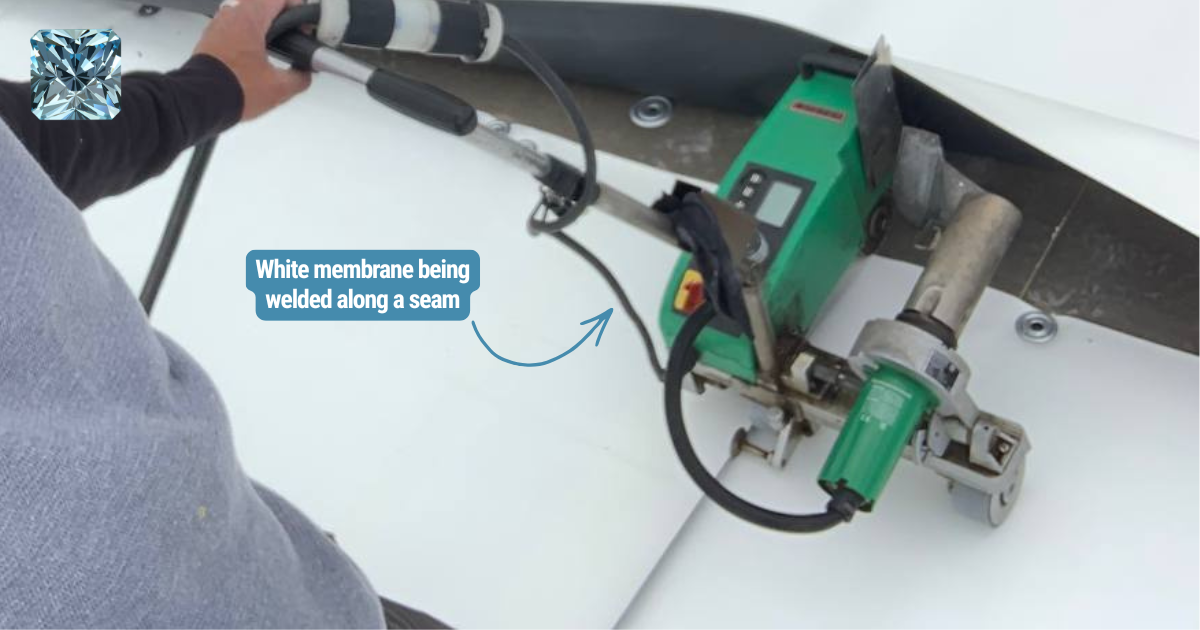
The Flexion 2.0 vinyl membrane system delivers a 25-year, 300-month non-prorated warranty. Seams are heat-welded (never glued, never taped), creating a continuous monolithic barrier. The membrane carries a Class A fire rating, which is worth noting because commodity TPO membranes do not carry a Class A fire rating. Flexion 2.0 is resistant to grease, acids, and chemicals. It is walkable. It is recoatable, meaning the building owner can extend the roof’s life with a maintenance recoat rather than a full replacement. And it preserves the insulation value underneath because there is no tear-off required.
Conklin’s own Outpost product is a TPO membrane, a high-quality one with Kevlar-reinforced fastening edges and non-moisture-wicking aramid/knit scrim. We offer it as an option. But the Flexion 2.0 vinyl system remains our primary recommendation because of the fire rating, the chemical resistance, and the proven long-term recoatability that TPO cannot match.
Commercial Roofing Questions Answered
Is fully adhered installation better for my building?
In most commercial applications, no. Mechanical fastening provides superior wind uplift resistance at a lower material cost with less installation risk. Fully adhered may be specified in rare situations where zero deck pass-through is required, but this is uncommon in standard commercial construction.
Will I hear noise from a mechanically fastened roof?
No. The ISO insulation board between the membrane and the deck absorbs sound. On commercial buildings with HVAC systems, interior noise, and typical ambient sound levels, the difference between mechanically fastened and fully adhered is not perceptible.
Can you mechanically fasten over an existing roof?
Yes, in many cases. Depending on the condition of the existing deck and the number of existing roof layers, mechanical fastening can be installed over legacy roofing systems. This is determined during the free roof evaluation.
What is a wind uplift rating?
A wind uplift rating (such as FM 1-60 or FM 1-90) indicates how much upward wind pressure the roof system can resist, measured in pounds per square foot. FM 1-60 means 60 PSF. FM 1-90 means 90 PSF. Higher numbers indicate greater wind resistance. Fastener density and pattern are the primary variables that determine the rating.
What deck types can you fasten into?
Steel (22, 20, and 18 gauge), wood and plywood, structural concrete, Tectum, lightweight concrete, and gypsum. Each deck type requires a specific TruFast fastener and installation technique. See the TruFast specification guide or contact Pristine for details.
How long does mechanical installation take?
Mechanical installation is generally faster than fully adhered because there is no adhesive application, drying time, or temperature restrictions to manage. A trained Conklin-certified crew can install significantly more square footage per day with mechanical attachment.
Your Roof’s Survival Starts at the Deck
The membrane gets all the attention. The warranty gets all the marketing. But the attachment method is what determines whether your roof is still on your building after the next big storm. Mechanical fastening is stronger, more reliable, and less expensive than fully adhered installation for the vast majority of commercial flat roofs.
If you own or manage a commercial building in Lake County or Porter County, Indiana, Pristine Industrial Roofing offers a free, no-obligation roof evaluation. We will assess your existing roof deck, identify your current membrane type, measure the total area, and provide a detailed proposal for a Conklin Flexion 2.0 vinyl restoration or replacement.
For larger projects, SBA 504 and 7(a) financing is available through Centier Bank to help spread the investment over time without depleting operating capital.
Pristine Industrial Roofing is a Gospel Business. Every roof we install funds community outreach and worldwide missions. When you invest in your building, you invest in something bigger.
Pristine Industrial Roofing
Conklin-Certified • Lake County & Porter County, Indiana
PristineIndustrialRoofing.com
Read other blog:

We Love Conversations
 SoHelpful@PristineIndustrialRoofing.com