
Water on Your Roof Won't Hurt Anything ... Except Everything Under It
Why Most Commercial Property Managers Discover Their Roof Problem After It Has Already Cost Them Thousands. Because water always shows up uninvited..
🔑 Spring and Fall roof checkups save thousands. Bring materials for touchup.
🔑 Emergency roof repairs cost 2-3x normal rates. Plus mold. Plus tenant chaos.
🔑 Pay predictably now or pay painfully later. Water decides the timeline.
🔑 Sweaty pipes quietly destroy insulation long before the first ceiling stain.
🔑 The $500 fix today is the $15,000 emergency next year.
🤔 Let Me Guess How You Found Out
You did not wake up one morning, walk on the roof, spot a small crack, and think, "I should get that fixed before it becomes a problem."
No.
You found out because Sandra from Accounting emailed facilities about the bucket in her office. Or because a tenant called, again, about the water stain spreading across their drop ceiling tiles. Or worst of all, because your maintenance tech found mold during a routine filter change, and now you are staring down a five-figure remediation bill enforced by the Lake County Health Department.
Pure joy.
Here is the thing about commercial roofs: they fail in slow motion, then all at once.
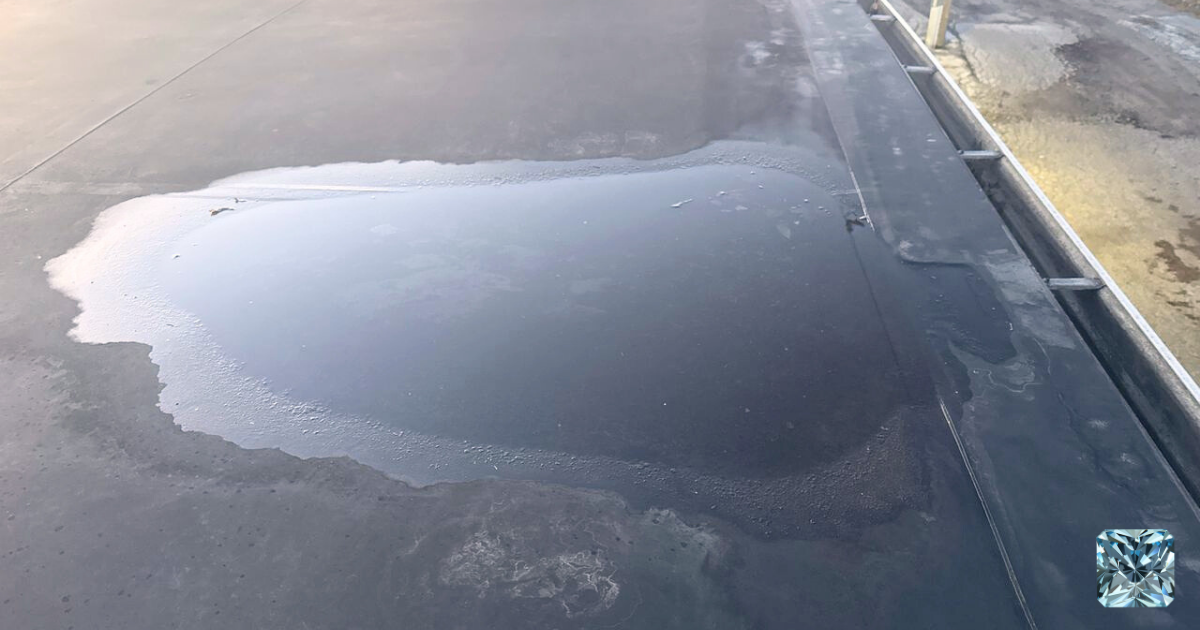
That pooling water you have been meaning to check? It has been there for months. Quietly working its way through your roof membrane. Those hairline cracks around the HVAC curbs? They are letting in just enough moisture to rot your decking. Not enough for you to notice until it is too late.
The tiny roof issue that costs you $500 to touch up today will cost you $15,000 to fix next year. Plus business interruption. Plus emergency labor rates. Plus tenant complaints.
This is about understanding one of the most expensive lessons in commercial property management before it costs you what it costs everyone else who waited.
💸 The Real Cost of "It's Just Water"
When Water Wins (Spoiler: It Always Does)
Water is mysterious. Seriously. How did the two H's connect to the O in the first place?
Water does not care about your budget cycle. It does not wait for a convenient time to cause problems. And it absolutely will not announce itself until the damage is done.
And here is what most people miss: rain is no longer innocent.
Today's water carries metal particles, industrial runoff, resin, burning acid from the refineries and factories scattered across Hammond, East Chicago, and Whiting. Pollution is a pest. The stuff that falls on your roof in Northwest Indiana is chemically supercharged.
So let us paint a picture of what "just water" actually costs.
The Obvious Costs
- Emergency roof repair at 2-3x normal rates
- Interior damage plus relocation headaches
- Replacement of damaged inventory or equipment
The Hidden Costs Nobody Mentions
- Lost productivity when staff cannot work in affected areas
- Tenant rent reductions or withholdings
- Increased insurance premiums after a claim
💡 Wisdom is balancing proactive prevention to reduce explosions or spikes in the building budget.
🛑 Real Talk: One Warehouse. One Puddle. $47,000.
I talked to a facility manager right here in Indiana last month. Managed a 40,000 square foot warehouse. Single pooling water issue on the roof.
"We knew it was there," he said. "We were going to handle it during the summer budget."
That ponding acid water found a seam.
That seam let water into the insulation.
That wet insulation created mold.
That mold spread to the interior.
And mold rots human lung tissue.
Total cost when it was all said and done? $47,000.
The preventive fix would have been $1,200.

📊 The 80/20 Rule for Roof Maintenance
Or: How to Stop the Bleeding
You do not have unlimited time. You definitely do not have unlimited budget. So here is what matters.
20% of roof maintenance activities prevent 80% of expensive failures.
The question is, which 20%?
After working with hundreds of commercial properties across Lake and Porter Counties, the pattern is unmistakable. Here is what actually moves the needle.
💧 1. Drainage: Dry Roof, Happy Building
Most flat roofs are simply too flat. Grow some curves. Get some slant. It is engineering. Slope it for the win!
Keep liquid rolling off your roof. This is your single highest-impact activity for roof preservation.
Clogged drains, pooling water, and blocked scuppers cause untimely roof failures. Totally preventable.
Just let the pros handle the rough roof work. Set it and forget it. We show up every Spring. Every Fall. We touch it up. We clean it up. We document the progress. We remove the junk. We clean all the debris away.
You have got other areas of concern. STOP trying to manage every wall and every brick and every tile in every room. Can you please just trust somebody?
🔧 2. Pipe Sealing: Where 70% of Leaks Happen
Every pipe, HVAC unit, vent, and rooftop piece of equipment creates a weak point on your roof membrane. Pipes and perimeters are where the overwhelming majority of leaks start.
It is human error. Not material defect.
Right over there in Valparaiso. You probably know the place. We met with Todd. He took us on a quick tour. The leaks were right next to some expensive equipment. The materials installed around his pipes were melting. Obviously. It was just plastic. Who knew? Pretty obvious that hot pipes melt plastic. That is not the right chemistry.
We needed high-heat vinyl. Significantly different product. Or industrial urethane, which is not easy to burn once cured. The point? The right material on the right pipe saves the whole building.
I am super glad Todd's business is still producing in today's economy.
🛡️ 3. Flashing: Your Roof's First Line of Defense
Quick definition: flashing is the metal trim around the edges of your building where the roof meets walls, curbs, or edges. Think of it like weather stripping for your roof.
It is the first thing to fail when nobody is watching. And it does not send you a text message about it.
4. Catching It Small Before It Gets Expensive
Tiny tears. Micro peeling. Caulking gets brittle.
Catching membrane bubbles or splits before they become full-thickness failures is the difference between a $300 patch and a $30,000 section replacement.
That is it. That is the list.
🏆 Congratulations on actually caring about your building and your people enough to read this far into the article. We are human too. These are necessary conversations that are sometimes a little boring, but we try to spice it up. We are trying really hard to not let the robot take over our brand personality.
⚠️ Things That Feel Productive But Do Not Move the Needle
Here is what facility managers spend time on that delivers minimal return:
🧹 Roof washing or cleaning (unless debris is blocking drainage).
Remember the last time you had a kid go clean something? And he brought you back a cute picture of his progress and the results? And then he posted it on Instagram? Yeah, he got 312 likes on that. I guess that helped the brand image?
Look. People over 50 do not love climbing around on roofs with a power washer. You are going to have some kid get up there and he is going to mess it up. He is not going to be supervised. He is just going to start having fun and cleaning things that do not need cleaned. Then over-cleaning areas that are sensitive. It is like skin. WeWashFlatRoofs.com can handle a quote for you. Because it is way beyond washing. What if the same people that washed the roof can identify the pinholes and do the touchups at the same time? And then we use an appropriate conditioner because your roof needs more than just shampoo. 🧴
🔁 Replacing the same small section repeatedly without addressing the root cause. Consider all the layers.
📋 Over-documenting minor cosmetic issues that do not threaten waterproofing.
I am not saying do not do these things. I am saying if you are doing these while ignoring pooling water, you are rearranging deck chairs on the Titanic.
🧪 How Water Actually Destroys Your Roof
The Science You Deserve to Know
Most people think roof damage happens because water dissolves or erodes materials. Not quite.
Water carries cousins. Water is not pure. Water is a magnet. It grabs contaminants. Remember once a year the city has to mail you a water purity checklist? It shows you how much arsenic and lead and industrial runoff and lawn pesticides are in your water. That is the stuff that comes out of your tap. Imagine the unfiltered stuff from the sky.
Chemically supercharged water snoops for a weakness. Mystery water and its varying cousins are like a team, looking for a tiny crack, an expired chunk of caulking, a deteriorating boot wrap. They all seep in together. Under the curtain of darkness. Raise their weapons and go about raiding the place.
Water acts as a powerful hydraulic jack by expanding 9% when frozen so that it can then go deeper into more layers when it thaws.

This cycle repeats every single day the temperature crosses the freezing point. In Northwest Indiana, that is 40 to 60 times per winter. Cedar Lake to Crown Point to Merrillville. Same brutal freeze-thaw pattern. Every single year.
One NWI winter can crank a hairline fracture into "hair loss" for your building. 😂
Does a building have hair? No. But does it have a protective surface that can thin out, recede, and leave it exposed? Absolutely. And just like Bill is not excited about his next dermatology appointment, your building is not excited about another unprotected winter.
💨 SOG = SAG
When Your Roof Gains Water Weight, Your NIPSCO Bill Goes Through It
Your roof material is important. But underneath that membrane is your insulation. And if that insulation gets wet, it becomes a ticking financial disaster.
Consider.
Insulation works by trapping air. We all knew that.
Wet insulation is compressed insulation.
Compressed insulation does not trap air.
When insulation does not trap air, it does not insulate.
Then NIPSCO goes up 40%. Rocket through the roof! 🚀
💡 Here is what nobody tells you:
People do not fix their roof because it has a leak. They get their roof looked at to see if they can reduce their NIPSCO. Put an extra coat of insulation on your roof and reduce your NIPSCO by 35%. Literally. We can do that.
This next sentence might cause temporary pain because we love you enough to tell you the truth. You have got to do something.
Wet insulation is also heavy insulation. That additional weight stresses your roof structure. And wet insulation promotes mold growth, which means your "roof problem" becomes an "indoor air quality problem."
Hats off to you, by the way. We commend you on all of your prevention and protection so far. The whole team feels a lot safer because you are here. We are just trying to elevate your efforts slightly. We are coming alongside you to help.
📧 Want a Free Roof Assessment?
We respect your inbox. No sales pressure. No spam. Just genuinely helpful information about protecting your commercial property. Unsubscribe anytime.
Your Name: _______________________________________________
Your Email: _______________________________________________
Building Address: _______________________________________________
Number of Buildings You Manage: _________
[ ] Yes, send me helpful roofing insights and maintenance tips
[ ] Yes, I would like someone to take a look at my building
⚡ PRO 🆚 RE
Proactive vs. Reactive Building Management
Let me introduce you to two facility managers I know. Both manage similar properties. 150,000 square foot distribution centers with roofs installed around the same time.
😴 Randy Reactive
- Waits for visible leaks before taking action. "I do not want to believe problems are possible."
- Gets quotes only when there is already an emergency. No pre-approved contractor relationship.
- Budget for roofing: allocated only when something breaks.
✅ Paula Proactive
- Gets the roof walked every Spring and Fall. Documented photos. Progress compared.
- Maintains a relationship with a qualified contractor who already knows the building.
- Budget for roofing: $3,000 to $5,000 annually for preventive maintenance. Predictable. Peaceful.
- Sleeps soundly. Kenny is not stressed. Nancy is not surprised. Bill is not angry.
- Understands that her building has a lifetime. And thinks beyond five years.
Same buildings. Same age. Same weather. Wildly different outcomes.

Think of your building like a vehicle. There is a reason why people love Toyota. Proven track record of lower cost of ownership over the lifetime. Your building has a lifetime too. And its lifetime is different than your lifetime. You have to think beyond five years.
That is why you are in the building business. You are not in this seat because you are the cheapest option. Let the finance department worry about pennies. You are the protector. The hero. Explore the future of products. Get to know acrylic. And urethane. And vinyl. Stop thinking about tar and expired rubber and disposable plastic wrap TPO. Those are ancient and expired.
📅 What Actually Works: Your Practical Schedule
You do not need to be a roofing expert. You need to know what to look for and actually look for it.
Each Spring. Each Fall. Checkup. That is it.
Here is what we look at on every visit:
💧 Drainage points: Are drains clear? Is water flowing freely? Any signs of pooling more than 48 hours after rain?
🔧 Pipes and perimeters: Any gaps, cracks, or separation around pipes, HVAC units, or vents? Metal caps, clay caps, edge trim. All checked.
🧤 Membrane condition: Any bubbling, splitting, or tears in the roof surface?
🛡️ Flashing and edges: That metal trim around the edges. Any separation, rust, or damage where the roof meets vertical surfaces?
We take photos. We shoot video. We document progress. And we touch up any pinholes or areas of concern. Note the date. Compare to the last six months. If something is getting worse, that is your early warning system.
We do not come out quarterly. We do not skip to see you just once a year. Spring and Fall is ideal. Plenty good.
The Twice-a-Year Deep Dive
This is not a maintenance tech glancing from the ground. This is someone on the roof, checking infrared for moisture intrusion, testing drainage flow rates, and documenting conditions.
Value: Usually $300 to $800 depending on roof size. 100% of our properties are on a preventative maintenance plan based on a monthly auto-charge per square foot. With a touchup budget included.
Real Value: Finding the $500 problem before it becomes the $15,000 emergency.
✉️ The Email You Need to Send Right Now
Here is what I want you to do today. Forward this article to your maintenance supervisor, your roofing contractor if you have one, or whoever handles your roof issues.
In the email, write:
Subject: Let us talk about our roof before it talks to us
"I just read an article about proactive roof maintenance and realized we might be letting small issues become expensive problems. Can we schedule 30 minutes this week to walk the roof and put together a basic inspection schedule? I would rather spend $1,000 preventing problems than $20,000 fixing them after the fact."
That is it. No complex RFP process. No budget approval meetings. Just a conversation that could save you tens of thousands of dollars.
💰 The Bottom Line
Because Your CFO Is Going to Ask
Your roof is a $200,000+ asset sitting on top of everything else you are trying to protect. It has exactly one job: keep water out.
When it fails at that job, the costs pile up fast: interior damage, lost productivity, tenant complaints, emergency repairs at premium pricing, insurance claims that increase your premiums, and decreased property value.
Preventive maintenance costs 5-10% of reactive emergency repair.
But beyond the math, there is this: peace of mind. Knowing that water is not quietly destroying your building while you sleep. Knowing that you will not get that panic call from a tenant about ceiling leaks. Knowing that when budget season comes, you are not scrambling to explain a surprise capital expense.
👂 Your Roof Is Talking. Are You Listening?
That pooling water? It is talking.
Those small cracks? They are talking.
The question is whether you are going to listen while it is still whispering, or wait until it is screaming.
Because water on your roof will not hurt anything. Except the roof membrane, the insulation, the decking, the structure, the interior finishes, the equipment below, your tenant relationships, your budget, and your peace of mind.
Other than that? Totally harmless. 😏
Want to stop playing roof roulette with your commercial property? No roofing experience required. Because the only thing worse than a roof problem is a roof problem you saw coming but did not prevent.
📧 Want a Free Roof Assessment?
We respect your inbox. No sales pressure. No spam. Just genuinely helpful information about protecting your commercial property. Unsubscribe anytime.
Your Name: _______________________________________________
Your Email: _______________________________________________
Building Address: _______________________________________________
Number of Buildings You Manage: _________
[ ] Yes, send me helpful roofing insights and maintenance tips
[ ] Yes, I would like someone to take a look at my building
Continue Your Journey
🔗 Finding the Right Commercial Roofing Solution → RoofServiceMenu.com
🔗 Before You Fix the Roof, Fix the Conversation → RelationshipRoofing.com
🔗 Modern Roof Chemistry Explained → ModernRoofChemistry.com

Read other blog:

We Love Conversations
 SoHelpful@PristineIndustrialRoofing.com