
PVC vs tPo: Why We Stopped Installing Plastic Wrap on Commercial Roofs
The commercial roofing industry’s most popular membrane has a documented history of premature failure, seam separation, and shrinkage. Here is what the manufacturers are not eager to tell you.

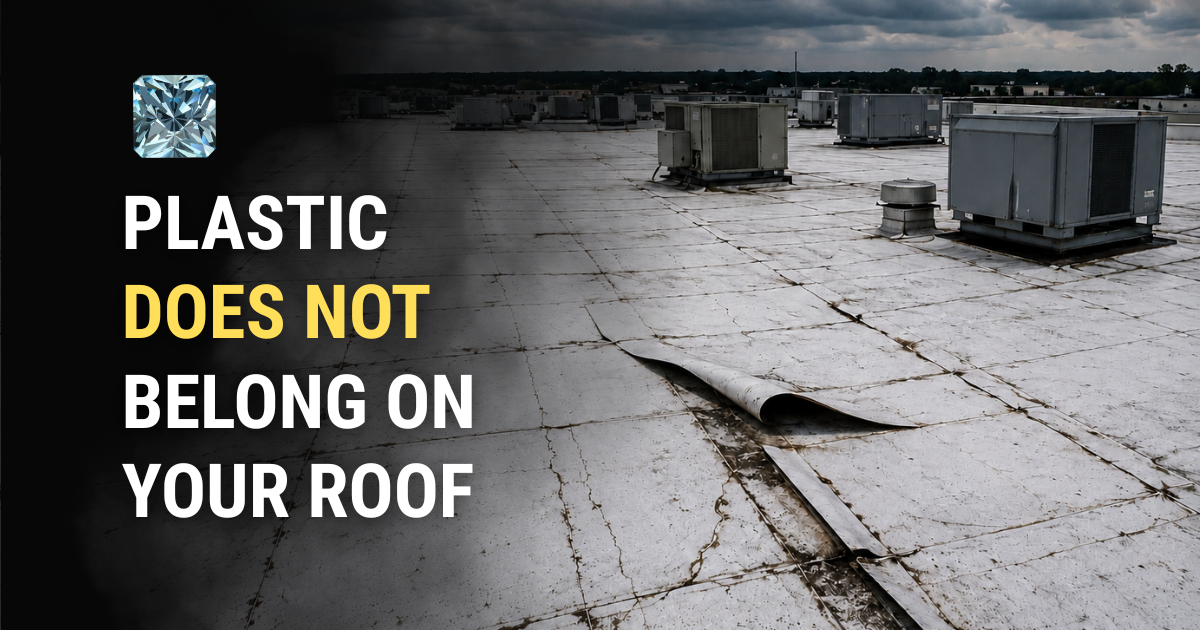
🔲 While TPO performs well initially, many systems begin to show seam failure, shrinkage, and UV degradation within 5 to 10 years, with significant brittleness and repair needs often appearing before or around the warranty period.
🔲 PVC’s chemistry provides inherent fire resistance and strong durability against grease, fats, and industrial chemicals, making it especially suitable for restaurants and industrial buildings, conditions that actively degrade TPO membranes.
🔲 Although TPO has a lower upfront cost, its shorter service life and higher likelihood of repairs or early replacement often make it more expensive over time compared to longer-lasting PVC systems.
🔲 TPO performance is highly sensitive to heat exposure, seam welding quality, and environmental stress, whereas PVC systems (especially reinforced ones) provide more consistent, durable performance across varying conditions.
Over 40% of new commercial roofing projects in the United States use thermoplastic polyolefin. It is cheap. It is white. It is everywhere. And for about 10 to 12 years, it works just fine.
Then the chemistry catches up.
The Midwest Roofing Contractors Association issued research findings recommending caution about elevated temperature exposure. ASTM International tightened their heat-aging test from 28 days to 224 days back in 2011 after documented premature failures. Multiple manufacturers have quietly reformulated their products, some more than once, because the original chemistry could not hold up under real-world conditions.
Here is the part that should concern you most: there have been no updates to those standards or advisories since 2011. No new ASTM revisions. No updated performance bulletins from manufacturers. The industry moved on, but the problems did not.

The Failure Timeline Nobody Advertises
Years 1–5: The membrane looks great. White, reflective, clean. Seams appear tight. Building owner is satisfied. Warranty paperwork sits in a drawer somewhere in Portage or Hammond.
Years 5–10: Seam adhesion begins weakening. UV degradation starts microscopic crazing. Thin 45-mil formulations show early stress. Shrinkage pulls membrane edges away from flashings and parapet walls, creating entry points for water. Entry points are not ideal.
Years 10–15: The membrane becomes noticeably brittle. Puncture resistance drops. Freeze-thaw cycling in Northwest Indiana Winters accelerates cracking. Surface fibers start showing through. Ponding water degrades the membrane faster than the surrounding field.
Years 15–20: If you have made it this far without significant repairs, you had good installation, mild weather, and regular maintenance. What are they actually maintaining though? Just looking at it? Most facilities in Merrillville and Schererville are looking at significant seam re-welding, patchwork, or full replacement before the warranty expires.
A typical warranty runs 10–20 years. The membrane was never designed to outlast the warranty by much, and that is by design. When the manufacturer says it lasts 20–30 years, they are talking about laboratory conditions with perfect installation, no foot traffic, no storms, no grease exhaust, and no thermal cycling. Your building does not live in a laboratory.

Why PVC Chemistry Is Fundamentally Different
PVC is fire-resistant by chemistry. Not by coating. Not by additive. It achieves UL 790 Class A fire rating because the chlorine in the polymer chain naturally resists combustion. tPo (plastic wrap, poor thing) achieves its fire rating through flame-retardant additives that degrade over time, especially under UV exposure.
PVC resists animal fats, industrial acid rain, grease exhaust, and petroleum-based chemicals. This matters enormously for restaurants, industrial kitchens, and any facility with rooftop exhaust. Those same chemicals actively break down the tPo polymer structure. Confirmed by lab testing. Not marketing claims.
There is a reason Conklin built FLEXION vinyl 300 the way they did. The DuPont Elvaloy copolymer-alloy chemistry did not happen by accident. Neither did the Kevlar-reinforced fastening edge. Forty-five years of field testing has a way of informing product decisions.
Flexion 2.0 vs Brittle Plastic-Wrap: Side by Side

The numbers are not editorial. They are spec-sheet numbers. Pull the data sheets and compare them yourself. We will wait.
✉️ One roof in your portfolio is already past the tipping point. Which is it?
Subject Property Address: ___________________________
Drop the address. We will tell you what we see.
FREE evaluation. No sales pitch. No pressure. No obligation.
[ Email address ] → [ Send Me the Real Stuff ]
The Restaurant Roof Problem
Every restaurant with a rooftop exhaust hood is pumping animal fats and grease directly onto the membrane. Every day. This greasy film makes heat-welding repairs impossible from the top side.
That is why every restaurant roof repair requires blindside technique: cutting in from underneath and welding the patch from below, where the membrane is still clean. Most generic roofers do not know this. Others know it and will not do it because it takes longer. The result is a visible patch on top that looks finished but is not sealed underneath, and you will find out the hard way the next time Hammond gets three inches of rain in six hours.
If your building has a kitchen exhaust, tPo is not a cost-saving decision. It is a deferred replacement schedule.

The Honest Cons of PVC
We believe in full transparency. PVC can experience plasticizer migration when placed directly against incompatible substrates. This is why a separation layer, called a divorce board, is necessary when installing over old tar, modified bitumen, or expired rubber membranes. Atlas polyiso insulation serves as that separation board in every Conklin-certified system we install in Lake and Porter Counties.
PVC also does not stay as visually clean as tPo initially. The flexible surface develops small textural features during manufacturing that attract dirt in the first months. Power washing with mild detergent removes them, after which PVC maintains its cleanliness for a longer period than the alternative.
Neither of these cons is structural. Neither affects waterproofing. Neither shortens the membrane's lifespan. They are real trade-offs worth knowing, but they are cosmetic and procedural, not chemistry failures.
The difference between a cosmetic inconvenience and a chemistry failure is about $80,000 in emergency replacement costs. Nance can confirm.
What Meg Needs to Bring to the Table
If you are the property manager who noticed the problem first, flagged it to ownership, and got told to keep an eye on it, this section is for you.
Here is the language that shifts the exposure back to where it belongs.
Written notice of a defect on a commercial roof changes the liability picture. Once a property owner has documentation showing they were aware of a roof condition, a maintenance report, a vendor email, a work order, and chose to defer action, insurance carriers can reduce or deny future claims tied to that condition. The roof does not have to be leaking yet. The documented awareness is enough.
Print this article. Put it in the folder. You did your job.
The SBA and Capital Planning Angle
A FLEXION vinyl 300 roof system through Conklin qualifies as a capital improvement under standard SBA 7(a) lending guidelines. Building owners in Hammond, Portage, and Merrillville who are planning facility upgrades can fold roof replacement into their financing package rather than pulling from operating budget.
The annualized math is not complicated. A $68,000 tPo replacement at year 15 on a building that could have had a 25-year Conklin system for comparable upfront cost is not a savings story. It is a procurement decision that gets re-examined every decade.
NIPSCO energy costs in Northwest Indiana make reflectance a numbers conversation, not a color preference. An aged tPo membrane retaining dirt and losing reflectance means higher cooling loads. The CRRC data showing FLEXION vinyl 300 at 70% aged reflectance versus a visually dirty tPo surface is not aesthetic. It is a line on the utility bill.
Frequently Asked Questions
Q: How long does a tPo roof actually last? Industry data shows 15 to 25 years with proper installation and maintenance. However, poorly welded seams can fail within 5 to 10 years, and documented cracking and crazing have been observed in high-UV and high-heat environments. The membrane was not designed to outlast its warranty period by much.
Q: Why is PVC the better choice for restaurants? PVC is chemically resistant to animal fats, grease, and petroleum, the exact chemicals that rooftop exhaust systems deposit on the membrane daily. These same chemicals actively break down tPo polymer structure. For any building with a kitchen exhaust, PVC is not optional. It is necessary.
Q: What is a divorce board? A separation layer, typically Atlas polyiso insulation, placed between incompatible roof surfaces. It prevents chemical reactions between old tar or rubber and new PVC membrane. The chemicals in the old material react with PVC plasticizers and accelerate aging at the contact point. Every Conklin-certified system we install includes it.
Q: Can you install PVC directly over an old roof? Yes, with conditions. You need a minimum 1.5-inch Atlas polyiso separation layer, and the building cannot already have two existing roof systems. Code allows a maximum of two total roof layers. Old tar-and-gravel at the bottom counts as layer one.
Q: What makes FLEXION vinyl 300 different from other PVC membranes? Kevlar-reinforced fastening edge, DuPont Elvaloy copolymer-alloy chemistry, -40°F cold flexibility, 26,000-hour UV resistance, and a 25-year / 300-month NDL warranty through Conklin. The 30-year performance horizon is under active lab testing. Most PVC membranes do not carry any of those specs. FLEXION carries all of them.
Q: Does NIPSCO bill change with a reflective roof? Yes. Cooling load reduction from a high-reflectance membrane has a measurable effect on summer utility costs, particularly for flat commercial roofs in Northwest Indiana where heat absorption without reflectance means air conditioning is compensating for the roof. The CRRC-rated reflectance data for FLEXION vinyl 300 is available on request.

The Bottom Line
A commercial roof membrane should be three things. Measurable, verify every claim with a spec sheet. Desirable, it should solve real problems you actually have. Believable, the warranty should be backed by a company with the financial strength and 45-year history to stand behind it.
A warranty is only as good as the company behind it. A lot of roofing material gets warrantied beyond its actual shelf life. Chemistry does not care about marketing departments. The sun cooks. The acid eats. The cycles of freeze and thaw crack what was never built to flex.
We install what we would put on our own building. Full stop.

✉️ Let us take a look at that one property in your portfolio, you know the one.
Subject Property Address: ___________________________
Drop the address. See your options. No obligation.
FREE evaluation. No sales pitch. No pressure. No obligation.
[ Email address ] → [ Send Me the Real Stuff ]
SEE YOUR OPTIONS. NO OBLIGATION.
Pristine Industrial Roofing | Lake & Porter Counties | Conklin Certified
(219) 529-1995 | ModernRoofChemistry.com
We love you enough to tell you the truth.
Read other blog:


We Love Conversations
 SoHelpful@PristineIndustrialRoofing.com