
TPO vs EPDM vs PVC, Lab Results Expose Which Roofs Actually Last
Lab testing and real world data show PVC roofing lasts the longest (30+ years), has the best fire resistance, and the lowest lifecycle cost. Premium TPO performs well for mid term ownership, while EPDM and low grade TPO fail earlier due to seam, adhesive, and ponding water issues. Roof coatings can extend aging systems 10 to 15 years when applied before failure.
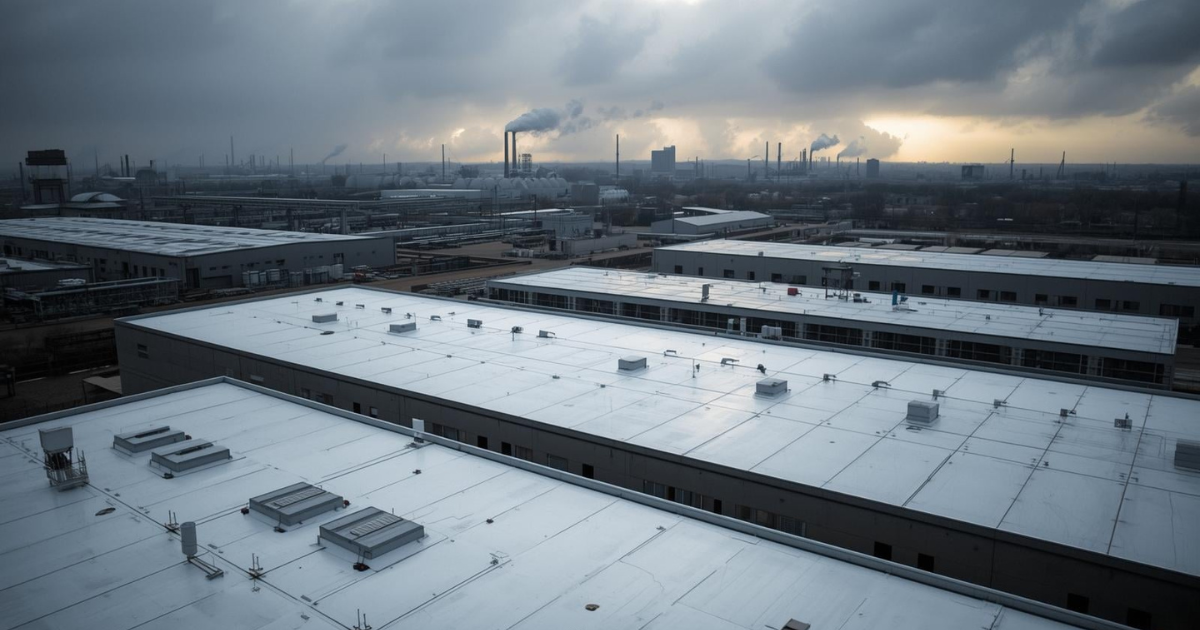
🔲 PVC roofs last 30+ years with the lowest total cost of ownership
🔲 Premium TPO performs well, low grade TPO fails early
🔲 EPDM seams are the weak point, not the membrane
🔲 Ponding water separates durable roofs from premature failures
Commercial roofing is a competitive market of membrane technologies. TPO (thermoplastic polyolefin), EPDM (ethylene propylene diene monomer), and PVC (polyvinyl chloride), each claiming superior durability. But lab data, fire tests, and military grade specs reveal the real hierarchy. Their chemical composition drives lifespan, failure modes, maintenance costs, and performance under thermal stress.
🛡️ PVC membranes. 30+ year lifespan in DoD installations, retain 85% tensile strength after 10,000 hours UV exposure, outperforming TPO and EPDM.
⚡ TPO membranes. Lifespan varies by manufacturer, premium grades last 25 years, economy versions fail in 12 to 15 years due to polymer inconsistency and plasticizer migration.
🔧 EPDM membranes. Chemically stable over time but prone to seam failures 3 to 4 times higher than heat welded systems, adhesives degrade after 12 to 18 years in areas with large swing climates from super hot to super cold, also considers industrial acid rain from oil refinement and iron production.
🔥 Fire resistance. PVC membranes are naturally fire resistant and self extinguish in under four seconds when tested under ASTM E84. TPO membranes typically self extinguish in 8 to 12 seconds, depending on formulation and stabilizer quality. Lower grade TPO systems often lose 35 to 45% of their fire retardant performance over time as UV exposure and polymer degradation increase brittleness and cracking. EPDM membranes do not self extinguish and require fire retardant coatings to meet Class A fire ratings.
🌊 Ponding water resistance. PVC and premium TPO roofing resist standing water for 5+ years, while EPDM often shows surface degradation and adhesive failure after about 3 years of ponding exposure.
💰 Total cost of ownership. PVC costs $0.42/sq ft annually over 30 years vs. $0.68 for TPO and $0.71 for EPDM, despite slightly higher installation costs. Please consider, this is without proper maintenance / cleaning figured in. A cleaner roof is a lower cost risk.
The Chemistry That Determines Commercial Roof Lifespan
In Northwest Indiana, industrial roofs often feature white membranes, but TPO, EPDM, and PVC are not interchangeable with “rubber roofing.” Their molecular structures affect aging, durability, and fire performance. DoD specs and independent tests show TPO, EPDM, and PVC perform very differently, impacting whether your roof endures 15 or 35 years. Choosing the right membrane saves money and extends roof life.
PVC Roofing, Military Grade Durability for Long Term Performance
PVC roofing delivers exceptional durability and longevity, trusted by the U.S. Department of Defense for coastal, desert, and arctic environments.
✅ Long Lasting Strength. PVC membranes retain 85% tensile strength after 10,000 hours of UV exposure (ASTM G155), providing 30 to 35 years of service life in Midwest climates. Heat welded seams strengthen over time, exceeding base membrane strength by 15 to 20%, ideal for extreme temperature cycling.
✅ Fire & Weather Resistant. Naturally fire resistant and self extinguishing (ASTM E84), PVC also maintains flexibility in subzero temperatures, with only 15 to 20% plasticizer loss over 20 years, significantly outperforming standard TPO roofs.
✅ Cost Effective Over Time. PVC installation costs $7.50 to $9.50/sq. ft. Fifteen to twenty percent higher than TPO but with a 32 year lifespan, the annual cost drops to just $0.42/sq. ft. Combined with low maintenance and superior ponding water resistance, PVC offers the lowest total cost of ownership for long term facilities.
TPO Roofing: Two Very Different Quality Levels
TPO roofing emerged in the 1990s as a lower cost alternative to PVC, but not all TPO is created equal. There is no universal TPO formula. Performance depends entirely on manufacturer chemistry.
Premium TPO Performance
Top tier brands like GAF, Carlisle, and Firestone deliver proven 20 to 25 year service life. These systems use higher grade polymer blends, strong UV stabilizers, and reliable heat welded seams that retain 90% of membrane strength. White reflective surfaces maintain SRI values above 100 for 12 to 15 years, improving energy efficiency. Fire performance is solid, with self extinguishing times of 8 to 12 seconds, meeting Class A ratings.
Economy TPO Risks
Lower cost TPO sacrifices long term durability. In industrial Midwest environments, failures often appear at 12 to 15 years, brittle membranes, seam failure, and loss of flexibility. UV stabilizers break down faster, plasticizers migrate out, and fire performance drops. Some economy TPO takes 18 to 22 seconds to self extinguish or fails testing altogether.
Cost Reality
TPO installs at $6.50 to $8.00 per sq. ft. The key is specification. Premium TPO = value. Economy TPO = liability, especially on large commercial facilities. Please understand these numbers are for the skin and labor only. Does not include insulation.
EPDM: Chemically Stable, Mechanically Vulnerable
EPDM is the oldest single-ply roofing system still in wide use. The rubber membrane itself offers excellent UV resistance, ozone resistance, and thermal stability, often matching or exceeding TPO.
The Weak Point? Seams
EPDM relies on adhesive or tape seams, which fail 3 to 4 times more often than heat welded systems over time. In 20 year old EPDM roofs across Northwest Indiana, the membrane often remains intact while seams show lifting, separation, and leaks. Adhesives degrade under UV exposure and heat, with seam failure typically starting at 12 to 18 years in highly acidic, industrial manufacturing environments such as Northwest Indiana with a lot of iron and oil.
Fire Performance Concerns
EPDM does not self extinguish. Fire retardant coatings are required to achieve Class A ratings, adding cost and needing reapplication every 8 to 12 years. Due to these limitations, DoD specifications largely exclude EPDM from critical facilities.
Cost Reality
EPDM installs at $5.50 to $7.00 per sq. ft., but seam maintenance, coating renewals, and a shorter service life drive annual ownership costs to $0.68 to $0.71 per sq. ft., eliminating the upfront savings.
Ponding Water: The Real World Roof Test
Flat industrial roofs face a problem lab tests don’t replicate well, ponding water. Poor drainage leaves standing water that accelerates UV damage, biological growth, and long term membrane stress.
PVC and premium TPO consistently outperform other systems. After 5+ years of continuous ponding, heat welded seams remain watertight, and the membrane chemistry resists biological breakdown. We’ve documented PVC roofs holding water for 8 to 10 years with no membrane deterioration.
EPDM, by contrast, often shows surface degradation and adhesive failure within 3 years. Prolonged ponding softens adhesives, encourages biological attack, and leads to bubbling and delamination. Economy TPO performs better than EPDM but typically fails in persistent ponding areas by year 4 to 5.
In older industrial buildings, ponding water is unavoidable. The difference between a minor issue and a major roof failure comes down to membrane chemistry and seam technology.
The Conklin Coating Alternative
For facility owners with aging TPO or EPDM roofs, full tear off isn’t always necessary or cost effective.
Conklin acrylic and silicone roof coatings can extend the life of lightly to moderately worn membranes by 10 to 15 years. Restoration typically runs $3.50 to $4.50 per square foot, compared to $6.50 to $9.50 for full replacement. These coatings form a new protective layer that blocks UV exposure, seals minor cracking, and slows membrane degradation.
Timing is critical. Coatings work best on roofs showing surface weathering and reduced flexibility but before structural damage or widespread seam failure. Applied at the right stage, about 12 to 15 years for TPO and 10 to 12 years for EPDM, they meaningfully extend service life. Applied too late, they only delay replacement.
Conklin silicone coatings are especially effective in ponding water conditions. Silicone resists biological growth, maintains elasticity under constant moisture, and performs well on flat roofs with drainage challenges, common in Northwest Indiana industrial buildings.
For best results, spring and fall offer ideal curing conditions. Extreme summer heat can affect adhesion, while winter installs require special controls and added cost.
Four Service Tiers for Commercial Roofing
Commercial roofing isn’t one-size-fits-all. Our approach is built around four service tiers, matching roof conditions to the right solution, not unnecessary work.
Emergency Repair Response
For active leaks threatening operations or inventory. We provide 24 to 48 hour response, temporary weatherproofing, and damage assessment to stop water intrusion and stabilize the situation while a permanent plan is developed.
Maintenance & Restoration
Designed for aging but structurally sound roofs. This includes coatings, localized repairs, and scheduled maintenance to extend system life. Most Northwest Indiana industrial facilities enter this tier around year 12 to 15 of membrane service.
Complete Roof Replacement
When a roof reaches end-of-life or shows structural failure, full replacement is required. This tier covers specification, material selection, and installation for long term (20 to 30 year) roofing decisions.
Preventive Assessment Programs
The most cost effective option. Semi annual inspections, thermal imaging, moisture scans, and minor repairs help prevent emergencies and reduce total roofing costs by 30 to 40% over a facility’s lifespan.
Most facility owners engage us during a crisis or replacement. The real value comes from transitioning to preventive management, where proactive planning, material chemistry knowledge, and data driven decisions deliver measurable ROI.
Northwest Indiana Industrial Roofing Environment
Northwest Indiana creates roofing conditions that lab testing often overlooks. Great Lakes humidity, industrial air exposure, and extreme temperature swings significantly affect roof membrane performance compared to dry or mild climates. Oil refineries significantly impact the acid load in the rain. The red streaks of iron resin is visible on many roofs through Google Earth.
Winter thermal shock, from –10°F nights to 35°F days, places constant stress on seams and joints, requiring long term flexibility to prevent micro cracking. In these conditions, PVC performs best, premium TPO performs adequately, and EPDM commonly becomes brittle after 15+ years.
Industrial pollutants from nearby steel mills and chemical plants further accelerate membrane aging by 15 to 20%, a trend confirmed through side by side installations and long term field data.
In summer, dark roofs can reach 170°F, while white reflective membranes lower surface temperatures to 110 to 120°F. Despite this reduction, thermal movement still stresses seams and penetrations. Heat welded seams outperform adhesives because they expand and contract with the membrane.
For 15 to 20+ year roofing investments, regional performance is critical, systems that work in dry climates like Denver or Arizona often underperform in Northwest Indiana. Our recommendations are based on local installation data and real world field performance, not lab testing alone.
The Math That Actually Matters
Ignore warranty length. Cost per year of service and total lifecycle cost are what drive real roofing value.
💠 PVC Roofing
Installed at $9.00/sf with a 32-year service life = $0.28/year.
Add $0.14/sf for annual maintenance → $0.42 total annual cost.
💠 Premium TPO Roofing
Installed at $7.50/sf with a 23-year life = $0.33/year.
Higher seam maintenance ($0.18/sf) → $0.51 total annual cost.
💠 EPDM Roofing
Installed at $6.50/sf with a 18-year life = $0.33/year.
Maintenance and seam repairs push totals to $0.68–$0.71 per year.
These figures assume proper installation and routine maintenance. Skip maintenance and lifecycle costs spike fast. Small issues turn into premature system failure.
For facilities planning 20+ years, PVC delivers the lowest total cost despite higher upfront investment. For 10 to 15 year ownership horizons, premium TPO often makes financial sense. EPDM typically only works when the lowest initial cost is the primary driver.
Making the Right Roofing Decision
The right roof membrane comes down to four factors. Building lifespan, budget, environment, and risk tolerance.
🕒 Planning 20+ years in Northwest Indiana?
PVC roofing earns its premium through long service life, low maintenance, strong fire performance, and excellent resistance to ponding water.
⚖️ Balancing cost and performance?
Premium TPO from established manufacturers offers solid value. Confirm heat-welded seams, verify formulation quality, and plan proactive maintenance starting around year 12 to 15.
💲 Lowest upfront cost with uncertain long-term plans?
EPDM delivers basic protection at the lowest entry price but expects higher maintenance and a shorter effective lifespan.
🔄 Roof aging but not failing yet?
Conklin coating systems can extend service life 10 to 15 years, delaying major replacement and reducing capital expense.
Roof chemistry is proven through field data, specifications, and regional performance, not marketing claims. With the right information, you can make a data driven roofing decision aligned with your facility’s goals.
If your roof is over 12 years old and has ponding water, a preventive assessment now can determine whether you’re looking at a $4/sf restoration or a $9/sf replacement later.
Related Resources
For more information on protecting your commercial investment and making environmentally responsible choices,
- Finding the Right Commercial Roofing Solution
- The Truth About Commercial Roofing Warranties and What Most Owners Never Hear
- Commercial Roof Warranties Explained | Protection Beyond the Installation
- The Complete Guide To Commercial Roofing Materials | Durability Meets Cost Effectiveness
- Before You Fix the Roof, Fix the Conversation
Deep Dive Into Specific Topics
- YourWarrantySaysWhat.com (Loophole analysis)
- SiliconeIsSilly.com (Why we don't do silicone)
- WeWashFlatRoofs.com (Maintenance matters)
- BigBeautifulRoofBill.com (Transparent pricing guide)
- ModernRoofChemistry.com (What's going on up there?)
- SchoolEnergyRebates.com (Energy grants for schools)
- RelationshipRoofing.com (What matters more?)
- MeetYourInstallers.com (Fabulous families)
- RoofServiceMenu.com (What are my options?)
- TenantRoofRights.com (Tenant questions)

Read other blog:

We Love Conversations
 SoHelpful@PristineIndustrialRoofing.com