
Your Roof Is Working for NIPSCO. Here's How to Take It Back.
Part 1: The Science of Reflective + Thicker Roofing, And Why the Numbers Don't Lie

🔲 86% of sunlight bounces off a Pristine roof. Your dark roof absorbs it.
🔲 Reflective alone = ~25% energy savings. Add insulation = 35 to 40%.
🔲 NIPSCO raised electric rates 17% in 2025. They're not done.
🔲 Average Northwest Indiana commercial roof: under 3" of insulation. That's bleeding money.
🔲 Purdue tested 100+ materials for 7 years. The science is settled.
The Meter Is Running. Every Day.
Every commercial building in Northwest Indiana has the same silent problem. The roof. It's exposed to the sun twelve months a year. Absorbing heat in the Summer. Losing heat in the Winter. And every single month, NIPSCO collects their chunk.
In 2025, NIPSCO raised electric rates nearly seventeen percent. Gas rates went up the year before. And they're not done. More data centers are coming to Northwest Indiana, and somebody has to carry that burden on the fragile grid. Guaranteed it's not the billion-dollar companies. The medium and the little guys get to absorb that weight.
You can't switch providers. You already tried negotiating. The only lever you actually control is how much energy your building wastes through its largest exposed surface, the roof.
Right now, your roof is working for NIPSCO. Not for you.

The Science Is Not New. It's Just Been Ignored.
What Purdue Proved
Researchers at Purdue University spent seven years testing over a hundred different materials. Their goal, find the most reflective surface science could produce. The result was an ultra-white coating that reflects 98.1% of sunlight. In rooftop testing in West Lafayette, right here in Indiana, that surface stayed 8°F cooler than the surrounding air at midday. 19°F cooler at night.
They tested in Summer. They tested in Winter. At 43°F ambient, the surface was still 18 degrees cooler than its surroundings. The team estimated that coating a 1,000-square-foot roof delivers 10 kilowatts of cooling power, more than a residential central air unit.
That's not marketing. That's a peer-reviewed study published in ACS Applied Materials & Interfaces and verified by a Guinness World Record.
What the Data Shows Across Climate Zones
A 2021 comparative review across multiple climate zones found that switching from a dark roof to a reflective surface reduces energy consumption by 15% to 35.7%, depending on the region. In temperate climates like ours, where you run heat five months and cooling four months, the average documented savings from reflectivity alone lands around 25%.
But here's the part most people miss. That's only half the equation.
R & T: Reflective and Thicker
Reflectivity handles what happens on the surface. Thickness handles what happens underneath. The average commercial roof across Northwest Indiana right now has less than three inches of insulation. That is painfully thin. Your building is bleeding energy upward, through the roof, every hour of every day.
When you combine a white reflective surface with real insulation thickness, bringing a roof from under 3" to 6" with polyiso board overlays, the math changes. At R-9.6 per 1.5-inch board, four layers gives you an R-value of 38.4. That exceeds code. That's a thick Winter jacket for your building.

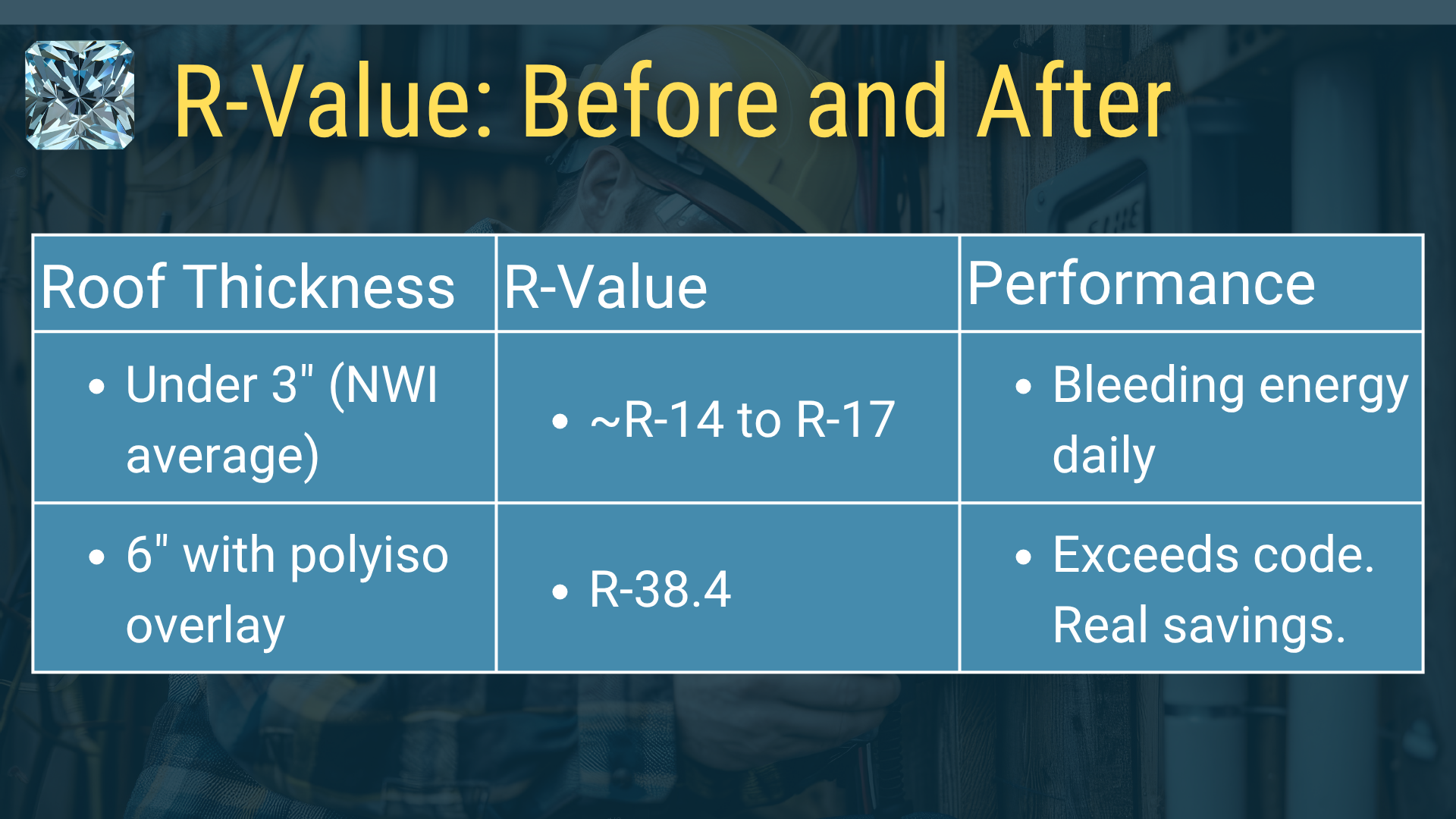
Exceeds code. Real savings.
Reflective Conklin coating alone gets you about 25%. Add the insulation? You're looking at 35 to 40% total reduction in heating and cooling costs. Other factors matter, total building volume, windows, doors, wall insulation. But the roof is the biggest lever you have. And the easiest to change.
✉️ Stop sending NIPSCO a check your roof earned.
If your building is running under 3" of insulation on a dark membrane, you already know what the next bill looks like.
Subject Property Address: ___________________________
Drop the address. We’ll tell you exactly what your roof is costing you every month before you write another check.
FREE evaluation. No sales pitch. No pressure. No obligation.
[ Email address ] → [ Send Me the Real Stuff ]
The Guy With the Buckets (A True Story, More or Less)
A building owner in Porter County called about leaks. He had a 12,000-square-foot metal building with a dark roof. Two inches of insulation underneath. His NIPSCO bill was averaging over $5,200 a month between heating and cooling. He'd been putting out buckets during rainstorms for three years.
We're not making fun of buckets. Buckets are resourceful. But buckets are not a roofing system.
That building went from a dark, leaking, barely-insulated roof to a fully restored system, white reflective Conklin coating, reinforced fabric, additional insulation layers. The first Winter, his gas bill dropped. The first Summer, his AC units weren't running overtime for the first time in a decade. The buckets went back to the garage where they belong.
He didn't do it because someone sold him. He did it because the numbers made sense.
Your AC Units Are Begging You to Read This
Here's something nobody talks about. Your rooftop HVAC units are sized for a certain thermal load. When your roof is absorbing heat all day and bleeding warmth all night, those units are working double overtime. They wear out faster. They cost more to maintain. They're burning through electricity at peak rates, which is when NIPSCO charges the most.
Now picture this: you go from 2 inches of protection to 6 inches. You flip a dark surface to an 86% reflective Conklin-coated surface. And when it's time, you upgrade to a high-efficiency HVAC unit that's now working with the building instead of fighting it.
Lower utility bills. Longer equipment life. And you're being kind to the next several generations who inherit that building. That's a triple win.

What This Looks Like on a Real Building
Before
After (R & T)
Roof Surface
Dark, under 3″ insulation
White reflective, 6″ insulation
Solar Reflectance
~15–25%
86% (CRRC verified)
R-Value
~R-14 to R-17
R-38.4
Monthly NIPSCO (est.)
$4,000–$6,000
$2,400–$3,900
Annual Savings
—
$15,000–$24,000+
Disclaimer: These estimates are based on published research and field data for commercial buildings in temperate climate zones. Actual results vary by building volume, window area, wall insulation, HVAC efficiency, and usage patterns. We measure your specific building before proposing anything.
Energy Efficiency + Commercial Roofing FAQs
How much can a reflective roof coating actually save on my NIPSCO bill? Reflective Conklin coating alone cuts cooling costs roughly 25%. Add polyiso insulation to 6" and total savings reach 35 to 40% on heating and cooling combined.
What is the R-value of a typical commercial roof in Northwest Indiana? Most are running R-14 to R-17, well under the Climate Zone 5 code minimum of R-30. Polyiso overlay to 6" gets you to R-38.4. Above code. Actual savings.
Did Purdue University actually prove reflective roofing works? Yes. Seven years, 100+ materials tested, 98.1% reflectance achieved. Rooftop surface ran 19°F cooler than ambient air at night. Published in ACS Applied Materials & Interfaces. Guinness World Record. Not marketing.
Why did NIPSCO raise rates and will they go up again? Data center growth is pushing grid infrastructure costs onto ratepayers. NIPSCO raised electric rates 17% in 2025. More increases are expected. Your building's energy consumption is the only variable you control.
What is CRRC verification and why does it matter? The Cool Roof Rating Council independently tests solar reflectance and thermal emittance. CRRC-verified means a third party confirmed the number, not the manufacturer. When we say 86%, that's verified.
Can I add insulation to my existing commercial flat roof without a full tear-off? In most cases, yes. Polyiso board installs as an overlay over your existing membrane before a Conklin coating or FLEXION vinyl 300 goes on top. No tear-off. Real R-value added in one project.
How does lake-effect weather in Northwest Indiana affect roof energy performance? 38 inches of annual precipitation, concentrated freeze-thaw window September through March. Thin insulation bleeds warmth in Winter and absorbs heat in Summer. Thickness is the fix.
What is the difference between the Conklin coating system and FLEXION vinyl 300 for energy performance? Both come in white reflective finishes with CRRC-verified ratings. Conklin is liquid-applied, no tear-off, up to 20-year warranty. FLEXION vinyl 300 is a physical membrane, heat-welded seams, 300-month factory warranty. Separate systems. Separate warranties. Never combined.

What's Next: Part 2
In Part 2, we'll break down the specific roofing systems, FLEXION vinyl 300 membrane and Conklin urethane coating, with their actual CRRC-verified reflectance data, warranty structures, and what makes professional-grade roof chemistry different from what you'll find on a hardware store shelf.
Data drives decisions. Part 1 gave you the why. Part 2 gives you the what.
✉️ Let’s Look at That One Property
Subject Property Address: ___________________________
Get your roof evaluated. Find out what your building is losing every month.
FREE evaluation. No sales pitch. No pressure. No obligation.
[ Email address ] → [ Send Me the Real Stuff ]
Pristine Industrial Roofing — Serving commercial and industrial property owners across Lake County and Porter County. Liquid-applied Conklin coating systems. FLEXION vinyl membranes. Proactive maintenance programs.
Read other blog:


We Love Conversations
 SoHelpful@PristineIndustrialRoofing.com