
Your Roof Is Not Nailed Down as Well as You Think It Is.
What 70 MPH Wind Actually Does to a Flat Commercial Roof, and Why Nobody Tells You Until It’s Too Late. The Physics of Wind Uplift, the Zones Where Every Roof Fails First, and What You Can Do About It Before the Next Storm.

🔲 Wind does not blow across your roof. It creates suction underneath it. The physics are identical to the lift force on an airplane wing, operating at building scale.
🔲 Corners fail first. Always. Aerodynamic pressure concentrates at corners and perimeter edges. That’s where the membrane lifts, the seams separate, and the claim begins.
🔲 You cannot see wind damage from the parking lot. Flat roof failure is measured in millimeters at the corners and edges. It requires a trained eye on the membrane surface to document.
🔲 FM 1-60 and FM 1-90 are not random numbers. They mean the roof system can resist 60 or 90 pounds per square foot of upward suction. Your fastener pattern determines which rating your building achieves.
🔲 Glued-down membranes are the first to fail. Adhesive bonds degrade over time. Condensation breaks them from below. Mechanical fastening into the structural deck is the only attachment method that survives.
🔲 The damage window closes fast. Every week without professional documentation makes the claim story harder to tell and easier for a carrier to contest. PristineIndustrialRoofing.com/wind
Kenny heard it before he saw it.
He was locking up the maintenance closet at the back of the warehouse on South Colorado Street when the sky turned that shade of green that makes people in Northwest Indiana stop talking. The wind came in sideways. Not gusty. Sustained. The kind of wind that does not feel like weather. It feels like pressure.
The building shook once. The overhead doors rattled. Something above him made a sound he had never heard before, not a bang, not a crack, more like a deep exhale, as if the entire roof had taken a breath and not let it out.
Forty-five seconds later, it was over. The lights flickered back on. The rain tapered off. Kenny walked outside, looked up at the roof from the parking lot, and saw... nothing. No damage. No debris. No missing pieces. The building looked exactly the same as it did an hour ago.
So he texted Megan, “Looks fine from the outside.”
And that text, sent in good faith by a maintenance professional who knows his building better than anyone, is exactly how wind damage claims die before they ever get filed. Because what Kenny could not see from the parking lot was happening at the corners, at the perimeter, at every seam and fastener location where seventy miles per hour of sustained uplift pressure had been quietly prying his membrane loose from the deck for the last forty-five seconds.
This article is about what actually happens up there when the wind hits. Not the dramatic version. Not the Hollywood version where the roof peels off on camera. The real version. The quiet version. The version that costs building owners hundreds of thousands of dollars in denied claims because nobody got on the roof in time to document what the wind actually did.
Your Roof Is an Upside-Down Airplane Wing
The physics are not complicated. But they are not obvious, and that is the problem.
Most people think wind damages a roof by blowing things off of it. Shingles fly. Debris scatters. The wind pushes down and the roof resists. That is how residential roofs fail, and it is what most people picture when they think about storm damage.
Flat commercial roofs fail differently. The wind does not push down. It pulls up.
When wind accelerates across a flat surface, the air pressure on top of the membrane drops. The air pressure underneath the membrane stays the same or increases slightly as wind forces air into any gap, seam, or edge detail. The result is a pressure differential, higher pressure below, lower pressure above, hat creates suction. Uplift. The exact same physics that make an airplane wing generate lift.
At 70 mph, that uplift force can exceed 30 to 40 pounds per square foot across the field of the roof. At the corners, where aerodynamic turbulence concentrates, the force can double or triple. On a 20,000-square-foot building, the wind is trying to lift the membrane with a combined force measured in hundreds of tons. Not pushing. Pulling.
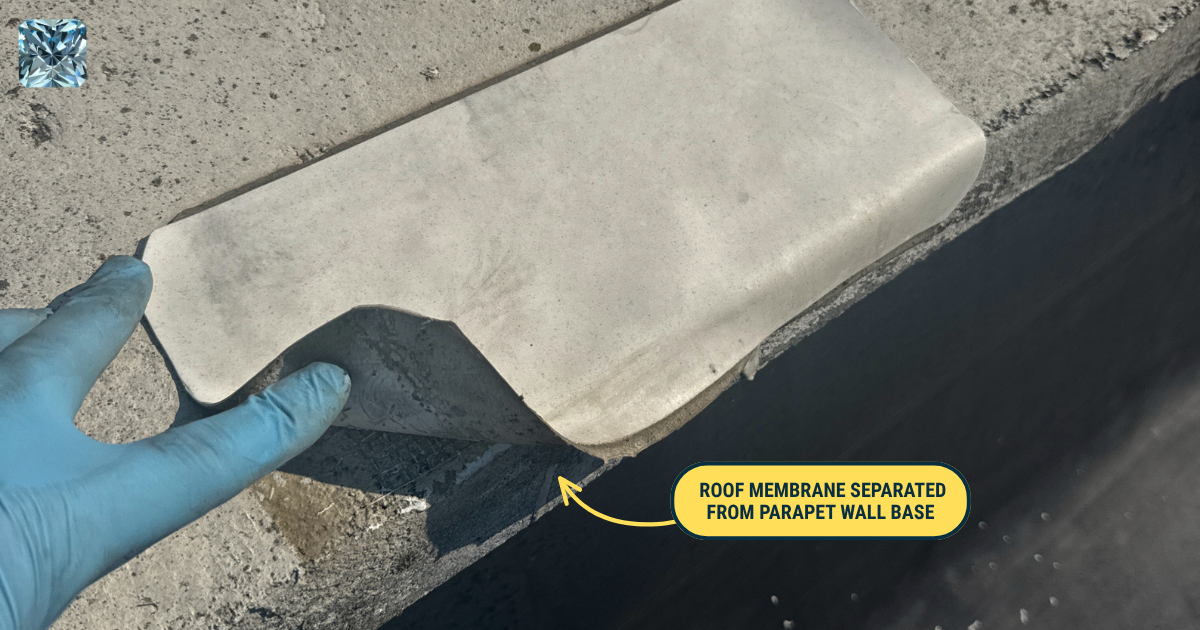
The membrane does not need to blow off for damage to occur. It just needs to lift. A quarter inch. An eighth of an inch. Enough to break an adhesive bond. Enough to flex a fastener plate. Enough to separate a seam that was sealed last October. That is not dramatic. It is not visible from the parking lot. And it is the beginning of a six-figure problem that either gets documented and recovered through insurance, or gets ignored and paid for out of pocket two winters later when the leak finally shows up inside the building.
Three Zones, Three Levels of Punishment
Wind does not hit your roof evenly. It concentrates. And it concentrates in predictable places.
Every flat roof has three wind zones, defined by Factory Mutual (FM Global) Loss Prevention Data Sheets 1-28 and 1-29. These zones determine how many fasteners are required per square foot, and they predict exactly where damage will show up after a storm.
Zone 1 — The Field (center of the roof): This is the open middle area, away from edges and corners. Wind pressure is lowest here. Fasteners are spaced at 12 inches on center in a standard installation. Damage in the field is possible but less common unless the membrane is old, the adhesive has degraded, or the fasteners were over-driven during installation.
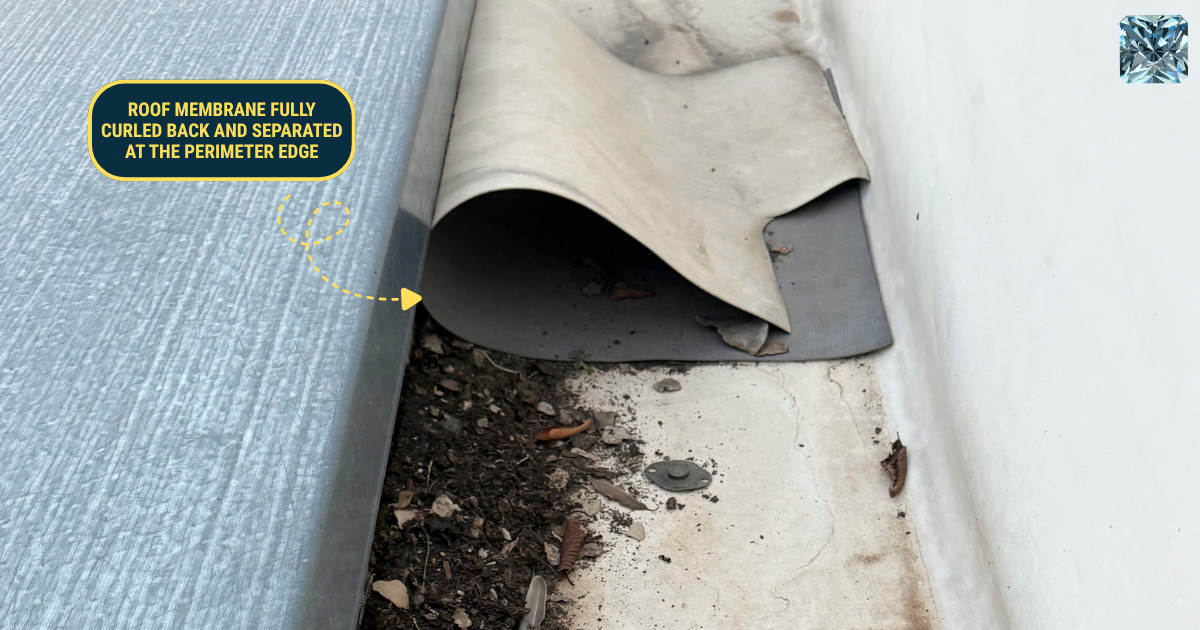
Zone 2 — The Perimeter (edges of the roof): This is the strip along every edge of the building, typically the outer 10–15% of the roof area. Wind pressure increases dramatically at the perimeter because this is where the air makes the transition from horizontal flow along the building wall to horizontal flow across the roof surface. That transition creates turbulence and concentrated uplift. Fasteners are spaced at 6 inches on center here, twice the density of the field. Perimeter seam separation, membrane edge lifting, and parapet flashing failure are the signature damage patterns in Zone 2.
Zone 3 — The Corners: This is where roofs fail first, fail worst, and fail most often. The corner zones are where two perimeter edges converge, creating maximum aerodynamic turbulence and the highest uplift forces on the entire roof. Fastener density in the corners is the highest on the building. Conklin’s Picture Frame perimeter fastening method places two half-strips of membrane around the entire building edge with fasteners spaced a maximum of 12 inches apart, and corners receive additional reinforcement beyond that.
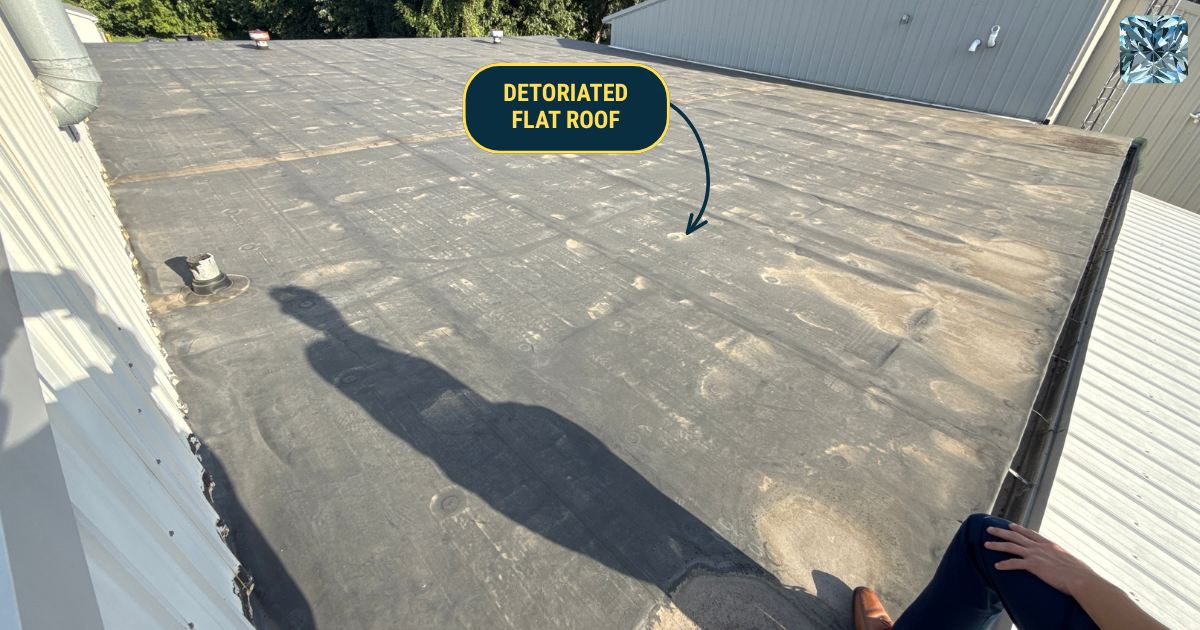
After a 70 mph wind event, a trained inspector goes to the corners first. Every time. If the corners are intact, the perimeter edges are checked next. If the perimeter is intact, the field is scanned for isolated failures. This is not guesswork. This is a predictable failure sequence based on physics that has been documented across millions of square feet of commercial roofing.
What Actually Fails and Why
Three attachment methods. Three very different failure modes. One of them survives.
Glued-down (fully adhered) membranes: The adhesive bond is the weak link. Adhesive degrades over time from temperature cycling, UV exposure, and moisture. If condensation has formed between the membrane and the insulation board, which is common on buildings with poor deck ventilation, the adhesive bond is already compromised before the storm arrives. Uplift pressure completes the failure. The membrane lifts. The insulation delaminates. The entire system separates from the deck. This is the catastrophic blow-off scenario, and it is not rare. Conklin’s training materials document it explicitly: fully adhered membranes exposed to condensation are prone to wind blow-off, and the results are catastrophic not only to the roof but to the entire building.
Ballasted (rock-weighted) rubber: This system uses loose-laid legacy rubber EPDM held in place by 10–15 pounds per square foot of river rock ballast. When wind exceeds the holding capacity of the rock weight, the membrane lifts, the rocks shift, and the system fails progressively from the corners inward. The rocks themselves become projectiles in extreme events. And under normal wind loading, the rocks simply hide whatever is happening to the membrane underneath. You cannot inspect a ballasted roof without moving the rocks. You cannot document damage without moving the rocks. The rocks are not a fastening system. They are a concealment system.
Mechanically fastened membranes: Heavy-duty screws driven through the membrane and insulation directly into the structural deck, held by barbed stress plates. The fasteners are not affected by adhesive degradation, condensation, or moisture. They bypass the insulation entirely and grip the steel, wood, or concrete deck below. At 70 mph, a properly fastened membrane with correct zone-density patterns stays in place. The screws hold. The plates hold. The membrane flexes slightly under uplift pressure and returns to position when the gust passes. This is not theory. This is the FM 1-60 and 1-90 wind uplift testing standard, verified in laboratory conditions and confirmed across thousands of post-storm inspections.
FM 1-60 and FM 1-90: What Those Numbers Actually Mean
Every building owner has seen these numbers on a spec sheet. Almost nobody knows what they mean.
FM stands for Factory Mutual, now known as FM Global. They are the largest commercial and industrial property insurance organization in the world. Their testing laboratories subject roof systems to controlled uplift pressure until failure, and the results produce a classification number.
FM 1-60: The roof system can resist 60 pounds per square foot of sustained upward pressure without failure. This is the standard classification for most commercial buildings in moderate wind zones.
FM 1-90: The roof system can resist 90 pounds per square foot. This is specified for high-wind areas, coastal locations, elevated buildings, and any structure where the local building code or insurance carrier requires enhanced wind resistance.
The three material properties that determine the rating are breaking strength (how much force the membrane can absorb before tearing), elongation (how far it can stretch without breaking), and tear resistance (how well it resists propagation once a tear begins). Conklin’s Outpost TPO 60 mil, for reference, tests at 403 lbf breaking strength in the machine direction, 373 lbf cross-machine, with tearing strength of 84 lbf (MD) and 126 lbf (CMD) — all well above the ASTM D 6878 minimums.
But material strength only matters if the membrane stays attached to the building. A membrane with perfect lab numbers will still fail catastrophically if the attachment method cannot hold it to the deck under real-world wind loading. That is why mechanical fastening with correct zone-density patterns is the standard, and that is why Pristine mechanically fastens every roof we install.
✉️ Did your building feel the last storm? One address. One answer.
We’ll get on the roof, check the corners, document what we find, and give you a straight answer.
PristineIndustrialRoofing.com/wind
Who Needs to Read This Right Now
The same people we always talk to. Different angle. Same urgency.
Kenny — Maintenance: You heard the building breathe during the last storm. You know something shifted. You sent the “looks fine” text because what else were you going to say from the parking lot? Now you need someone to get on the roof, confirm what you already suspect, and put it in writing so the conversation goes upstairs with documentation, not just a hunch. Send this article to Frank. Let the physics do the talking.
Frank — Building Owner: You got the “looks fine” text and moved on. That is a completely normal response. But here is what you are risking: if there is corner separation or perimeter seam failure up there right now, and you do not document it within the claim window, you are converting an insured event into an out-of-pocket expense. A $150,000 problem that your premiums already paid for becomes a check you write personally. One inspection. One hour. Zero cost. That is the math. PristineIndustrialRoofing.com/wind
Megan — Property Manager: You are the one who will get the phone call when water starts dripping on a tenant’s merchandise eight months from now. And the first question from Frank will be “why didn’t anyone check the roof after the storm?” We take that question off your plate. We come out, we document, we give you a clean written report. You forward it to Frank and file it away. Liability removed. PristineIndustrialRoofing.com/wind
Daniel — Facilities Director: You manage multiple properties. You have a capital budget and a deferred maintenance list longer than you’d like. Storm documentation across your portfolio is not a nice-to-have. It is a fiduciary obligation. We can assess multiple buildings in a single visit and deliver a consolidated report you can present to your board. PristineIndustrialRoofing.com/wind

After the Inspection: Liquid Wins Again
If the storm damaged your membrane, the question is what comes next. And the answer is probably not what your last contractor told you.
Most contractors will tell you that wind-damaged membranes need to be torn off and replaced with new solid sheets. That is one option. It is also the most expensive option, the most disruptive option, and the option that sends the most material to the landfill.
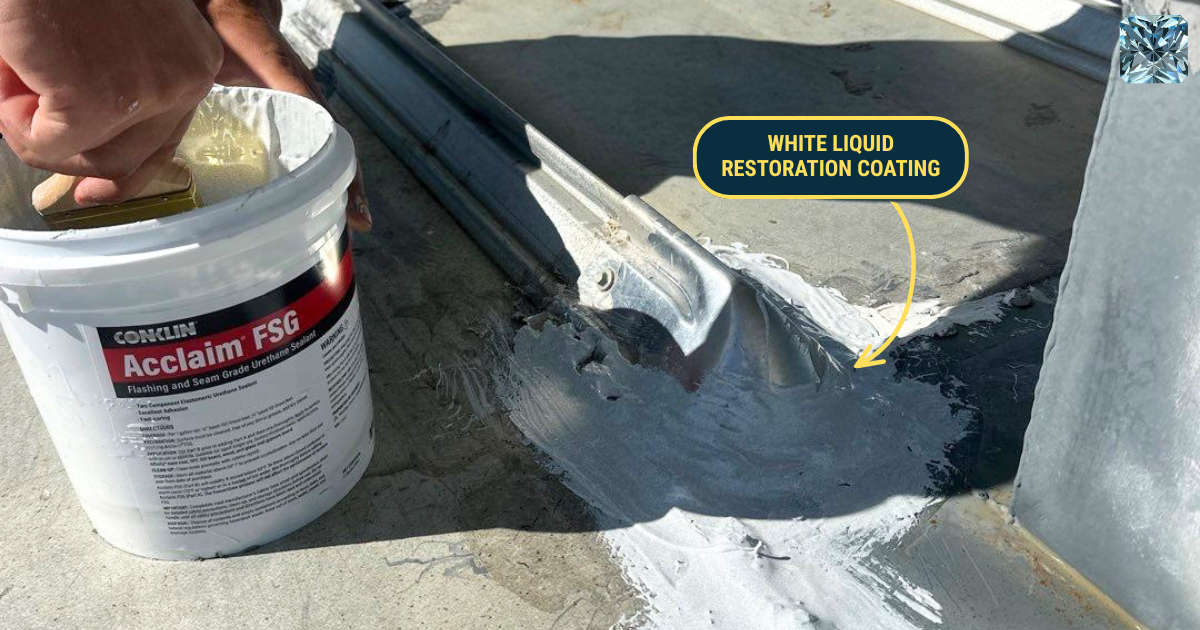
Conklin liquid-applied restoration systems can recover a wind-damaged membrane in many cases without full tear-off. Damaged areas are repaired, seams are re-sealed, and the entire surface receives a seamless, fabric-reinforced liquid coating that becomes the new weatherproofing layer. No joints. No seams. No weak points. Fire rated. Recoatable. And it costs 30–50% less than a full replacement with any solid membrane.
If your building sustained wind damage and the claim comes through, the question is not “do I replace it with rubber or plastic or vinyl?” The question is “can I restore it with liquid and keep the difference?” In many cases, the answer is yes. And the building ends up with a better roof than it had before the storm.
What Building Owners Are Asking Right Now
Every question answered plainly. Structured for speed.
Can I see wind damage from the ground on a flat roof?
Almost never. Flat roof wind damage shows up at corners, perimeter edges, and seam locations that are only visible from the membrane surface. A parking lot observation is not a roof inspection.
What does wind uplift actually look like on a flat roof?
Subtle. A seam separated an eighth of an inch. A membrane edge lifted at the parapet. A fastener plate pulled slightly through the membrane face. An air pocket under the field sheet that was not there before the storm. None of these are visible from the ground.
How quickly do I need to get an inspection after a storm?
As soon as possible. The damage documentation window closes week by week as moisture works into lifted edges and natural deterioration obscures wind-specific failure patterns. Carriers contest claims more aggressively as time passes.
What is the difference between FM 1-60 and FM 1-90?
FM 1-60 means the roof system resists 60 pounds per square foot of uplift. FM 1-90 means 90 PSF. The rating is determined by fastener density and pattern, not by the membrane alone. Higher wind zones require tighter fastener spacing.
Does a glued-down roof survive wind as well as a mechanically fastened roof?
No. Fully adhered (glued) membranes rely on adhesive bonds that degrade over time and fail under condensation. Mechanically fastened membranes are bolted to the structural deck and are not affected by adhesive degradation or moisture.
My building is in Lake County or Porter County. Was it in a wind event zone?
If your building was in the region during a confirmed severe weather event with documented wind speeds exceeding 60 mph, it qualifies for a professional storm assessment. Visit PristineIndustrialRoofing.com/wind to schedule.
What does a professional storm assessment cost?
Nothing. Pristine provides free post-storm assessments for commercial flat roofs in Lake and Porter County. If there is a viable claim, we connect you with Max4Claims for professional claims advocacy. If there is not, we tell you honestly and you have lost nothing but an hour.
Can a wind-damaged roof be restored without full tear-off?
In many cases, yes. Conklin liquid-applied restoration systems can recover wind-damaged membranes without removing the existing roof. This costs 30–50% less than full replacement and produces a seamless, fire-rated, warranted roof system.
The storm data is permanent. The damage documentation window is not.
One address. One inspection. One straight answer.
PristineIndustrialRoofing.com/wind
Text: (219) 529-1995
Continue Your Journey
- 70 MPH Winds. Tornado Warnings. Did Your Roof Feel It? — YourWarrantySaysWhat.com — The storm article that started this series
- Rubber vs. Plastic vs. Vinyl vs. Liquid — PristineIndustrialRoofing.com — The full comparison nobody else gives you
- TPO Will Burn: Fire Ratings Matter — PristineIndustrialRoofing.com — The fire rating gap explained
- How Can I Actually Afford a Commercial Roof Upgrade? — RoofServiceMenu.com — Creative financing for building owners
- The Truth About Commercial Roofing Warranties — YourWarrantySaysWhat.com — Warranty loopholes exposed
- You Reap What You Cheap — YouReapWhatYouCheap.com — The true cost of the low bid
Deep Dive Into Specific Topics
YourWarrantySaysWhat.com — Loophole analysis
SiliconeIsSilly.com — Why we don’t do silicone
WeWashFlatRoofs.com — Maintenance matters
BigBeautifulRoofBill.com — Transparent pricing guide
ModernRoofChemistry.com — What’s going on up there?
YouReapWhatYouCheap.com — The true cost of the low bid
RelationshipRoofing.com — What matters more?
MeetYourInstallers.com — Fabulous families
RoofServiceMenu.com — What are my options?
TenantRoofRights.com — Tenant questions
Pristine Industrial Roofing
Conklin-Certified • Lake County & Porter County, Indiana
(219) 529-1995 • PristineIndustrialRoofing.com
We’re a relationship company that happens to do roofs. Test us. Challenge us. Have breakfast with us.
A Gospel Business funding community outreach and worldwide missions with every roof we install.
Read other blog:

We Love Conversations
 SoHelpful@PristineIndustrialRoofing.com