
You Paid For This. Here's How to Collect, And How to Know If You Actually Can.
Your Premiums Paid For Protection, Here’s How to Know If Your Roof Qualifies After the Storm. Congrats! Your roof just fought a 70 mph monster. Where’s your check?

- Storm Verified, Wallet Activated. March 10’s 70+ mph winds weren’t just scary, they might finally pay off all those years of premiums.
- Corners Spill the Beans. If your roof’s edges are lifting, seams separating, or flashing flapping, that’s not a bad hair day, it’s cash in your claim.
- Documentation Isn’t Optional. Photos, measurements, and a savvy claims team turn “wind chaos” into a five- to six-figure reality.
- Free Roof Reality Check: One hour on your roof = yes or no. Either way, your premiums stop being a donation.
Let's be honest with each other for a minute.
You've been writing that premium check for years. Maybe a decade. Every renewal, the number goes up a little. Every year, nothing happens. You file it away, move on, and somewhere in the back of your mind there has always been this quiet, reasonable thought: at some point, something has to happen that makes all of this worth it.
A qualifying storm just came through Lake and Porter County. And now the thought isn't quiet anymore.
But you're also not naive. You've heard the stories, from other building owners at the chamber breakfast, from contractors who showed up promising the moon, from people who spent eighteen months chasing a claim and came away with legal fees and a letter of denial they still don't fully understand. You've watched someone else go through it badly. So before you let yourself get too hopeful, before you make a call or sign anything, you want someone to look you in the eye and tell you the truth.
Here it is. All of it.
The Honest Assessment, What Makes a Claim Legitimate

A legitimate commercial wind damage claim requires four things to be true at the same time. Not three of the four. Not three and a half. All four, simultaneously, documentably, professionally presented.
If even one of them is missing, the carrier has room to move. And they will use every inch of that room.
First: a qualifying weather event.
On March 10, 2026, Lake County and Porter County experienced confirmed damaging winds exceeding 70 mph, an active Tornado Warning issued by the National Weather Service, and a Level 4 Moderate Risk rating from the Storm Prediction Center, the second-highest classification on the scale. Tornadoes touched down in Newton County. Over 16,000 customers lost power across northern Indiana and Illinois. That box is checked. The data is permanent, publicly documented, and does not require your agent's confirmation or anyone's interpretation. The storm qualified.
Second: a roof that was in serviceable condition before the event.
Not perfect. Serviceable. There is an important difference. Carriers do not expect commercial flat roofs to be flawless. They expect them to be functional, performing their job, even if imperfectly, without pre-existing failures that were already underway before the storm arrived. If your roof was actively leaking before March 10, if it had been the subject of a prior denied claim, if it had documented pre-existing failures on record, those create complications. But if it was a functioning membrane doing its job, aging normally, without a failure history, you have a defensible starting point. Most buildings in Lake and Porter County with flat roofs under 20 years old meet this standard.
Third: visible, documentable evidence that the qualifying storm contributed to the current condition of the membrane.
This is the one that decides everything. It is also the one most building owners do not have, because getting it requires someone on the roof with the right eye, the right documentation process, and the right professional language before the carrier's adjuster gets there first.
Aging rubber peels on its own schedule. Old adhesive gives out. tPo, the flimsy plastic wrap that dominated a previous era of commercial flat roofing, separates at seams over time without any help from a storm. None of that, standing alone, is a claim. But wind uplift at the corners, membrane separation along the perimeter, fastener back-out, or displaced edge metal, documented with photographs, measurements, and a professional assessment connected to a qualifying wind event, that is a different story entirely. That is the story that closes at the right number.
Fourth: a professional team that can build that story correctly.
Documentation, Xactimate estimates, supplement management, and a claims advocate who knows how carrier review desks think. Without this fourth element, the first three do not matter. A real claim with incomplete documentation loses. A real claim with the right team behind it wins. This is not an opinion. It is the pattern we have watched play out across dozens of commercial properties.
All four present? You have a claim worth pursuing. One missing? You have work to do before anything gets filed.
What We've Actually Seen on Roofs Like Yours
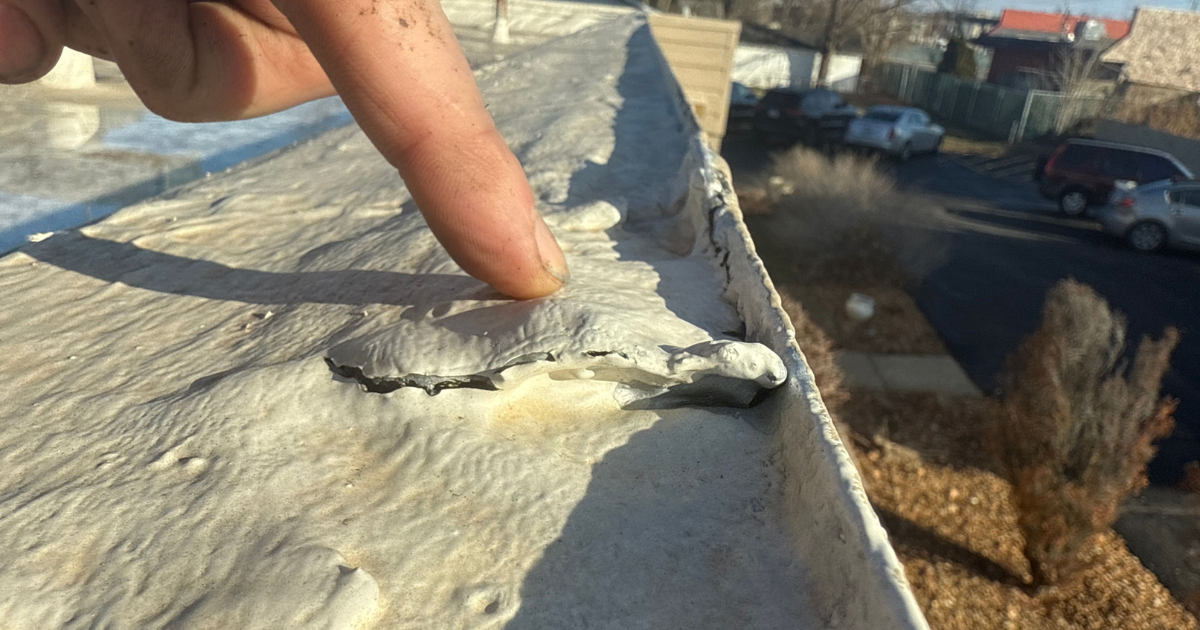
This is not hypothetical. This is what we find when we get on commercial flat roofs across Lake and Porter County in the weeks after a qualifying wind event.
EPDM rubber. The black membrane on a lot of older commercial buildings, gets brittle over time. The seams are bonded with adhesive that has a lifespan, and that lifespan is not infinite. Here is the thing about wind damage on an aging EPDM roof: the storm does not have to tear it off completely to create a viable claim. It has to accelerate a separation that would not have occurred without the wind event. Uplift force at 70 mph works into compromised adhesive bond at the perimeter and corners, opening seams that were holding last September and are no longer holding now. That acceleration is documentable. That is a claim.
tPo membranes. The white or gray plastic sheeting that was installed on a very large number of commercial flat roofs in a previous era, have their own storm vulnerability profile. tPo is more hail-resistant than rubber, which is why hail claims on flat roofs are less common than building owners sometimes expect. But tPo has real exposure at the perimeter flashings, the edge metal, and every penetration seal around HVAC curbs and pipe boots. A 70 mph wind event puts real mechanical force on each of those transition points. If any of them moved, if the edge metal lifted, if a flashing pulled away from the coping, if a penetration seal opened, that is evidence. Photograph it, measure it, connect it to the qualifying event, and you have the beginning of a viable claim document.
Conklin-coated roofs. Buildings where a liquid-applied restoration was done in recent years, are generally the most wind-resilient systems we see. A properly applied Conklin coating bonds fully to the substrate and eliminates the seam vulnerabilities that make membrane uplift so common on tPo and older EPDM. If your building is already running a Conklin system in good condition, the storm damage profile is different, and worth discussing specifically. Not every coating application holds equally, and age matters. We will tell you exactly what we find.
The corners are always where the story starts. On every flat roof, regardless of membrane type, aerodynamic uplift concentrates at the corners and the perimeter first. These are the highest-stress zones under wind load. If something moved on your roof on March 10, the corners will show it first. Loose corners. Lifting edges. Seams that are no longer bonded along the parapet line. These are not ambiguous findings when a trained contractor documents them in the immediate aftermath of a Level 4 wind event. They are evidence. They belong in your claim file.
The Number That Actually Matters

We are talking about five to six figures. That is not rumor, inflation, or contractor optimism. That is the realistic range for a commercial flat roof replacement or major Conklin restoration on a mid-size commercial building in Lake or Porter County, properly documented, professionally scoped, and advocated through the claims process by a firm like Max4Claims with the Xactimate submission to support it.
Max4Claims clients have recovered over $1.1 million in commercial supplement approvals in a single year. Those are not approvals from scratch, those are recoveries on claims that had already been reviewed and underpaid by the carrier the first time. The gap between what the carrier initially offered and what a professional supplement recovered is the number that changes a partial patch job into a complete restoration. That gap is real. It is consistent. And it exists because the original submission was made without the documentation and advocacy infrastructure to support the full scope.
We are not going to tell you every building qualifies. Not every building does.
Some roofs are too old. Some have pre-existing damage that a carrier will successfully argue was already underway. Some buildings were simply far enough from the worst of the wind track that the membrane did not experience meaningful uplift load. We will tell you honestly what we find when we get on your roof, because our reputation in Lake and Porter County has been built one honest assessment at a time, and that reputation is worth more to us than a single claim commission.
But if your building qualifies, membrane in serviceable condition, under 20 years old, no prior denial on record, corners and perimeter showing wind uplift signature, that five to six figure range is real. And the process, handled correctly, is designed to make you whole after a qualifying loss. That is the system working the way it was built to work. That is what the premiums were for.
You've been paying into this system for years. A Level 4 storm event just crossed your county. The only question left is whether your roof is in the conversation, and the only way to answer that question is to get on it.
✉️ You know the storm was real. You know your building has a flat roof. What you don’t know yet is what the corners look like.
Subject Property Address: ___________________________
We will schedule the assessment, document what we find and give you a straight answer.
[ Email address ] → [ Send Me the Real Stuff ]
What Happens After the Assessment

This is the part most contractors skip. They come out, they hand you a bid, and the next call you get is from a salesperson asking if you've made a decision. That is not how this works.
Here is the actual sequence when Pristine and Max4Claims work a storm claim together.
Assessment and documentation. We come out to your subject property. We conduct a forensic membrane inspection, corners first, then perimeter, then field seams, penetrations, flashings, and edge metal. We produce a written assessment with timestamped, GPS-tagged photography and professional notation that distinguishes wind-induced damage from normal aging deterioration.
This document is the foundation of everything that follows. It is also your protection if the carrier attempts to argue pre-existing condition, because it puts a Conklin-certified contractor on record describing your membrane condition in the days immediately following the qualifying event.
Claims intake with Max4Claims. If the assessment supports a viable claim, we connect you directly with Ray's team. Max4Claims reviews our documentation, conducts their own evaluation, and determines the full scope of what the Xactimate submission should capture. Every line item. Every legitimate material and labor component. Nothing left on the table because it was described vaguely or priced incorrectly.
Filing and adjuster management. Max4Claims manages the carrier interface from the moment the claim goes in. When the carrier's adjuster comes out, and they will come out, Max4Claims has already established the documentation record that gives the adjuster the full picture of what the storm did to your specific membrane. Your roofing contractor is not standing in the parking lot hoping for the best. The professional submission is already in the file.
Supplement management if needed. Initial carrier approvals are frequently below the full scope of what the evidence supports. Max4Claims handles supplement submissions, additional scope items captured after the initial review, with the same Xactimate precision as the original filing. Their clients' supplement recovery record is the reason we partner with them. They do not leave lines on the table.
Restoration or replacement. When the claim closes at the right number, Pristine executes the scope. For most commercial flat roofs in the eligible age window, that means a Conklin liquid-applied restoration system, seamless, fully bonded, carrying up to a 20-year warranty and eligible for renewable coverage going forward. For roofs where the membrane damage is too extensive for restoration, FLEXION vinyl 300 is the full replacement option, a 300-month, 25-year warranty membrane installed in rolls and mechanically fastened. Two separate systems. Two completely separate warranties. The right one for your roof depends on what we find on the assessment.
Neither system is a patch. Both are legitimate commercial flat roofing solutions that leave your building better protected than it was before March 10.
Why This Is the Moment, Not Next Quarter

Post-storm claim windows in commercial property insurance are not infinite. Most standard policies allow 12 months from the date of the qualifying event, but supplemental damage discovered after the initial filing carries its own shorter documentation window. More practically: every week that passes between the storm and the professional inspection is a week during which the evidence story becomes harder to defend.
Lifted membrane corners begin to show secondary moisture infiltration that an adjuster can argue was pre-existing. Wind-separated seams that were clean failures on March 11 look like years of progressive deterioration by May. The weather record is locked, the storm data does not change. What changes is how clearly and compellingly your roof connects to that storm data, and that connection weakens with time.
The building owners who file correctly and collect correctly are the ones who moved in the weeks after the storm, not the ones who waited until the next renewal and wondered if it was too late.
It is not too late right now. It will be, eventually. The difference between those two sentences is the action you take this week.
The Questions That Come Up Before Anyone Files
What if I had a repair done on my roof in the last two years? Does that disqualify me? Not automatically. It depends on what the repair covered, how it was documented, and whether the current damage is in the same location as the prior repair. A repair that was completed and documented correctly actually helps your pre-storm condition argument, it shows the roof was actively maintained. A repair that was done and never documented is a different conversation. Tell us what happened and we'll tell you how it affects the picture.
What happens if the carrier denies the claim after I file? A denial is not necessarily the end. Max4Claims reviews denials and determines whether the basis for denial is contestable, and in many cases, it is. A denial issued on the grounds of deferred maintenance when professional documentation exists to counter that argument can be supplemented and re-submitted. A denial on a policy exclusion is a different matter. Know the difference before you give up. Max4Claims knows the difference.
Is there a cost to the initial roof investigation? No. Pristine's post-storm assessment for commercial flat roofs in Lake and Porter County is no-cost. If the assessment supports a viable claim and you engage Max4Claims for claims management, their fee structure is separate and discussed directly with their team. The investigation itself costs you nothing.
What is the difference between a Conklin restoration and a FLEXION vinyl replacement? Conklin liquid-applied systems are coatings, applied wet, spray or roller, fully bonded to the existing substrate. They are seamless and carry up to a 20-year warranty. No tear-off required in most cases. FLEXION vinyl 300 is a membrane, installed in rolls, 100 feet by 6 feet, mechanically fastened. It carries a 300-month, 25-year warranty. These are completely separate systems with completely separate warranty structures. The right choice depends on the condition of your existing substrate and what the assessment finds. We will not recommend one over the other before we know what we are working with.
What does 'supplement' mean in a commercial insurance claim? A supplement is an additional scope submission made after the initial claim approval when items were missed, under-priced, or not captured in the first Xactimate estimate. Carrier initial approvals frequently do not capture the full legitimate scope of a commercial roof claim. Max4Claims specializes in identifying those gaps and submitting professional supplements that recover the difference. Their $1.1 million in single-year supplement recovery represents what was left on the table by carrier initial offers, and collected by professional advocacy.
My building is older than 20 years. Should I even bother calling? Call us. We will give you an honest answer. Older roofs face more aggressive depreciation arguments from carriers, but viable claims exist outside the 20-year window when documentation is strong, the membrane was functional before the storm, and a professional advocate is managing the submission. Do not disqualify yourself before someone who knows the system has looked at your specific situation.
The Straightest Thing We Can Say
You have paid premiums for years on a building that sits in a county that just experienced a Level 4 wind event with confirmed 70 mph gusts and an active tornado warning.
Either something happened to your roof on March 10, and you have a claim worth pursuing with the right team, or nothing happened, and you know that for free after a one-hour assessment.
Both of those outcomes are better than the alternative: doing nothing, letting the documentation window close, and finding out in February that a roof failure you could have addressed at carrier expense is now entirely yours to fund.
The investigation is free. The answer, yes or no, costs you nothing. A yes, with Pristine on the roof and Max4Claims on the claim, means a Conklin-restored or FLEXION vinyl 300 roof at a fraction of what you would spend writing a replacement check out of your capital budget.
That is what the premiums were for. That is the system working correctly. The only variable is whether the right team is in place to run it.
✉️ Four articles. One question left. Does your roof qualify?
Subject Property Address: ___________________________
One address. One assessment. A straight answer in either direction.
[ Email address ] → [ Send Me the Real Stuff ]
Pristine Industrial Roofing specializes in commercial flat roof systems across Lake and Porter County. Conklin certified. Max4Claims partnered. We don't do residential. We don't do shingles. We do flat roofs, and we do them right.
Ready to find out if your roof qualifies? Text us first.
Text: (219) 529-1995 | go.PristineIndustrialRoofing.com/wind
Serving Lake & Porter County commercial properties.
You've read the full Storm Claim Series. Part 1 — Should I Even Bother Filing a Wind Damage Claim on My Commercial Roof
Part 2 — The Worst Thing You Can Do After a Storm Is Call Your Insurance Agent
Part 3 — 70 MPH Winds. Tornado Warnings. Your County. Did Your Roof Feel It?
Part 4 — You Paid For This. Here's How to Collect, And How to Know If You Actually Can.
Storm damage isn’t always obvious. But knowing how the claim process actually works puts you ahead of most building owners. That knowledge can make all the difference.
Read other blog:


We Love Conversations
 SoHelpful@PristineIndustrialRoofing.com