
Why Urethane Roofing Is Ideal for High-Traffic Roofs
The Complete Decision-Making Guide for Facility Managers Who Are Tired of Replacing the Same Roof Twice

🔲 Seamless by design. Urethane cures into a continuous, seam-free membrane, eliminating the laps, edges, and seams where every other system eventually fails.
🔲 Built for punishment. With 200 to 400% elongation capacity and chemical bond integrity, urethane flexes and holds where sheet membranes crack, lift, and delaminate under repeated foot traffic.
🔲 Restore, don't replace. At end-of-cycle, a urethane roof can be recoated for another 10 to 15 years, turning a capital expenditure into a manageable maintenance cost.
🔲 The lifecycle math wins. On a 50,000 sq. ft. high-traffic roof, the 20-year total cost difference between urethane and TPO can exceed six figures, making it the stronger financial case, not just the better technical one.
Let's be real for a second. If you manage a commercial building, the roof is probably the last thing you want to be thinking about, until it becomes the only thing you're thinking about.
Maybe you've got HVAC units up there that need regular servicing. Maybe there's a rooftop deck, a mechanical room access point, or just a steady parade of maintenance contractors who treat your membrane like a parking lot. Whatever the case, a high-traffic roof is a different animal from the "set it and forget it" flat roof on a warehouse nobody ever visits.
So when it comes time to choose or replace a roofing system for a high-traffic commercial application, you need to make the right call, not the cheapest one, and definitely not the one recommended by someone who just got their contractor's license last spring.
Urethane roofing has become one of the most reliable solutions for exactly this scenario. Here's what you actually need to know, without the sales pitch.
What Makes a Roof 'High-Traffic' in the First Place?
Before getting into urethane specifically, it's worth defining the term. High-traffic in commercial roofing doesn't just mean "people occasionally walk on it", it means repeated, concentrated load stress on a regular, ongoing basis.
This includes rooftops with HVAC units requiring quarterly or monthly service visits, buildings with solar installations needing periodic cleaning and inspection, restaurants or hotels with rooftop terraces, industrial facilities where maintenance crews access equipment weekly, and multi-tenant commercial buildings where multiple contractors from different trades share the same roof surface year-round.
What happens when a standard roofing system faces this kind of punishment over time? The seams start to lift. The membrane punctures. Water finds its way into laps and flashings. And then you're not talking about routine maintenance, you're talking about a full system replacement years ahead of the projection you used to justify the original budget.
The Structural Logic of Urethane, Why It Handles Stress Differently
Most commercial roofing systems, TPO, EPDM, modified bitumen, rely on sheets or membranes that are mechanically fastened or adhered to a substrate. That means seams exist. And seams are, by definition, the weakest point in any waterproofing assembly.
Urethane coatings work differently. Applied as a liquid, they cure into a continuous, seamless, elastomeric membrane that bonds directly to the substrate below. There's no lap to peel. No edge to lift. No seam for water to probe at 2 a.m. during a storm.
From a structural standpoint, this matters for high-traffic applications for several reasons:
Load distribution: A seamless membrane spreads point loads, like the heel of a technician's boot, more evenly across the surface, reducing puncture risk at any single location.
Elongation capacity: Quality urethane systems can elongate 200 to 400% before failure, meaning they flex rather than crack under thermal cycling and substrate movement.
Chemical bond integrity: Urethane bonds to the substrate chemically, not just mechanically, which means it resists delamination under repeated compression cycles in ways that adhered membranes simply cannot.
For high-traffic roofs, these aren't minor technical footnotes. They are the difference between a system that delivers its full 20-year service life and one that generates emergency repair calls every two to three years.
Urethane vs. The Competition: A Side-by-Side Breakdown
Below is a direct comparison of the major commercial flat roofing systems, evaluated specifically for high-traffic performance. This isn't a claim that urethane is universally superior for every application, it's a clear-eyed look at how each system performs when regular foot traffic is a design condition.
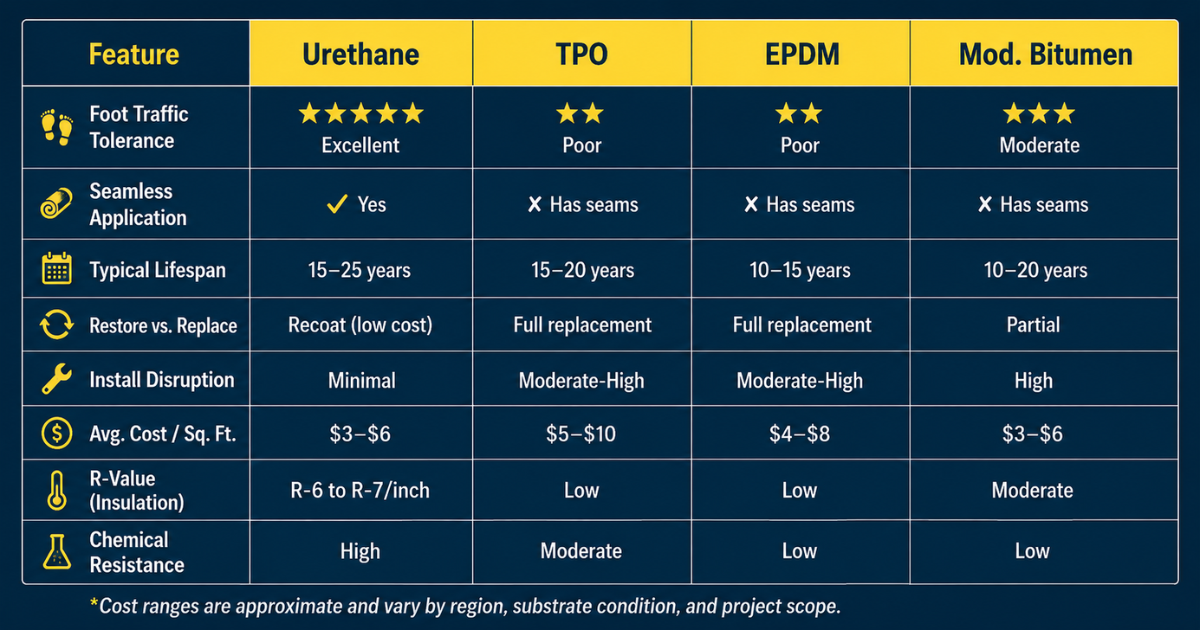
The restorability factor deserves particular attention. Rather than tearing off and replacing an entire system at end-of-life, a urethane roof in good structural condition can often be recoated, extending service life by another 10 to 15 years and deferring a major capital expenditure. That's not a small number for a 30,000 to 80,000 square foot commercial roof.
🏢 REAL-WORLD EXAMPLE: One facility manager in the food service sector had a TPO roof fail after just 7 years due to constant HVAC maintenance traffic. After switching to urethane, the property went 11+ years without a single warranty claim or emergency repair event.
🏗️ Is Your High-Traffic Roof Costing You More Than It Should?
Get our free Urethane Roofing Assessment Checklist, used by facility managers across the country to diagnose roof wear before it becomes a major repair bill. Drop your email and we'll send it straight to your inbox.
[ DROP YOUR EMAIL → GET YOUR FREE ROOF CORE ANALYSIS ]
The Thermal Performance Advantage Nobody Talks About
Here's something frequently overlooked in the urethane conversation: these coatings are exceptional insulators. Spray polyurethane foam (SPF), the substrate layer in many urethane roofing systems, delivers one of the highest R-values per inch of any commercial roofing material, typically R-6 to R-7 per inch.
A standard 3-inch SPF application provides roughly the equivalent insulation of 6 inches of fiberglass batt. For any commercial building that's meaningful, but it's especially relevant for facilities with heavy rooftop mechanical equipment that cycles on and off repeatedly, because temperature stability reduces the thermal shock the roof assembly experiences with each HVAC cycle.
More thermal stability means less expansion and contraction. Less expansion and contraction means less fatigue stress on the membrane. Less fatigue stress means longer service life, even under demanding foot traffic conditions. It's a compounding benefit that plays out over decades, not quarters.
High-reflectivity urethane topcoats (typically white or light gray) also reduce urban heat island contribution and can qualify for LEED credits, which matters increasingly for institutional and Class A commercial properties with sustainability reporting requirements.
Installation Realities, What Facility Managers Actually Experience
Urethane roofing installation isn't as straightforward as rolling out a membrane. It requires thorough surface preparation, moisture content testing of the existing substrate, proper ambient temperature and humidity conditions during application, and skilled applicators with system-specific training. This is not a job for the lowest bidder you found at the bottom of a search results page.
That said, for occupied commercial buildings, urethane has a meaningful installation advantage over membrane systems: there is no open-flame torching, no loud mechanical fastening, and work can typically proceed without requiring building occupants to vacate. The main disruption is odor during application, which dissipates within 24 to 48 hours in most conditions.
For buildings where operational continuity is non-negotiable, hospitals, hotels, schools, data centers, this matters enormously. A full TPO or EPDM replacement on a large commercial roof can require days of disruption, coordination with building operations, and protective measures inside the building. Urethane application typically doesn't create those conditions.
⚠️ CRITICAL WATCH-OUT: Always require a moisture scan of the existing substrate before any urethane application. Applying urethane over wet insulation will cause premature failure, and that failure won't be covered under the contractor's warranty. It'll come out of your budget.
When Urethane Roofing Is NOT Your Best Option
(Yes, we're going to tell you when to look elsewhere, because that's how you know you can trust us)
Urethane is an excellent solution for high-traffic commercial applications, but it's not a universal answer. Here are the scenarios where you should get a more detailed professional assessment before committing:
Severely compromised substrate: If the existing insulation shows widespread moisture damage, urethane is not a solution, it requires a tearoff first. Applying a coating system over structurally compromised insulation doesn't fix the problem; it just buries it.
Chronic ponding water: Urethane provides excellent waterproofing, but it cannot compensate for a roof with significant drainage deficiencies. Persistent ponding is a slope and drainage problem that must be corrected structurally before any coating is applied.
Heavy solvent exposure: For roofs adjacent to facilities with concentrated chemical exhaust or specific industrial solvents, formulation selection becomes highly technical. A specialist assessment is warranted before any specification is made.
Short ownership horizon: Urethane's value proposition is in long-term performance and lifecycle economics. If you're selling the property in 18 months and need the least expensive code-compliant repair, a full urethane system may not be the right financial decision in that specific context.
A contractor worth working with will identify these conditions proactively and tell you when urethane isn't the right fit. If yours doesn't do that, if every roof they look at happens to be a perfect urethane candidate, that's a signal worth acting on.
Running the Lifecycle Cost Numbers: How to Build the Business Case
(Your CFO's favorite section, and the one most roofing salespeople avoid)
The most common and expensive mistake in commercial roofing procurement is optimizing for installation cost rather than total cost of ownership. It's understandable, capital budgets are real, and the line item in front of you is the installation quote. But it's the wrong frame for making a decision that will affect your operations for the next two decades.
A complete lifecycle cost model for a commercial roof should include: initial installation cost, expected annual maintenance cost, probability and average cost of emergency repairs by year, mid-life restoration cost and timing, full replacement cost and projected timing, and energy cost differential over the full service period.
When you run this model for a high-traffic commercial application, urethane consistently outperforms membrane alternatives on a total cost basis — not because it's cheaper to install (it often isn't), but because it carries lower maintenance cost, longer service life, restoration rather than replacement at end-of-cycle, and measurable energy savings that accumulate continuously.
For a 50,000 sq. ft. commercial roof with regular foot traffic, the 20-year total cost of ownership difference between a urethane system and TPO can easily exceed six figures. That's not a rounding error in the building operations budget. That's a business case you can bring to leadership with confidence.
💡 BUYER'S TIP: Ask every contractor you're evaluating to provide a 20-year lifecycle cost projection alongside their installation quote. The ones who can do this, with real assumptions and clear line items, are the ones worth having a serious conversation with.
Urethane Roofing FAQs
Q: What makes urethane roofing better for high-traffic applications than TPO or EPDM?
A: Urethane is applied as a liquid that cures into a seamless, continuous membrane, no seams, no laps, no edges for water to penetrate. TPO and EPDM rely on sheet membranes with seams that are the first points to fail under repeated foot traffic stress. Urethane also elongates 200 to 400% before failure, meaning it flexes rather than cracks under the constant movement a busy rooftop creates.
Q: How long does a urethane roof last, and what happens at the end of its service life?
A: A properly installed urethane system typically delivers 15 to 25 years of service life. At end-of-cycle, the roof can often be recoated rather than replaced, extending service life by another 10 to 15 years at a fraction of full replacement cost. That restore-versus-replace advantage is one of the biggest differentiators in long-term lifecycle economics.
Q: Does urethane roofing cause major disruption during installation on an occupied building?
A: Significantly less than membrane alternatives. There's no open-flame torching, no loud mechanical fastening, and occupants typically don't need to vacate. The main disruption is odor during application, which dissipates within 24 to 48 hours. For hospitals, hotels, schools, and data centers where operational continuity is critical, this is a meaningful advantage over TPO or EPDM replacement.
Q: Are there situations where urethane roofing is NOT the right choice?
A: Yes. Urethane is not appropriate over severely moisture-damaged insulation, which requires a tear-off first. It also cannot compensate for chronic ponding water caused by drainage deficiencies, that structural issue must be corrected before any coating is applied. Roofs with heavy solvent exposure require specialist assessment, and buildings with a short ownership horizon may not recoup the investment. A trustworthy contractor will identify these conditions upfront rather than recommending urethane regardless of conditions.
The Bottom Line for Facility Managers Making This Decision Today
If you're managing a commercial building where the roof sees regular foot traffic, from HVAC contractors, maintenance crews, inspection teams, or rooftop amenities, urethane roofing isn't just a reasonable option. For most of these scenarios, it's the most defensible choice from a performance, longevity, and total cost standpoint.
It handles what other systems can't sustain: the relentless mechanical stress of people, tools, and equipment moving across a surface week after week. It does this without seams to fail, without edges to lift, without laps for water to find in the middle of the night. And when it reaches the end of its first service cycle, you restore it, you don't start over.
The key to making this work is pairing the right system with a contractor who takes substrate preparation seriously, understands your building's specific traffic patterns and operational requirements, and can support their recommendation with a real lifecycle analysis rather than just a per-square-foot price on a one-page proposal.
You've already got enough to manage. Your roof shouldn't be on that list any longer than it has to be.
🏢 Is Your Roof Built for Traffic or Just Hoping to Survive It?
Drop your email below and we’ll schedule your free roof core analysis. That’s it. One field. One step. Let’s see what we can save you.
[ GET MY FREE ROOF ANALYSIS → ]
Read other blog:


We Love Conversations
 SoHelpful@PristineIndustrialRoofing.com