
What’s Actually Up There? The Anatomy of a Flat Commercial Roof, Layer by Layer.
From the Steel Deck to the Top Coat: Every Layer Explained in Plain English. Because You Can’t Make a Smart Decision About Something You Don’t Understand.
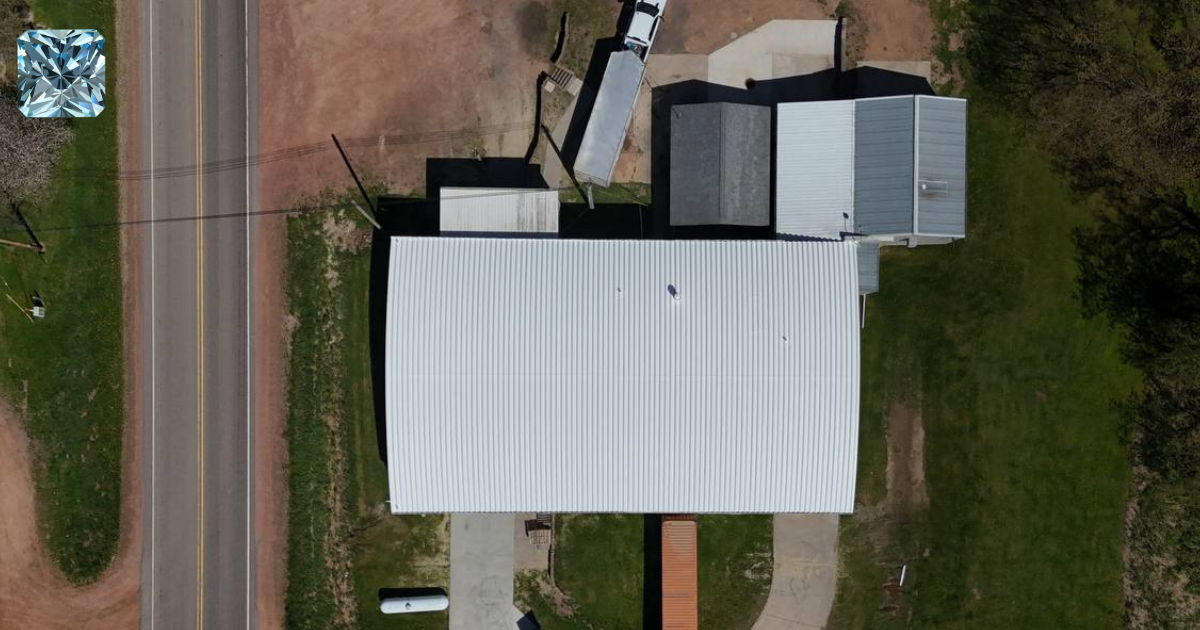
🔲 A flat commercial roof is not one thing. It is a layered system: structural deck, vapor barrier, insulation, membrane or coating, and accessories. Each layer has a job. When one fails, the others compensate, until they cannot.
🔲 The roof deck is the foundation. Steel, wood, plywood, or concrete. Everything else sits on top of it. If the deck is compromised, nothing above it matters.
🔲 ISO insulation board is the thermal barrier. It keeps conditioned air inside and weather outside. Tapered ISO creates slope for drainage on flat surfaces.
🔲 The membrane or coating is the weather face. This is what fights rain, UV, wind, chemicals, foot traffic, and fire. It is the most visible layer and the most discussed, but it is only one layer in the system.
🔲 Accessories complete the system. Walkpads, drain sumps, stack collars, corner pieces, coping, drip edges, and pre-formed crickets. The details are where roofs fail or succeed.
🔲 Free roof anatomy lesson on YOUR building: PristineIndustrialRoofing.com/evaluate
Frank has been staring at his roof for six months. Not literally. Figuratively. He knows it is up there. He knows it leaks near the back HVAC unit. He knows it is old. He knows three contractors have told him three different things in three different languages that all sounded like Charlie Brown’s teacher.
Here is Frank’s problem: he does not know what he is looking at. He has never been on the roof. He has never seen the layers. He does not know what ISO board means, what a parapet is, what coping does, or why there are rocks on some roofs and screws on others. He is being asked to write a check for $60,000 to $150,000 for a system he cannot visualize, built from materials he cannot name, installed by a process he has never watched.
That ends today. This is the anatomy of a flat commercial roof, layer by layer, in plain English, with zero jargon and no acronyms that are not immediately explained. By the time you finish reading this, you will understand what is on top of your building better than 90% of the building owners in Northwest Indiana. And you will make a much better decision because of it.
Layer 1: The Roof Deck (The Foundation)
This is the structural floor of your roof. Everything else sits on top of it. If this fails, nothing above it matters.

The roof deck is the structural surface at the top of your building. It is the foundation that supports every other layer of the roofing system. On most commercial buildings in Lake and Porter County, the deck is one of three materials.
Steel deck (22, 20, or 18 gauge): The most common in commercial and industrial construction. Corrugated steel panels spanning between structural beams. This is what you see when you look up from inside a warehouse before the ceiling is finished, the ribbed metal surface overhead. Fasteners must extend at least 1 inch through the top flute of the steel to achieve proper pull-out strength.
Wood or plywood deck: Common in older commercial buildings, strip malls, and retail spaces. Plywood or dimensional lumber planking across structural joists. Fasteners require minimum 1 inch of embedment in plank or 1 inch through plywood.
Structural concrete: Found in institutional buildings, parking structures, and multi-story commercial properties. Fasteners require pre-drilling at least half an inch deeper than the fastener length, and carbide drill bits.
There are also specialty deck types: Tectum (a wood-fiber acoustic panel), lightweight concrete, and gypsum board. These require specialized TruFast TL fasteners with a non-pass-through design and minimum 1.5 inch embedment.
The deck determines everything: which fasteners you use, how they are spaced, whether the roof can support additional layers, and how much weight the structure can carry. A contractor who does not ask about your deck type before writing a bid is guessing. And guessing on a roof is how six-figure problems start.
Layer 2: The Vapor Barrier (The Moisture Shield)
This invisible layer stops moisture from rising through the deck and destroying the insulation from below.
Warm air holds more moisture than cold air. Inside a heated commercial building, warm moist air naturally rises toward the roof. When that warm air meets the cold underside of the roof deck, the moisture condenses, the same way a cold glass sweats on a humid day. That condensation collects on the insulation, degrades the adhesive bonds, and slowly destroys the roofing system from the inside out.
A vapor barrier is installed between the deck and the insulation to prevent this moisture migration. It is one of the least discussed and most important layers in the system. Buildings with poor or missing vapor barriers experience accelerated insulation failure, adhesive delamination, and chronic moisture problems that no membrane or coating can solve from above.
Layer 3: Insulation (The Thermal Barrier)
This is what keeps your heating and cooling bills from eating your profit margin alive.
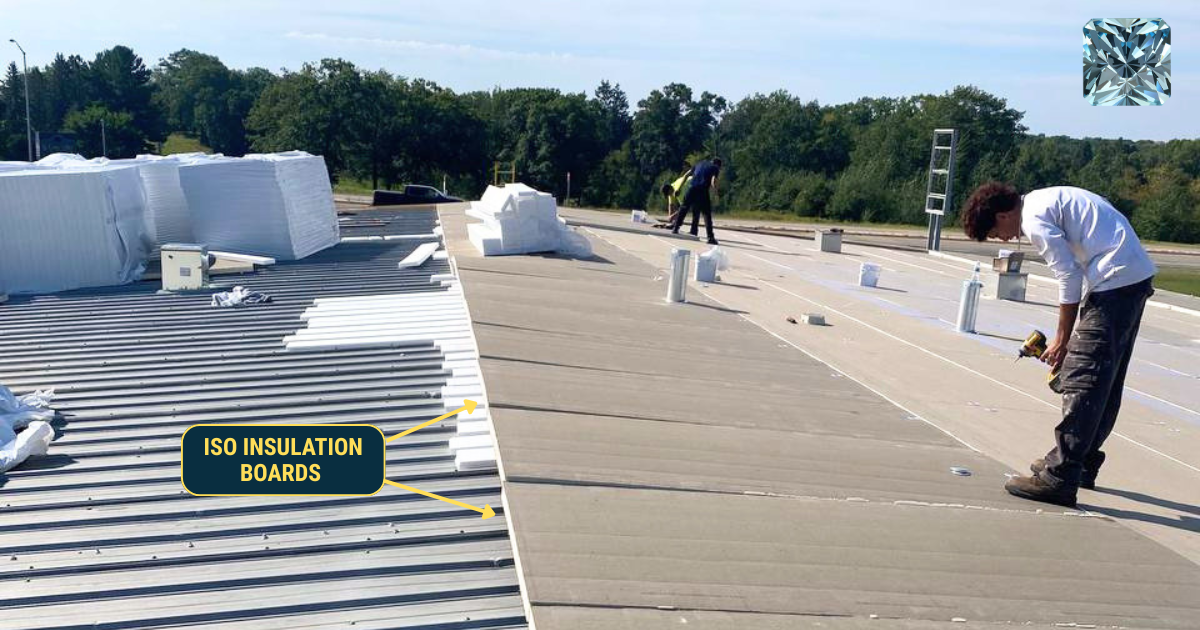
Insulation board, most commonly called ISO board (polyisocyanurate), sits on top of the vapor barrier and provides the thermal barrier between the conditioned interior and the weather above. ISO board has fiberglass facers on both sides and comes in thicknesses ranging from 1 inch to 4 inches or more, depending on the building’s energy requirements and local code.
Flat ISO board provides uniform insulation. Tapered ISO board is cut at a slight angle, typically 1/8 inch, 1/4 inch, or 1/2 inch of slope per foot, to create drainage paths on an otherwise flat surface. Water does not pond on a properly tapered system. It flows toward drains, scuppers, or roof edges. You cannot see the slope from a photo, and most building owners have no idea their roof is engineered to drain in specific directions. But it is, and the tapered insulation is what makes it happen.
Pre-formed crickets, diamond-shaped tapered pieces, are installed around large drains and equipment curbs to direct water flow from all directions toward a single drain point. These are the traffic cops of the roof drainage system.
When a roof is restored with a liquid-applied Conklin system, the existing insulation is preserved. No tear-off. No insulation replacement. No thermal value lost. The liquid coating goes over the existing surface, and the insulation stays intact underneath. That is one of the primary cost advantages of liquid restoration over solid membrane replacement: you are not buying new insulation and you are not sending the old insulation to the landfill.
Layer 4: The Membrane or Coating (The Weather Face)
This is the layer everyone talks about. It is also only one layer in a multi-layer system. Stop acting like it is the whole roof.

The membrane or coating is the topmost layer, the one that faces the weather. It fights rain, snow, hail, UV radiation, wind, foot traffic, chemical exposure, thermal cycling, and fire. It is the most visible layer and the one that gets all the marketing attention. But it is only effective if every layer below it is intact.
We have covered the membrane options extensively in our comparison articles, but here is the quick reference.
Legacy Rubber (EPDM): Black thermoset rubber. Glued seams. Shrinks. Dissolves under grease. Being retired across the industry.
Brittle Plastic Wrap (TPO): White thermoplastic polyolefin. Cheap. No Class A fire rating. Narrow welding window. 40% of new installs because contractors love the margin.
Pro-Grade Vinyl (PVC / Flexion 2.0): White thermoplastic. Class A fire rated. Acid and grease resistant. Heat-welded seams. 25-year warranty. The best solid membrane option.
Liquid-Applied (Rapid Roof III / Affinity): Seamless, fabric-reinforced coatings applied over existing surfaces. Fire rated. No seams. 66% of Conklin’s volume. The future of commercial roofing. 30–50% less cost than solid membrane replacement.
The membrane or coating is what the Conklin training binder calls the “weatherproofing material”, the topmost or outermost layer, exposed to the weather. Many materials have been used as weatherproofing over the years. The ones that survive are the ones that fight on two fronts: protecting against attacks from above (wind, rain, UV, fire, chemicals, traffic) and attacks from below (air moisture, heat, structural stress, vapor).
✉️ Want to see the actual layers on YOUR roof? We’ll walk you through it on-site.
PristineIndustrialRoofing.com/evaluate
Layer 5: Accessories (The Details That Make or Break the System)
Every pipe, vent, drain, corner, and edge is a potential failure point. The accessories are what seal them.
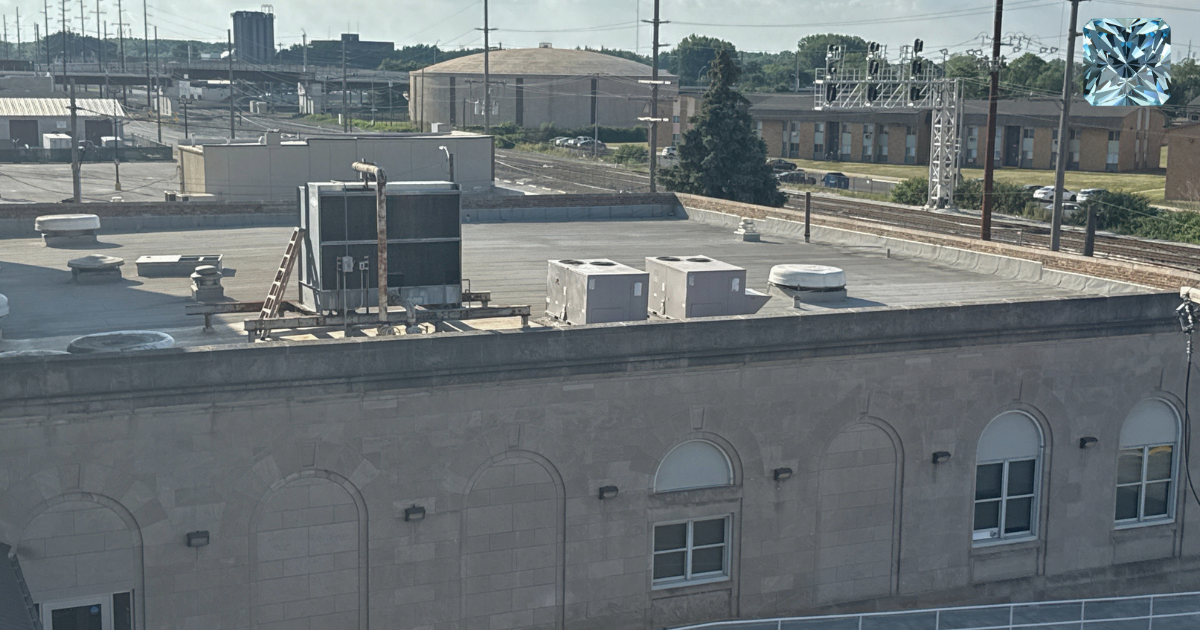
A flat roof is not a smooth, uninterrupted surface. It is covered with HVAC units, exhaust vents, plumbing stacks, electrical conduits, drains, scuppers, skylights, access hatches, and equipment curbs. Every one of those items interrupts the waterproof membrane. Every interruption is a potential leak point. The accessories are what seal those interruptions.
Stack collars: Pre-fabricated cone-shaped pieces that wrap around pipe stacks and heat-weld to the parent membrane. Conklin’s come in two sizes (1”–4” and 3.5”–7”), cut-to-fit, and weld to the field sheet with a Leister handheld tool.
Inside and outside corners: Pre-fabricated corner pieces from Acme Cone that weld directly to the parent membrane at every parapet corner and wall transition. No field-fabricated corners. No cutting and folding. Pre-made pieces that fit precisely.
Scupper sleeves: Pre-fabricated sleeves that line the scupper openings in parapet walls, heat-welded to the field membrane and sealed with 360-S urethane sealant.
Drain sumps: Cut into the insulation to create a depression at drain locations, ensuring water flows to the drain point from all directions.
Walkpads: OSHA-yellow spaghetti-textured pads or black rubber pyramid pads installed around HVAC equipment and along maintenance access routes. Protects the membrane from foot traffic damage. We prefer the yellow, visible, safe, and OSHA-compliant.
Coping and drip edges: PVC-covered metal flashing at the roof perimeter, mechanically fastened and heat-welded to the field membrane. The coping caps the parapet wall. The drip edge directs water off the building edge into gutters.
These accessories are not optional. They are not upgrades. They are the system. A membrane without proper accessories is a waterproof sheet with holes in it.
Now You Know What You Are Looking At
This is the education that should come before the bid. Not after.
Frank: You now know more about your roof than you did thirty minutes ago. The deck, the vapor barrier, the insulation, the membrane, the accessories — five layers, each with a job. When a contractor hands you a bid, you can ask: what deck type do I have? Is there a vapor barrier? What condition is the insulation in? What membrane or coating are you proposing and why? What accessories are included? If they cannot answer all five, they have not done a real evaluation. PristineIndustrialRoofing.com/evaluate
Kenny: You already knew most of this. But now you have the vocabulary to explain it upstairs in a way that Frank understands. Print this article. Walk Frank through the five layers. Then call us and we will walk you both through YOUR five layers on YOUR building.
Megan: The next contractor who calls you will use jargon to sound smart. Now you know what ISO board is, what a vapor barrier does, and why accessories matter. You are no longer the person who sends “looks fine from the outside.” You are the person who asks the right questions.
What Building Owners Ask About Roof Anatomy
Q: How many layers does a flat commercial roof have?
A: A complete system has five primary layers: structural deck, vapor barrier, insulation, membrane or coating, and accessories (flashings, drain components, walkpads, and edge details). Each layer has a specific function and all five must be intact for the system to perform.
Q: What is ISO board?
A: ISO board (polyisocyanurate insulation) is the thermal barrier in a flat roof system. It sits between the structural deck and the membrane. It comes in flat sheets for uniform insulation or tapered sheets to create drainage slope on flat surfaces.
Q: What is tapered insulation and why does my flat roof need slope?
A: Tapered ISO board is cut at a slight angle (1/8” to 1/2” per foot) to create drainage paths on a flat roof. Without slope, water ponds on the surface, accelerating membrane degradation and adding structural weight. Tapered insulation directs water toward drains and scuppers.
Q: What are the accessories on a flat roof?
A: Stack collars around pipes, pre-fabricated corners at parapet walls, scupper sleeves at drainage openings, drain sumps at drain locations, walkpads around HVAC equipment, and coping/drip edges at the roof perimeter. These seal every interruption in the membrane surface.
Q: Can I keep my existing insulation when re-roofing?
A: If the existing insulation is dry and structurally sound, a liquid-applied Conklin system can be installed directly over it without tear-off. This preserves the insulation’s thermal value and eliminates the cost of new insulation and landfill disposal.
Q: What is a vapor barrier and does my building need one?
A: A vapor barrier prevents moisture from rising through the deck and condensing on the underside of the insulation. Most commercial buildings with heated interiors benefit from a vapor barrier. Missing or failed vapor barriers are a common cause of chronic roof system deterioration.
Q: How do I know what deck type my building has?
A: A professional roof evaluation includes deck identification. Steel deck is identified by the corrugated rib pattern visible from below. Wood and plywood are identified by material inspection. Concrete is identified by surface composition. The deck type determines which fasteners are used and how the system is attached.
Five layers. Five questions. One free evaluation.
PristineIndustrialRoofing.com/evaluate • Text (219) 529-1995
Continue Your Journey
- Rubber vs. Plastic vs. Vinyl vs. Liquid — PristineIndustrialRoofing.com — The full comparison
- That Bucket in the Back Hallway Is a Seam Problem — PristineIndustrialRoofing.com — Why 90% of leaks start at joints
- From Noah’s Tar to Your Roof — PristineIndustrialRoofing.com — 4,000 years of waterproofing history
- Your Roof Is Not Nailed Down as Well as You Think — PristineIndustrialRoofing.com — Wind uplift physics
- TPO Will Burn: Fire Ratings Matter — PristineIndustrialRoofing.com — The fire rating gap
- How Can I Actually Afford a Roof Upgrade? — RoofServiceMenu.com — Creative financing
Pristine Industrial Roofing
Conklin-Certified • Lake County & Porter County, Indiana
(219) 529-1995 • PristineIndustrialRoofing.com
A Gospel Business funding community outreach and worldwide missions with every roof we install.
Read other blog:


We Love Conversations
 SoHelpful@PristineIndustrialRoofing.com