
What Happens If My Roof Lacks Insulation?
Cover Boards Are Expensive Sponges. Here’s What Smart Contractors Use Instead. Updates on the Latest Insulation Technology, Because Thin Is Trending, But Strong Is What Matters.
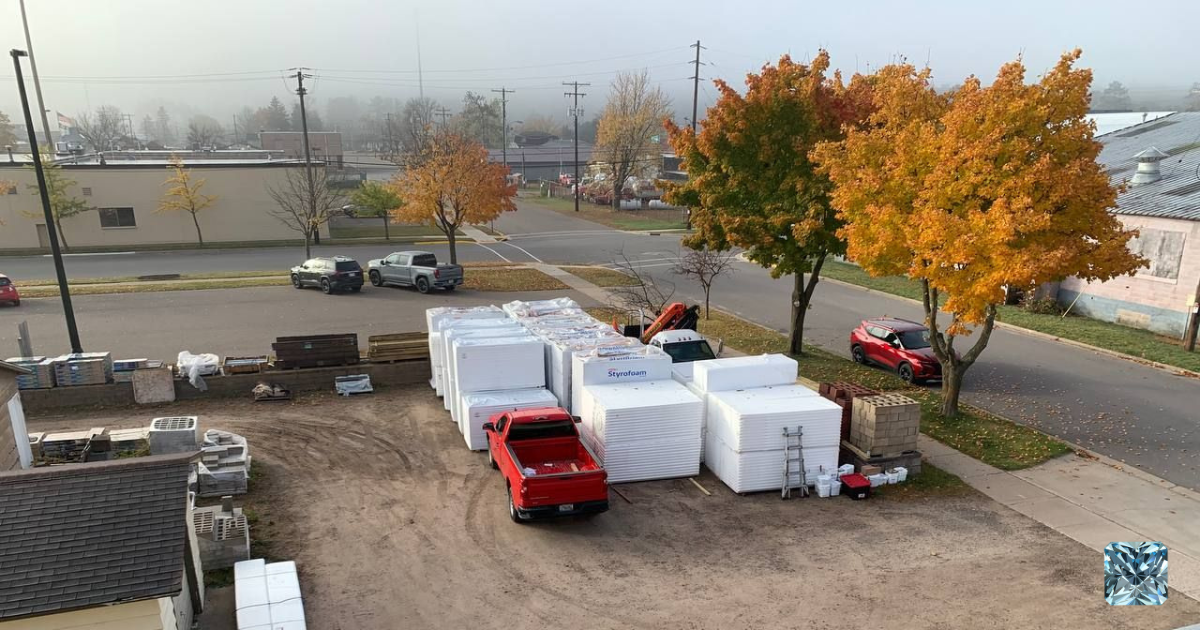
🔲 Energy Bills Are Exploding – Small businesses are paying double on NIPSCO bills. Every building is bleeding cash.
🔲 Insulation = Savings – High-density foam traps heat and AC, keeping your money inside your building.
🔲 Next-Gen Roof Tech – ThermaThin 7, Plazamate XR, and smart fastening cut material, labor, and energy waste.
🔲 Cut Layers, Cut Costs – Skip fiber cover boards; seamless coatings + HD foam slash energy bills 30–40%.
The Bill That Changed Everything
People in Lake County are inventing brand new cuss words right now, and every single one of them is aimed at NIPSCO.
You know Vinny. Bossman Tacos. Right here in the heart of Lake County. Great guy. Good businessman. The kind of owner who knows every dollar going to every supplier. Vinny keeps a tight ship. So when he tells us his NIPSCO bill last year was $2,200 a month and this year it’s sitting at $4,000, that’s not a man who missed something on a spreadsheet. That’s a man watching his profits get donated to a utility company against his will.
Almost double. For a 3,000 square foot restaurant. Some ovens. A walk-in cooler. That’s it. That’s the operation. And NIPSCO looked at Vinny the same way they looked at every other business owner in this county and said, “Pay up.”
Now multiply that. Your favorite gas station. The strip mall where you get your hair cut. The church your family has attended for three generations. The warehouse that employs half your neighborhood. If Vinny’s little taco spot is getting hit for $4,000, what do you think the big buildings are bleeding every single month?

There Is No Plan B
And here’s the part that makes people’s blood pressure spike, there is no Plan B.
Lake County still runs on good old-fashioned coal and natural gas. Look around. Where’s the solar? Where are the wind farms? You won’t find them. Not here in Northwest Indiana. NIPSCO has pretty much locked that door. They’ve got big plans for nuclear. They’ve got legislative muscle to make sure every business, every school, every building stays plugged into their grid. It’s actually illegal to just unhook your building and run your own power. You can’t grab a generator and a battery bank and tell NIPSCO to kick rocks. You’re stuck. We’re all stuck.
People are calling it a tax. People are taking to the streets. And honestly? The data centers aren’t even built yet. This is the warm-up. Whatever NIPSCO is charging right now, the trajectory is up. Way up. And there’s a bigger conversation coming about why, but that’s another article, and trust us, we’re writing it.
So the question for right now, today, for every building owner reading this is simple ...
What can you actually do about it?
You can’t negotiate with NIPSCO. You can’t switch providers. You can’t go off-grid. But you CAN control how much of your money walks right through the ceiling and out the roof. You can control the envelope. You can stop paying to heat the sky and cool the clouds.
And it starts with something most building owners have never looked at, never thought about, and definitely never gotten excited about, until right now.
Your roof insulation.
Because insulation is money. Every inch of it. Every R-value point. Every degree it keeps inside your building is a dollar that stays in your pocket instead of padding NIPSCO’s quarterly earnings. And in 2026, the science of trapping air, because that’s all insulation really is, trapped air, just took a massive leap forward.
The Science (But Make It Make Sense)
So what is insulation, really? Forget the technical jargon for a second. Insulation is trapped air. That’s it. That’s the science. You’re taking air, the same air you’re breathing right now, and you’re locking it inside millions of tiny closed cells in a rigid foam board. Those little pockets of air are what stand between your climate-controlled building and whatever Lake County weather is throwing at you on any given Tuesday.
The reason it works is simple. Air doesn’t transfer heat well. So when you trap enough of it in a tight enough space, you’ve built a wall between your conditioned air and the outside world. The thicker the wall, the higher the R-value. The higher the R-value, the more of your money stays inside your building.

Why Rigid Foam and Not Fiberglass?
Now, why rigid foam? Why not fiberglass like what’s in the walls of your house? Because this is a commercial flat roof. You’ve got technicians walking on it. You’ve got heavy HVAC equipment sitting on it. You’ve got service crews rolling compressors and dragging tools across it. Fiberglass would get crushed on day one. You need a board that can take the weight, handle the foot traffic, and still do its job as insulation for the next 20 to 30 years.
That’s where polyiso comes in, polyisocyanurate foam, if you want to impress somebody at a dinner party. Standard polyiso gives you about R-5.7 per inch of thickness. So if you need an R-30, which is what most of the gas stations we work on are targeting — you’re looking at about 5 inches of the right foam. That means your fasteners need to be at least 6 inches long to bite into the decking underneath. That’s manageable. That’s a normal day on a commercial roof.
Standard Density vs. High Definition
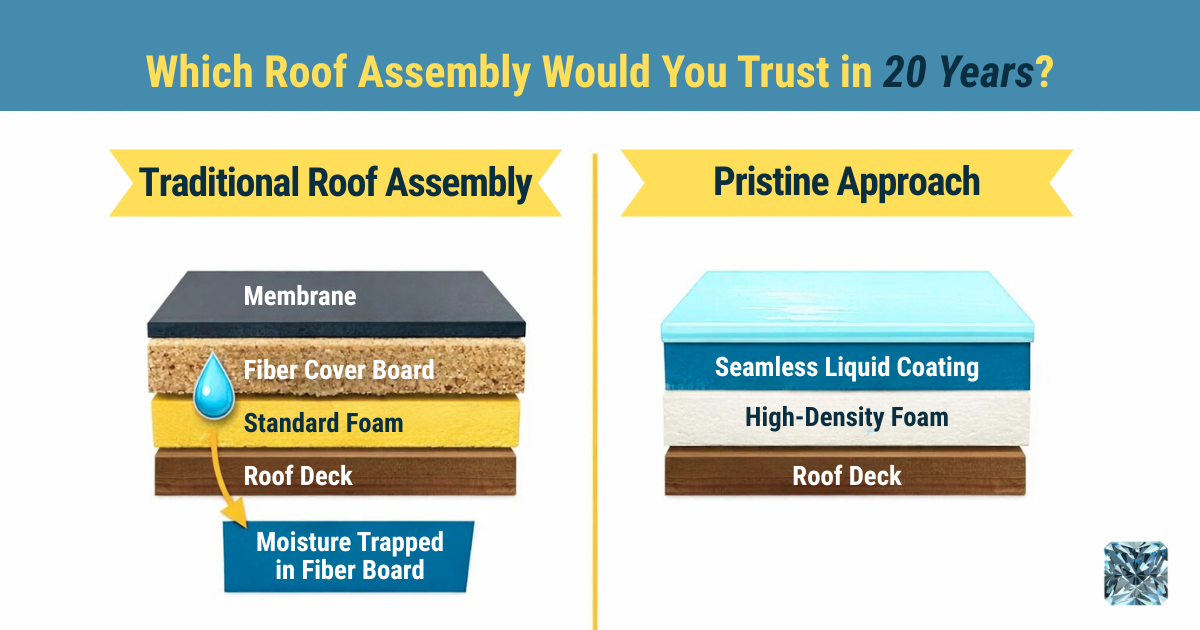
But here’s where people get it wrong. They’ll spec standard density foam and then slap a cover board on top because they’re worried about foot traffic denting the insulation. That cover board is fiber. And what does fiber do when it meets moisture? It drinks it. It holds it. It becomes a sponge living inside your roof assembly.
Meanwhile, high-density polyiso, we call it HD, gives you the compressive strength to handle boots, equipment, and snow load without needing that extra fiber layer at all. HD boards are what we spec on every job because when you’ve got the right density, you’ve got the right rigidity. You don’t need a crutch.
And density matters for another reason most people never think about. Your roof isn’t always laser-level. You get low spots. You get bird baths — those little puddles that form after a rain and just sit there. Those puddles become ponds. Those ponds create compression. That compression creates sag. And sag creates structural issues that cost real money. When you start with a denser, more rigid foam, you’re building in resistance to all of that from day one.
Two things. That’s all your insulation needs to do.
Number one, thermal performance. Trap the air, hold the R-value, keep your conditioned air where it belongs. Number two, rigidity. Handle the weight, handle the traffic, handle the weather without folding. If your foam does both of those things, you don’t need a fiber sponge sitting on top of it pretending to help.

Want to Know What Your Building Is Actually Losing Through the Roof?
We come out, pull a core sample, and tell you exactly what’s in your roof right now, how thick, how old, what condition the insulation is in, and whether there’s trapped moisture working against you. No pressure. Just the facts about YOUR building.
[ DROP YOUR EMAIL → GET YOUR FREE ROOF CORE ANALYSIS ]
“Thin Is In” — The 2026 Insulation Revolution
The International Roofing Expo just wrapped up in Las Vegas last month, January 20–22, 2026. Over 700 exhibitors. 230,000 square feet of show floor. And the loudest buzz in the building wasn’t about membranes or shingles. It was about insulation.
Specifically, it was about getting more R-value into less thickness. Because when science figures out how to trap more air in a thinner board, everything downstream gets cheaper. The fasteners get shorter. The material handling gets lighter. The truckloads go down. And the building owner’s insulation budget stretches further.
Here are the three innovations that caught our attention,
1. Carlisle ThermaThin 7
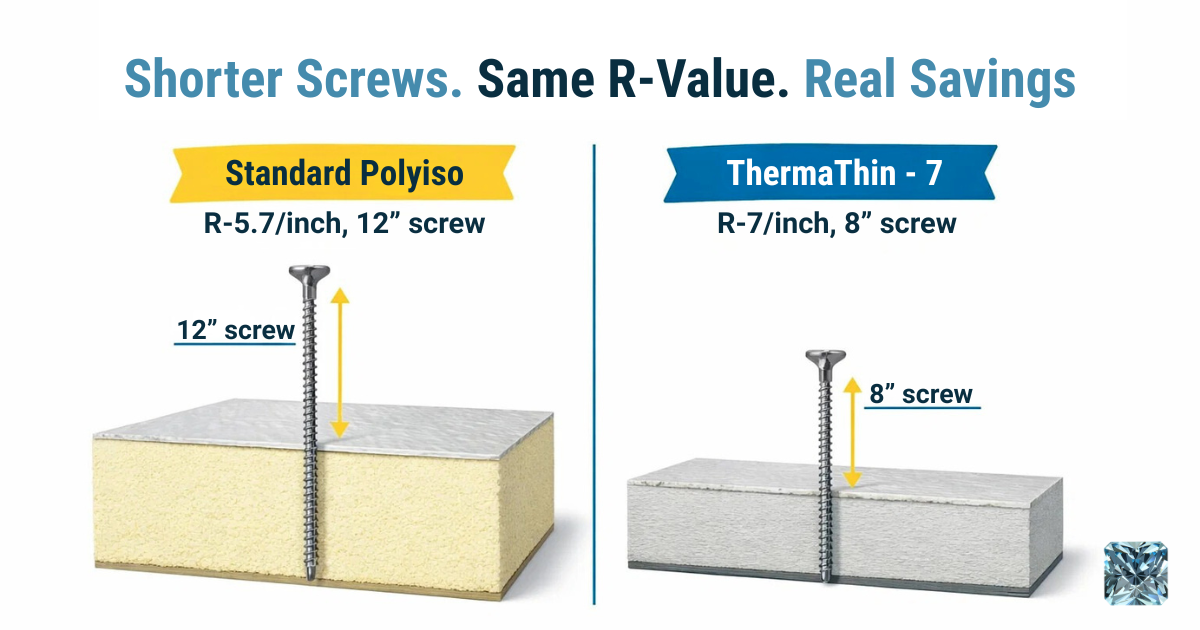
This was the star of the show. Carlisle SynTec Systems unveiled ThermaThin 7, a next-generation polyiso board that delivers R-7 per inch. Standard polyiso sits at R-5.7 per inch. That’s a 23% jump in thermal performance in the same thickness of material.
What does that mean on your roof? The total insulation thickness drops by about 17%. That means shorter fasteners across the entire roof. If you’re installing 10 fasteners per 4×8 sheet, which any contractor worth their salt does, code says 6 but we always do 10 in an X pattern, the savings on fastener depth alone can run into thousands of dollars across a full roof.
Carlisle also estimates ThermaThin 7 reduces truckloads by at least 20%, which means lower freight costs, less jobsite congestion, and faster installation. It won the IRE 2026 Innovative Product Award in the Siding & Insulation category. Available to contractors by summer 2026.
2. DuPont Styrofoam Plazamate XR
DuPont came to IRE with Plazamate XR, an extruded polystyrene (XPS) board hitting R-6.7 per inch. That’s the highest thermal resistance of any XPS product on the market, 30% more insulating power per board foot than standard XPS.
But here’s what really got our attention: 60 psi compressive strength. That’s walkability built into the board. That’s equipment-on-the-roof-without-flinching territory. And it’s moisture-resistant by nature, which means it’s not going to become a sponge like fiber-based cover boards do over time.
For building owners in Northwest Indiana dealing with freeze-thaw cycles, heavy snow loads, and rooftop equipment, that combination of thin profile and serious compressive strength is exactly what modern roof design calls for.
3. Atlas Roofing — The Engineering Play
Atlas didn’t drop a new thin board at IRE this year. What they did was arguably smarter for contractors in the field: they launched a job-specific fastening pattern calculation service.
You provide Atlas with your roof specs, wind uplift requirements, snow load, what the code demands, and their engineering team tells you exactly how many fasteners you need and where they go. No guesswork. No over-fastening. No under-fastening. Just precision.
Their ACFoam-IV and ACFoam-HD boards are still the workhorses of the Atlas product line, and their HD CoverBoard eliminates the need for traditional fiber cover boards in many applications. But the engineering service is the move that tells you Atlas understands what contractors actually need, not just better materials, but better information.
The Cover Board Conversation (Let’s Be Honest)
The roofing industry has been spec’ing cover boards for decades like it’s gospel. And for a long time, with the foam densities available, it made some sense. Standard 20 psi polyiso under a single-ply membrane needed something on top to protect it from foot traffic and hail. So the industry added a fiber cover board. Problem solved. Sort of.
Here’s what actually happens with that cover board over the life of your roof. It’s fiber. It’s sitting between your insulation and your membrane. And eventually, maybe not this decade, maybe not next decade, but within 15 to 20 years on average, the seals start to give. Around the pipes in particular, there’s going to be motion. Edges start to move. Flashing details shift. And when moisture finds its way in, and it always does, that fiber cover board becomes a sponge.
It doesn’t dry out easily. It sits there holding liquid. And that trapped moisture weakens everything around it. The insulation underneath loses R-value. The adhesion between layers breaks down. The whole assembly starts working against itself from the inside.
What We Do Instead
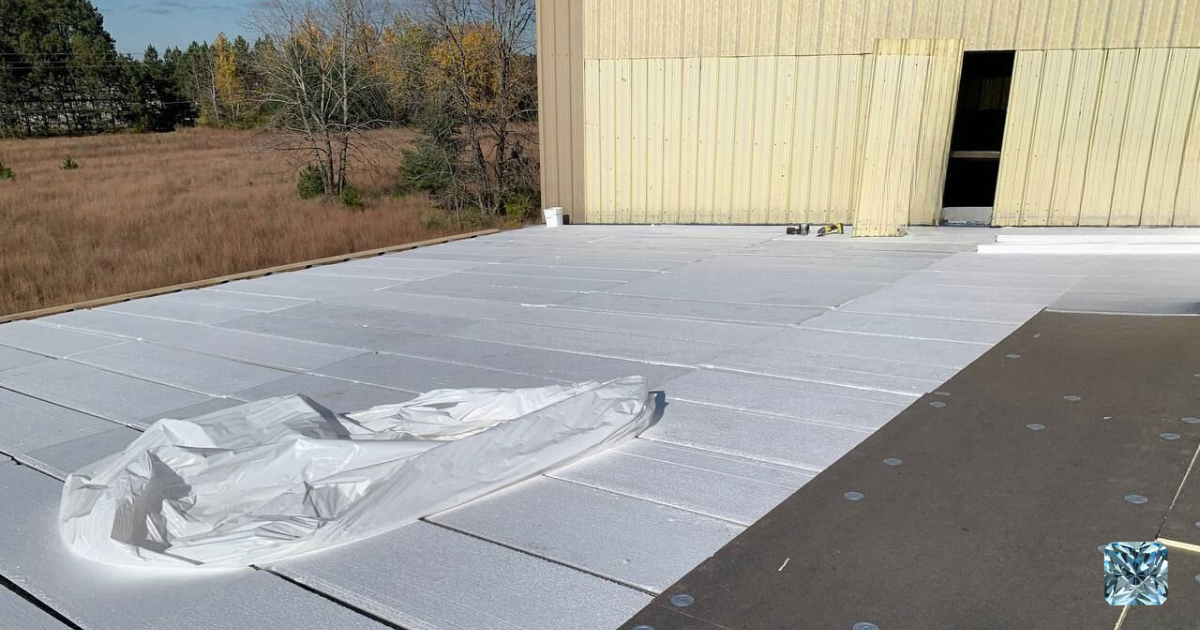
We don’t quote cover boards. Period. We never have and we don’t plan to start. Instead, we spec HD polyiso, the right density for the right function. When you’ve got a board running 80+ psi compressive strength, you don’t need a fiber crutch sitting on top of it. The foam IS the protection.
And on top of that foam, we install a liquid-applied seamless coating system. No seams means no weak points. No edges peeling. No joints separating. The coating stretches with the building’s natural thermal movement, remember, 70 degrees inside and 0 degrees outside means your roof is constantly expanding and contracting. A seamless system moves with it instead of fighting it.
We can add spun flex fiber mesh reinforcement to make it Class 4 hail rated. That means a 2-inch steel ball dropped from 20 feet doesn’t indent it. Doesn’t rip it. Doesn’t compromise the seal. That’s tougher than what most people imagine when they hear “coating.”
And here’s the budget reality: when you eliminate the cover board, you eliminate an entire layer of material cost, an entire layer of labor, and an entire layer of potential moisture problems. That’s not cutting corners. That’s cutting waste.
So What Can You Actually Save?
Let’s get practical. Because this isn’t theory. This is what happens when we show up to a commercial building and do the work.
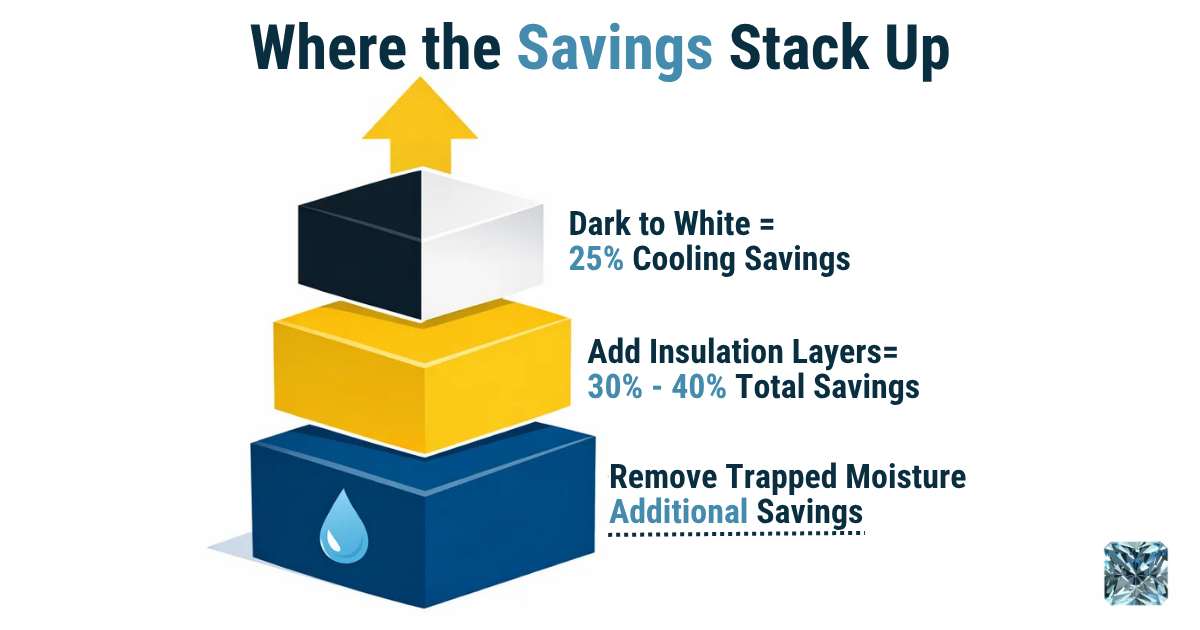
Dark roof to bright white reflective seamless coating? That’s 25% off the top of your cooling costs right there.
A dark membrane absorbs heat all day and pushes it into your building. A bright, reflective white coating bounces that solar energy back into the sky where it belongs. That’s not marketing. That’s physics. And on a Lake County summer day, that difference shows up on your NIPSCO bill immediately.
Add proper insulation thickness on top of that? You’re looking at 30–40% savings. Realistically.
When you combine a reflective surface with the right R-value underneath it, your HVAC system stops working overtime. It stops running just to overcome what the roof is letting in. Your building holds temperature. Your equipment lasts longer. Your bill drops.
And most of these roofs have trapped moisture.
When we pull a core sample and find wet insulation, which happens more often than building owners expect, that moisture is actively working against your thermal performance. Wet foam doesn’t insulate. It conducts. So just removing the moisture problem and replacing compromised insulation puts money back in your pocket on top of everything else.
We’re not here to over-promise. We’re here to look at the numbers, look at your building, and show you what’s real. Every roof is different. Every building has its own story. That’s why we start with a core sample, because the truth is in the layers.
One Question. One Step.
How thick is your insulation? How old is it? Is there moisture trapped in it right now working against you?
We come out. We pull a core sample. We tell you exactly what your roof looks like from the inside. And then we run the numbers, what’s your current R-value, what could it be, and what would that do to your energy bill.
No pressure. No games. Just the truth about your building.
Let’s Find Out What Your Roof Is Costing You.
Drop your email below and we’ll schedule your free roof core analysis. That’s it. One field. One step. Let’s see what we can save you.
[ GET MY FREE ROOF ANALYSIS → ]
Read other blog:

We Love Conversations
 SoHelpful@PristineIndustrialRoofing.com