
UV Degradation Timeline | When Your 'Warranted' Commercial Roof Actually Starts Failing
The warranty says 20 years. The UV index didn't get the memo. Your membrane is chalking, cracking, and losing flexibility right now. The paperwork is fine, though.

🔲 UV degradation begins on day one. Warranties typically kick in at year ten, after the damage is done.
🔲 Chalking, embrittlement, and seam brittleness are not "normal aging." They are early failure signals.
🔲 tPo and EPDM shed UV protection within 3 to 5 years. Your urethane topcoat does not.
🔲 A Conklin-coated roof reflects UV instead of absorbing it. The membrane underneath stops aging.
There is a document in your filing cabinet or your property management portal, or your contractor's inbox, that says your commercial roof is covered for 20 years. Maybe 15. Maybe 25 if someone paid for the upgrade.
That document is real. The coverage is real. And your roof is still failing.
Not all at once. Not dramatically. It is failing the way a car engine fails when you skip oil changes, gradually, invisibly, and then suddenly at the worst possible moment. The mechanism is ultraviolet radiation. The timeline is faster than the warranty implies. And the specific thing the warranty mostly doesn't cover is the very thing that is happening to your roof every day the sun rises over Northwest Indiana.
This is the article that explains what UV actually does to a commercial membrane, when the damage becomes structural, and why the Firestone warranty your last contractor handed you is a floor, not a ceiling.
What UV Radiation Does to a Roofing Membrane

Ultraviolet radiation does not punch holes in roofing membranes. It does something more insidious, it breaks molecular bonds. The polymers that give roofing membranes their flexibility, their tensile strength, and their ability to accommodate thermal movement are long-chain molecules held together by chemical bonds. UV radiation attacks those bonds directly, breaking the chains into shorter fragments.
The results are physical and measurable.
Chalking. The white powdery residue that appears on aged TPO and certain coating surfaces is not dirt. It is degraded polymer, the literal surface of the membrane breaking down into fine particulate. When you wipe chalk off a roof surface, you are wiping off former roofing membrane. The material is thinner than it was.
Embrittlement. A new TPO membrane flexes. It accommodates the thermal expansion and contraction of the deck below it without cracking. An embrittled membrane does not. When the deck moves, and every deck moves, every day, with every temperature swing, the membrane cracks instead of flexing. Those cracks do not heal. They widen.
Loss of reflectivity. Most commercial membranes start white or light-colored for a reason: solar reflectance reduces cooling loads and slows UV degradation by reducing surface temperature. As UV breaks down the surface chemistry, reflectivity drops. The membrane gets hotter. The heat accelerates the UV degradation. The cycle compounds.
Seam brittleness. On mechanically fastened or adhered systems, the seams are the last line of defense. Seams are also where two pieces of membrane overlap, where adhesive or heat-welding holds the system together, and where water infiltration begins if the bond fails. UV-embrittled seams crack, lift, and separate. Once a seam opens, no amount of warranty language closes it.
None of this triggers a warranty claim. All of it is happening to your roof.
The UV Timeline, Year by Year
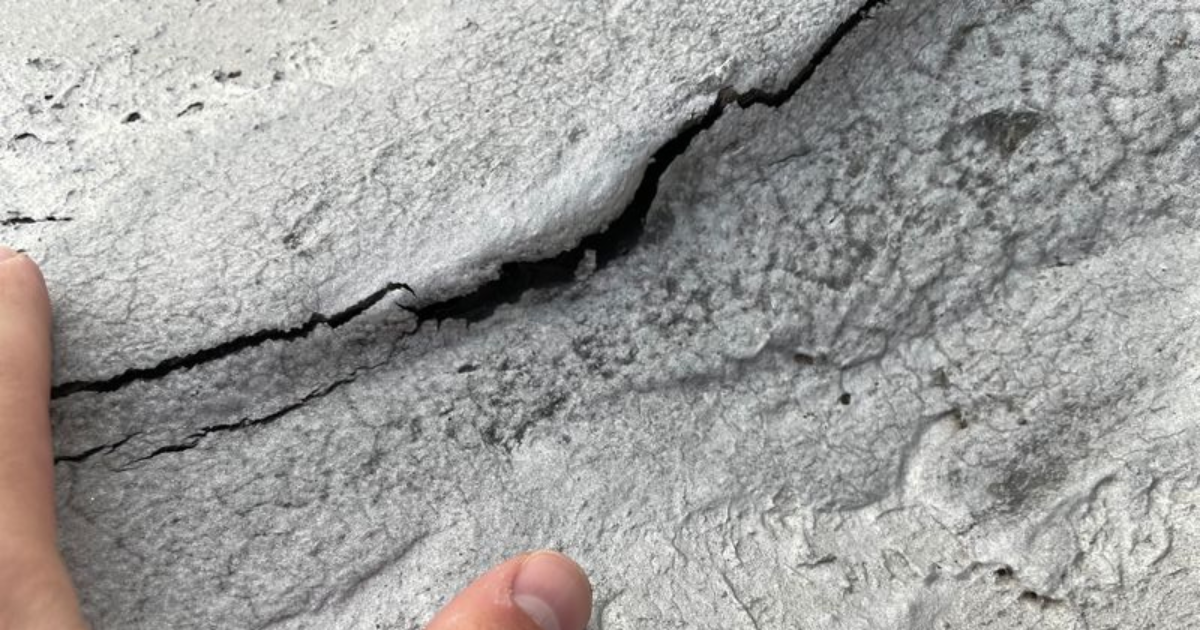
UV degradation is not linear. It follows a curve, slow at the start, accelerating in the middle years, and then running ahead of anyone's ability to stop it through surface maintenance.
Here is what that curve looks like on a standard commercial flat roof in a climate like Hammond or Portage, 38 inches of annual precipitation, lake-effect cloud cover through Fall and Winter, and aggressive UV exposure in the Spring and Summer months when the cloud cover breaks and the sun hits a white membrane at high angles.
Years 1–3: Surface chalking begins. Reflectivity drops measurably but the membrane is still performing as designed. This is the window where a UV-reflective topcoat pays for itself most efficiently, the substrate is still intact.
Years 3–5: On tPo and EPDM systems, the plasticizers that maintain flexibility begin migrating out of the membrane. This is chemistry, not installation error. Plasticizer migration is a known, documented phenomenon in thermoplastic membranes. The membrane becomes measurably stiffer. Thermal cycling stress increases. Seam edges begin to show micro-cracking.
Years 5–8: Embrittlement is visible at penetrations, corners, and seam edges. Lap seams on tPo systems begin to show the characteristic "picture framing", a slightly raised, stiff perimeter around each overlap that indicates adhesive failure under UV-accelerated stress. Drains and curb flashings show surface crazing. A competent inspector can identify these as pre-failure indicators. Most annual maintenance visits miss them entirely.
Years 8–12: This is the window where most "20-year roofs" begin generating service calls. The membrane is still nominally intact. The warranty is still technically active. But the performance has degraded to the point where the next significant hail event, the next freeze-thaw cycle, or the next heavy rain sits on a surface that cannot shed it the way it did in year three. Leaks appear, not at the seams yet, but at penetrations, flashings, and the perimeter zones where UV exposure is highest.
Years 12–15: This is where the warranty conversation begins to get interesting. The damage is real. The causes are documentable. And the warranty exclusions for "improper maintenance," "UV degradation," and "normal weathering" start appearing in the response letters from the manufacturer's claims department.
Year 15 is not when the roof failed. Year 15 is when everyone agrees it failed. The failure started in year three.
What Warranties Actually Cover And What They Don't
Commercial roofing warranties are manufacturing defect warranties. They cover the scenario where the membrane delaminated because of a factory error, where the adhesive failed because of a batch formulation problem, or where the seam bond was insufficient because the material was out of spec.
They do not cover,
- UV degradation described as "normal weathering" in the exclusion language
- Plasticizer migration in thermoplastic membranes
- Reflectivity loss over time
- Embrittlement at penetrations and seams attributed to "thermal cycling"
- Ponding water damage, which, as we covered previously, often begins at installation
- Maintenance neglect, defined broadly enough to exclude most building owners who are not putting a roofer on the roof twice a year
Read the exclusion section of any Firestone, Elevate, or Carlisle warranty. It is longer than the coverage section. The coverage section is the marketing. The exclusion section is the product.
This is not cynicism. It is contract literacy. A warranty is a specific promise about specific failure modes. UV degradation, which is the primary aging mechanism for every membrane on the market, is explicitly excluded in most standard warranty language as "normal weathering."
Korellis will hand you a warranty document and call it coverage. We will hand you the same document and explain what it doesn't say, because you deserve to make decisions based on what is actually true about your roof's future.
✉️ Is your roof in the 5 to 12 year window?
That is the highest-risk zone for UV-driven performance loss, and the window where intervention costs the least.
Subject Property Address: ___________________________
We'll send you a FREE UV condition assessment. No sales call. No obligation.
[ Email address ] → [ Send Me the Real Stuff ]
tPo and EPDM vs. Urethane and Silicone Topcoats, A Real Comparison
Here is what the material science actually says, stripped of brand marketing.
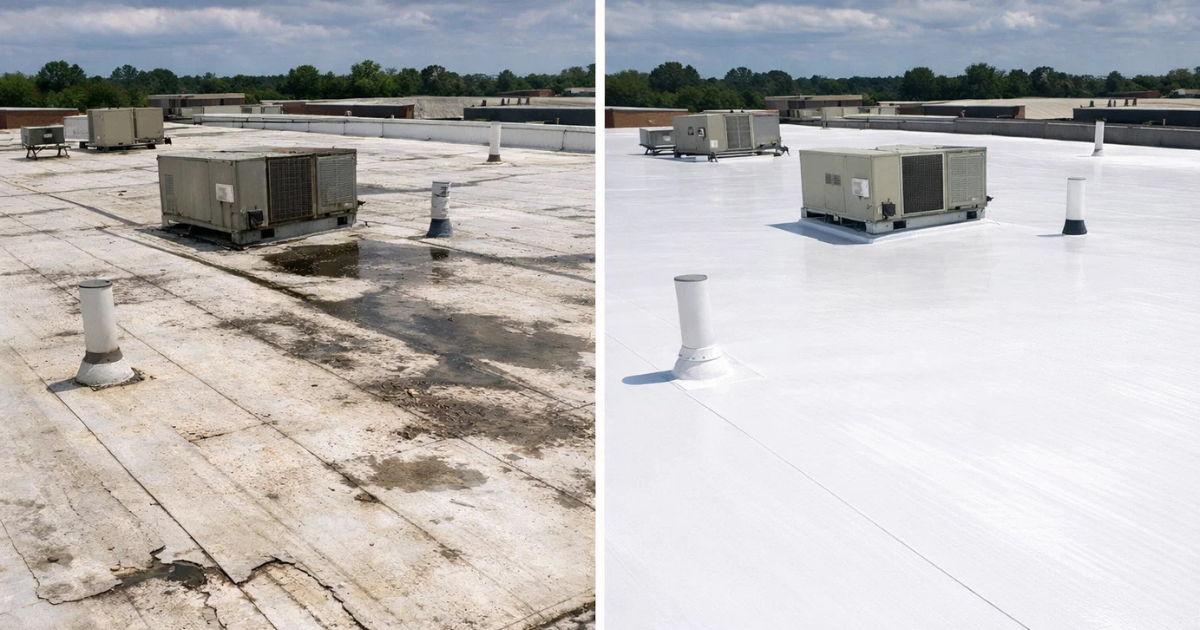
tPo (thermoplastic polyolefin). tPo (we call him Tipo, tea-po, poor and plastic as his name suggests) was the dominant commercial membrane of the last two decades because he was cheap to manufacture and fast to install. His UV resistance is provided by titanium dioxide pigmentation in the surface layer. As UV breaks down that surface layer through chalking, the titanium dioxide concentration drops. So does the UV resistance. tPo's effective UV protection degrades proportionally with its surface thickness. On a membrane that started at 45 or 60 mil, you are losing UV protection from the first day.
EPDM (ethylene propylene diene monomer). A rubber membrane with genuinely good UV resistance in its base chemistry. EPDM handles UV better than tPo. It does not chalk the same way. What it does instead is oxidize, surface hardening, loss of flexibility, and eventual seam failure as the laps dry out and separate. EPDM's seam adhesive is its weakest link under UV stress. The membrane often outlasts its own seams.
Urethane topcoats (Conklin MR System). A spray-applied urethane is a UV-sacrifice layer. The chemistry is designed to absorb UV and dissipate it as heat rather than passing it through to the substrate below. As the topcoat weathers, it is renewed, not replaced. The Conklin MR System is re-coatable: when the topcoat has given its UV sacrifice, a maintenance coat restores the protection layer without touching the base coat or the substrate. The roof underneath stops aging. That is not a marketing claim. That is photochemistry.
Silicone topcoats. Silicone has excellent UV resistance and superior ponding water tolerance. It does not chalk and does not embrittle under UV the way thermoplastics do. The limitation is adhesion: silicone over a contaminated or chalking substrate fails at the interface, not the surface. Silicone is a strong choice when surface preparation is done correctly. It is an expensive failure when it isn't.
The comparison is not really about which membrane wins. It is about what happens to each material in year seven, year ten, year fourteen. tPo at year twelve with no topcoat is a different roof than tPo at year twelve with a Conklin urethane system applied in year four. One is embrittled, chalking, and generating service calls. The other stopped aging at year four and has been reflecting UV ever since.
Superior menu options exist.
The Maintenance Gap Nobody Talks About
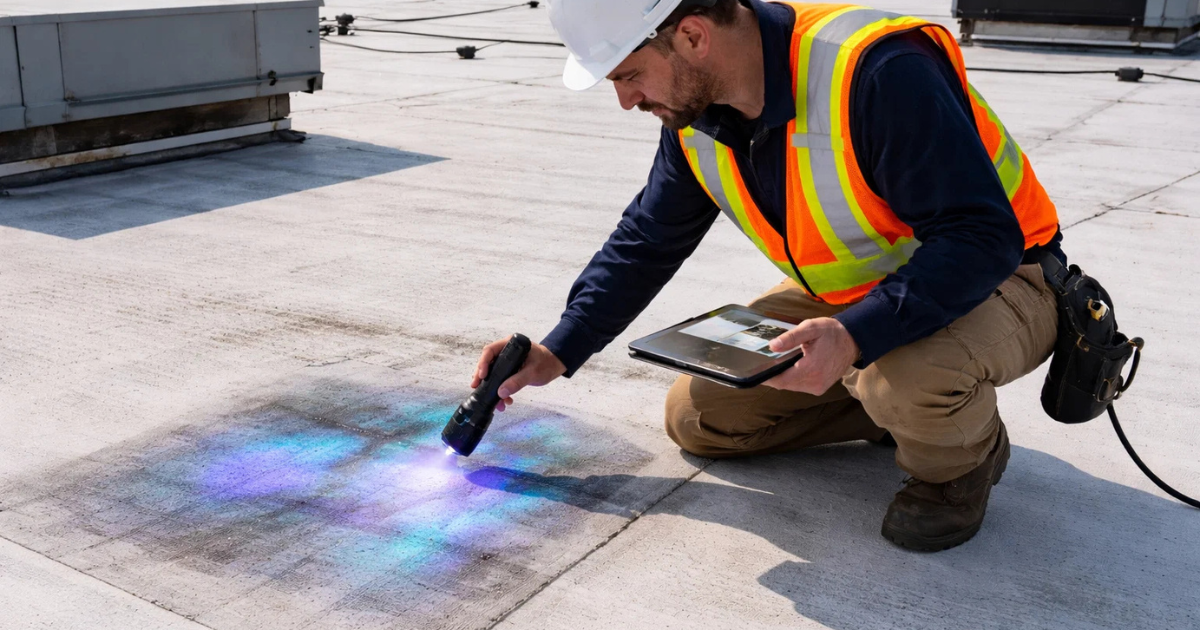
Most commercial building owners have a maintenance plan. The plan says "annual inspection." The inspection is a roofer walking the roof, checking the drains, looking at the flashings, and filing a report that says the roof is in fair condition.
What that inspection almost never includes: a UV degradation assessment. A reflectivity measurement. A plasticizer migration check at the seam edges. A membrane thickness reading at the high-UV zones, south-facing sections, areas near HVAC equipment that concentrate heat, the perimeter strip where the sun hits at low angles.
What are they actually maintaining though? Just looking at it?
The inspection protocol for most commercial roofing contractors was designed to catch active leaks and obvious damage. It was not designed to catch the slow UV degradation curve that will turn an 8-year-old roof into a 12-year-old problem. That curve is invisible to a visual inspection until it isn't, and by then, the membrane is already in the failure window.
A real UV assessment uses a reflectometer, a membrane thickness gauge at suspect zones, and a seam pull-test at representative locations. It produces numbers, not impressions. It tells you where on the degradation curve your roof actually sits, not where your warranty paperwork implies it should be.
UV Degradation FAQ
When does UV degradation begin on a commercial roof? Immediately. UV breaks molecular bonds on contact. The first year of exposure begins the chalking and polymer chain-shortening process. Degradation is slow in years one through three and accelerates as surface protection is consumed.
Does a white roof membrane resist UV better than a dark one? Yes, but not because of color alone. White membranes reflect more solar radiation, which reduces surface temperature and slows thermally accelerated UV degradation. However, reflectivity decreases as chalking removes the UV-reflective surface layer, so a white tPo membrane loses its advantage progressively over time.
What is plasticizer migration and why does it matter? Plasticizers are chemical additives that give thermoplastic membranes their flexibility. Over time, particularly under UV and thermal stress, plasticizers migrate out of the membrane into the surrounding environment. The result is embrittlement, a membrane that no longer accommodates thermal movement without cracking.
What does warranty language typically exclude regarding UV damage? Most commercial roofing warranties exclude "normal weathering," which encompasses UV degradation, chalking, reflectivity loss, and embrittlement under thermal cycling. Warranty claims for UV-driven failures are routinely reduced or denied on these grounds. Read the exclusion section before assuming coverage.
What is the highest-risk zone for UV damage on a flat commercial roof? South-facing perimeter sections, areas adjacent to HVAC equipment (which concentrate heat and elevate surface temperature), and low-slope sections where water ponds and creates UV-amplified oxidation. In Northwest Indiana's climate, 38 inches of annual precipitation plus aggressive Spring and Summer UV, these zones degrade measurably faster than the roof average.
Can a Conklin coating restore UV protection on an aging membrane? Yes, with preparation. A Conklin urethane system applied over a cleaned, primed substrate encapsulates the existing membrane and provides a fresh UV-sacrifice layer. The substrate stops aging. The system is re-coatable, meaning the UV protection layer can be renewed without removing the base coat. This is the core value proposition of a liquid-applied restoration over tear-off replacement.
At what age should a commercial roof receive a UV assessment? Year five is the ideal entry point, early enough that restoration options are fully available, late enough that real degradation data exists. Roofs in the 8 to 12 year window should be assessed immediately, as this is the highest-risk zone for UV-accelerated performance loss that has not yet generated visible leaks.
The Honest Number

A commercial roof that is UV-managed, assessed at year five, coated with a urethane system, and re-coated on a Conklin maintenance schedule, routinely reaches 25 to 30 years of total service life. The Conklin warranty on a properly applied liquid system runs up to 20 years. The FLEXION vinyl 300 system carries 300 months.
A commercial roof that is not UV-managed reaches year twelve, generates its first significant repair bill, and begins the slow negotiation with a manufacturer's warranty department about what "normal weathering" means.
The difference in cost between those two outcomes is not close. The difference in what your building's maintenance history looks like, for your own records, for your board, for your insurance carrier, for the next buyer, is also not close.
Your warranty is a floor. UV is the ceiling. What happens in between is a management decision.
✉️ Let’s put a number on your roof’s UV exposure.
If your roof is past year five and hasn't had a UV condition assessment, we want to see it before year twelve finds you first.
Subject Property Address: ___________________________
We'll take a look. FREE evaluation. NO obligation. No contractor sales pitch.
[ Email address ] → [ Send Me the Real Stuff ]
Pristine Industrial Roofing — Hammond, IN | Conklin Authorized Applicator | FLEXION Vinyl 300 Installer
Read other blog:



We Love Conversations
 SoHelpful@PristineIndustrialRoofing.com