
The Summer the Sky Lost Its Mind
One June. One region. A 165 mile per hour tornado, an 85 mile per hour wall of wind, hail off the state line, and a heat dome for dessert. Your roof stood outside for every second of it. Here is what it has not told you yet.
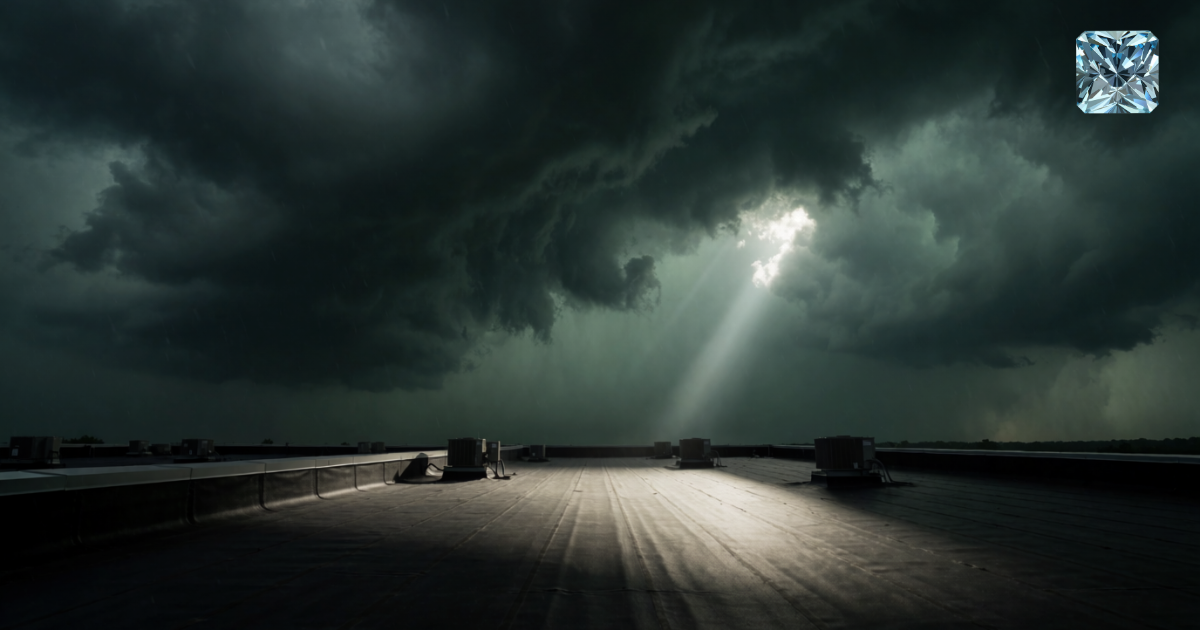
🔲 You felt this one. If your building sits anywhere across the six counties, the storms of June rolled over your roof whether you were watching or not.
🔲 The damage you can see is not the damage that costs you. The dent in the flashing is cheap. The water quietly sitting in the insulation is not.
🔲 Wet insulation stops working. Fibrous roof insulation can lose most of its thermal value once it gets soaked, and it does not dry out on its own up there.
🔲 There is a menu, not a sales pitch. Patching, liquid coating, and overlay are three different answers to three different roof conditions. You get to see all three.
🔲 One address gets you a free look. Text or scan us the address of a single property in your portfolio and we will tell you honestly what we find.
The short version.
The spring and summer of 2026 handed the six counties the most violent stretch of weather most building owners can remember. In a single week a derecho, a tornado outbreak, hail, and floods rolled through, and then a heat dome parked on top. Storms do not always leave a hole you can see from the parking lot. They leave water where it does not belong, and hidden water is the most expensive thing that can happen to a flat roof. This article walks through what actually hit, why the view from the ground lies to you, and what a building owner can do about it before the next round.
Quick Answers Before You Dig In
How bad was the weather, really?
Historically bad. Northwest counties do not normally see strong tornadoes, and June 11 produced at least fifty one tornadoes across the region, the second largest outbreak on record for the local weather office. A 165 mile per hour tornado tracked more than twenty two miles through Porter County, and an EF-2 damaged more than two hundred buildings in Merrillville and Hobart.
My roof looks fine from the ground. Am I safe?
Maybe, and that is exactly the problem. Wind lifts and reseats membrane, hail bruises a surface without opening it, and driven rain finds seams. Most storm damage on a flat roof is invisible from below and only shows up as a stain, a smell, or a power bill months later.
Do I have to tear the whole thing off?
Usually not. If the deck and most of the insulation are dry and sound, a coating or an overlay can restore the roof for a fraction of a full replacement. Tear off is the answer when the water already won. We tell you which one you are looking at.
What does a look cost me?
Nothing. Send one address, get one honest evaluation. No pressure, no theatrics.
Grab a Coffee. Let Us Walk Through It.
This was not a normal spring, and you are not imagining it.
Every year has weather. This one had a personality disorder. The rain came early and would not quit, the region logged severe weather day after severe weather day well above the normal pace, and by the time June arrived the ground was already soaked and the sky was already loaded. Then it all went off at once.
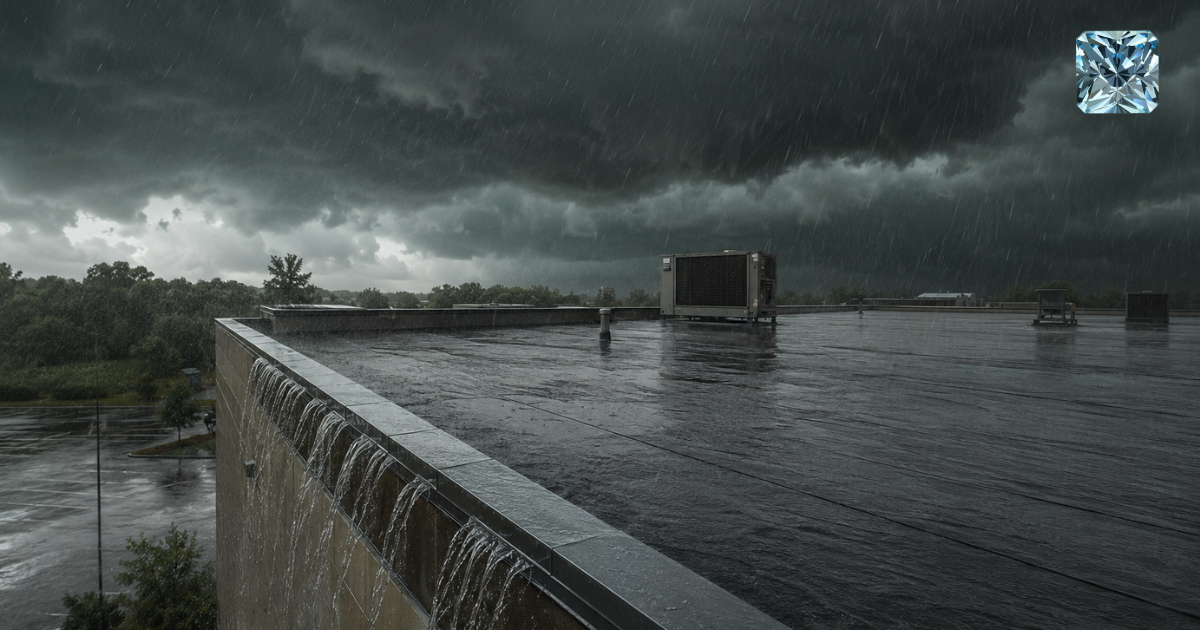
First the wind came in a straight line.
On June 10 a derecho ran across the region, a wall of straight line wind with gusts of eighty to eighty five miles per hour that stretched for hundreds of miles. More than half a million customers lost power. A derecho is not a tornado. It is worse in one way, because it does not skip. It hits everything in its path at once, and it puts uplift pressure on every roof edge and seam it crosses.
Then, the next evening, the sky opened.
June 11 produced a tornado outbreak that the local weather office ranked as the second largest in its recorded history. The strongest was an EF-3 with peak winds near 165 miles per hour that tore more than twenty two miles from near the Newton County line through Hebron and Kouts, sheared steel power line towers off at their base, and flattened a home. An EF-2 raked Merrillville and Hobart, damaged more than two hundred buildings, and tore into the roof of Andrean High School. Smaller tornadoes touched down from St. John to Schererville, at Cedar Lake, and near Schneider.
A 165 mile per hour tornado does not ask whether your warranty is current.
And the hail did its quiet work at the edges.
Through the same stretch, hail battered northern Lake County, and just across the state line stones the size of golf balls and larger fell near the Lake County line in early July. Hail rarely punches a hole in a commercial membrane. It bruises it. It fractures the surface, ages it a decade in ten minutes, and opens the door for the next rain to get underneath.

Then the heat rolled in and started cooking everything that got wet.
Right behind the storms, a heat dome settled over the region through the July 4 weekend. Highs pushed into the mid nineties and the feels like numbers ran past a hundred and ten. Here is the cruel part. Every drop of water that got trapped in a roof during the storms now sits under a surface baking well past a hundred and forty degrees, steaming, expanding, and working itself deeper into the assembly.
The View From the Ground Is Lying to You
A flat roof is the one part of your building you never actually see.
You see the lobby every day. You see the parking lot every day. The roof you see maybe once a year, from below, squinting. That blind spot is where storms do their best work, because the roof can be quietly failing for months while everything downstairs looks perfectly normal.
Bill: You own the building, so the roof is your asset and your liability at the same time. After a season like this one, an unseen roof problem is not a maintenance line item. It is a number that grows every week you do not look.
Meg: You manage the property, and you are the one who gets the call when a tenant finds a ceiling stain. A post storm evaluation is the cheapest way to stop that call before it happens.
Kenny: You keep this place running, and you already know the roof has been acting different since June. Trust that. You are usually the first person a roof tells the truth to.
The Real Villain Is Water You Cannot See
The storm is not the expensive part. The water it left behind is.
A torn corner of flashing costs a little to fix. Water that got past that flashing and soaked into the insulation costs a lot, because it does not leave. It sits between the membrane and the deck, and it does two things at once. It rots the assembly from the inside, and it destroys the one job the insulation was hired to do.
Wet insulation is barely insulation at all.
Independent testing has found that some fibrous roof insulation loses more than sixty percent of its rated thermal value once it is wet. Read that again. A soaked roof can throw away most of the insulation you already paid for, and it does it silently. You do not get a leak. You get a slightly higher power bill every single month, forever, until someone finds the water and dries the assembly out.
A storm can raise your energy bill without ever dripping on your desk.
Which is exactly where this story turns.
The storms of 2026 did not just threaten to leak. They quietly turned a lot of roofs into heat sponges right before the hottest stretch of the year, and that is a second bill entirely, the one NIPSCO sends every month. We wrote a companion piece on the heat, the surface temperatures, and the utility that has been raising rates faster than anyone in the state. If the storm was round one, the heat is round two.
See the companion article, Your Flat Roof Is a Heat Magnet, on ModernRoofChemistry.com ]
What You Can Actually Do About It
There is no one answer, because there is no one roof. Here is the menu.
1. Patching. When the damage is contained to a few spots and the rest of the roof is healthy and dry, a targeted repair stops the bleeding for a modest cost. The right first move for a roof that took a glancing blow.
2. Liquid coating. When the membrane is aged or bruised but the roof underneath is still sound, a liquid applied system seals the whole surface seamlessly, restores reflectivity, and buys many years without a tear off. No heat, no open flame, no torch.
3. Overlay. When the surface is spent but the deck and most of the insulation are dry, a new membrane goes over the old with fresh insulation added, upgrading the roof toward a full new system warranty without the cost and mess of a complete removal.
There is a fourth answer, full tear off, for roofs where the water already won. We will tell you plainly if that is where you are. We would rather lose the coating job and keep the relationship than sell you the wrong thing.
One Address. One Honest Look.
You do not have to decide anything today. You just have to point.
Pick a single commercial property in your portfolio, the one that has been nagging at the back of your mind since June, and send us the address. Scan the code on the card or text it to us. We will pull it up, take a look, and come back with a straight answer and the menu above. No high pressure, no scare tactics, no theatrics. Just a local company telling you the truth about your roof.
Text us one address: (219) 529-1995

Therefore whosoever heareth these sayings of mine, and doeth them, I will liken him unto a wise man, which built his house upon a rock: And the rain descended, and the floods came, and the winds blew, and beat upon that house; and it fell not: for it was founded upon a rock.
Matthew 7:24 and 25
Where These Numbers Come From
- National Weather Service, Chicago and Northern Indiana offices, June 11 2026 tornado outbreak summaries and storm surveys.
- NOAA Storm Prediction Center, June 2026 storm reports.
- ABC7 Chicago and WGN, Merrillville and Hobart EF-2 damage reporting.
- The Watchers and CBS Chicago, regional tornado confirmations.
- U.S. Department of Energy and independent accredited insulation testing, on thermal value loss in wet roof insulation.
- PowerOutage.us and regional utility reporting, June 10 derecho outage totals.
Read other blog:

We Love Conversations
 SoHelpful@PristineIndustrialRoofing.com