
The Band-Aid on the Black Roof And Why It Always Bubbles, A Friendly Warning to Every Kenny Out There
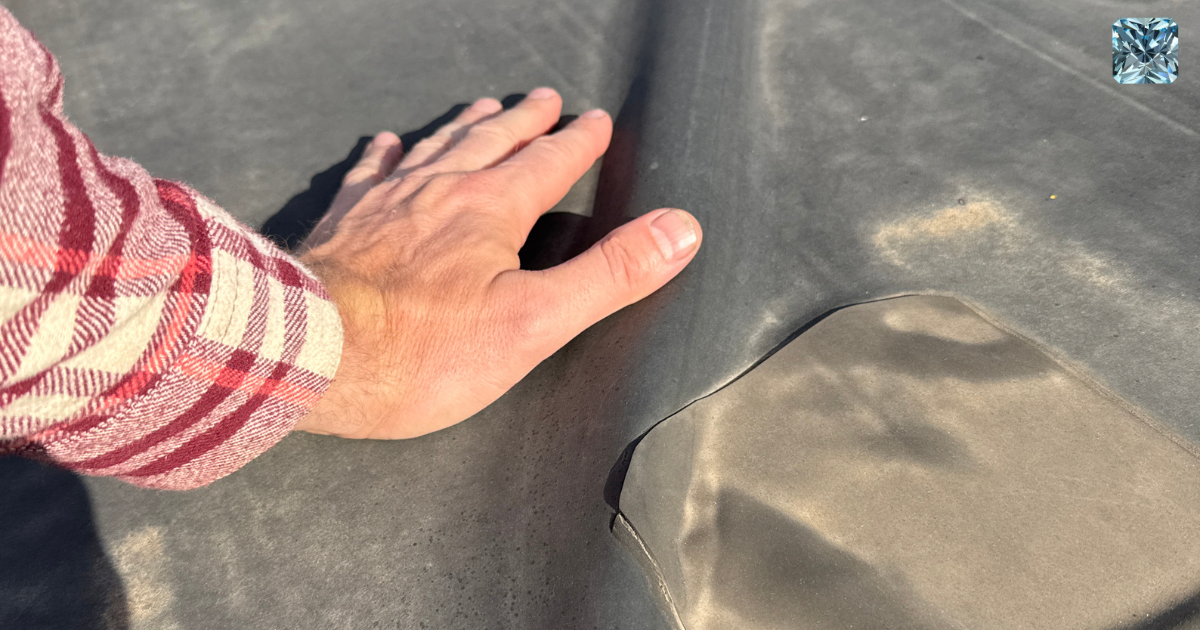
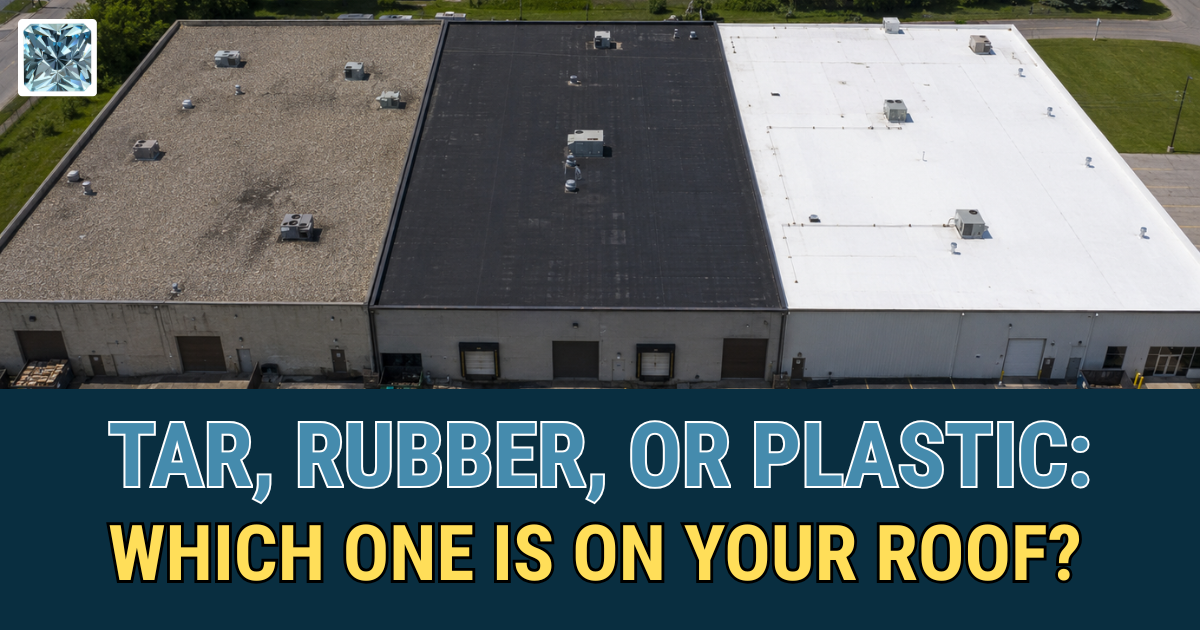
🔲 Rubber-on-Rubber Repairs Fail, It’s Chemistry, Not Kenny. Black EPDM roofs can hit 180°F in summer. At that temperature, new rubber patches trap air, bubble, and eventually crack.
🔲 You Don’t Need a Tear-Off, You Need the Right Coating System. Instead of ripping off aging EPDM, apply a three-layer liquid coating system.
🔲 White Reflective Coatings Stop the “Slow Cooker” Effect. Switching from black rubber to a white reflective surface dramatically reduces roof temperature, lowering thermal stress and potentially reducing energy costs. Less heat. Less expansion stress. Longer roof life.
Fair warning: This is an attempt at entertainment with just a little bit of education along the way. Because responsibility in business does not have to be boring. We refuse to be cardboard.
Let's talk about rubber. Not the fun kind. The kind baking alive on your commercial roof right now, slowly going brittle, peeling at the seams, and quietly plotting its retirement.
We call it Legacy Rubber. You might know it as EPDM, which sounds like a military branch or a prescription medication, but is actually short for Ethylene Propylene Diene Monomer. You're welcome. That information will never help you in a trivia game.
What it means in plain English, you've got a black rubber roof, it's probably 15 to 25 years old, it came in strips about six feet wide, and those strips are glued together at the seams. And those seams? They're the villain of this story.
"The weak spot of every rubber roof is the edge. It's always the edge."
Meet Kenny
Every building we've ever visited has a Kenny.
Kenny is the maintenance manager, the facilities coordinator, the get-it-done guy, the keeper of the supply closet, and the unofficial guardian of all things mechanical, electrical, plumbing, structural, and occasionally spiritual in a building that is somehow always older and more complicated than it looks on the outside.
Kenny has a framed certificate on his wall. It reads: Certificate of Attempting All Possible Ways to Resolve Problems. He earned it the hard way. Multiple times.
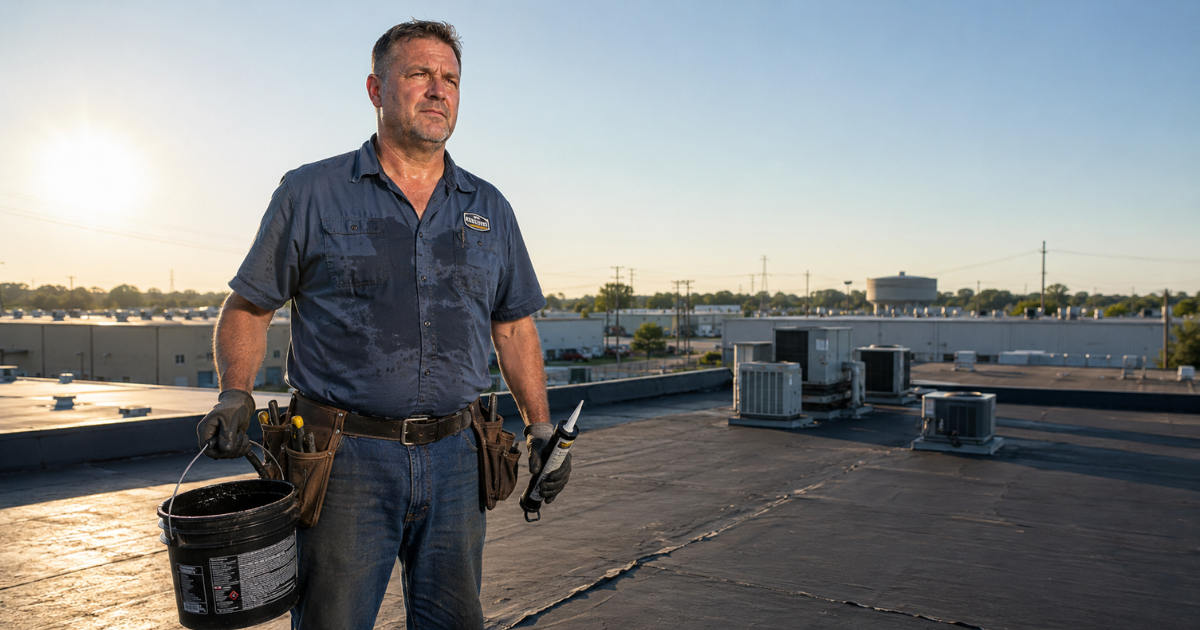
Kenny is not lazy. Kenny is not incompetent. Kenny is outnumbered. There's always something outside, something inside, something downstairs, and just a whole lot of square feet to babysit.
So when Kenny climbs up to the roof in late July, sweating through his shirt at 7 AM, and sees the rubber seams peeling back like the lid of a sardine can, he does what any reasonable, resourceful, certificate-holding professional would do.
He goes to the roofing supply store. He orders some rubber strips. He comes back with a tube of seam prep and a bucket of black goop. And he slaps a beautiful six-inch rubber band-aid right over the problem.
Kenny, buddy. We love you. We're on the same team. But we need to talk about the bubble.
The Bubble Problem
Here's what nobody tells you about putting rubber over rubber: it bubbles. Every time. Not sometimes. Every. Single. Time.
The temperature of a black rubber roof membrane in a Northwest Indiana summer hits somewhere around 180 degrees. That's not a typo. One hundred and eighty degrees. For reference, the NIPSCO sidewalk outside gets up to about 130. Your black roof beats it by fifty. You could, in theory, fry an egg up there. (We have debated this in the office. A wager has been placed. Results pending.)
"180 degrees. That's hotter than blacktop. Your roof is cooking eggs."
Now take that 180-degree surface and press a fresh rubber strip onto it with adhesive. What happens? The chemistry goes sideways. The glue activates, tries to cure, and somewhere in that heat cycle it traps air. Big air. Thick, domed, half-inch-to-one-inch bubbles that look exactly like what you tried to fix, only worse and more embarrassing.
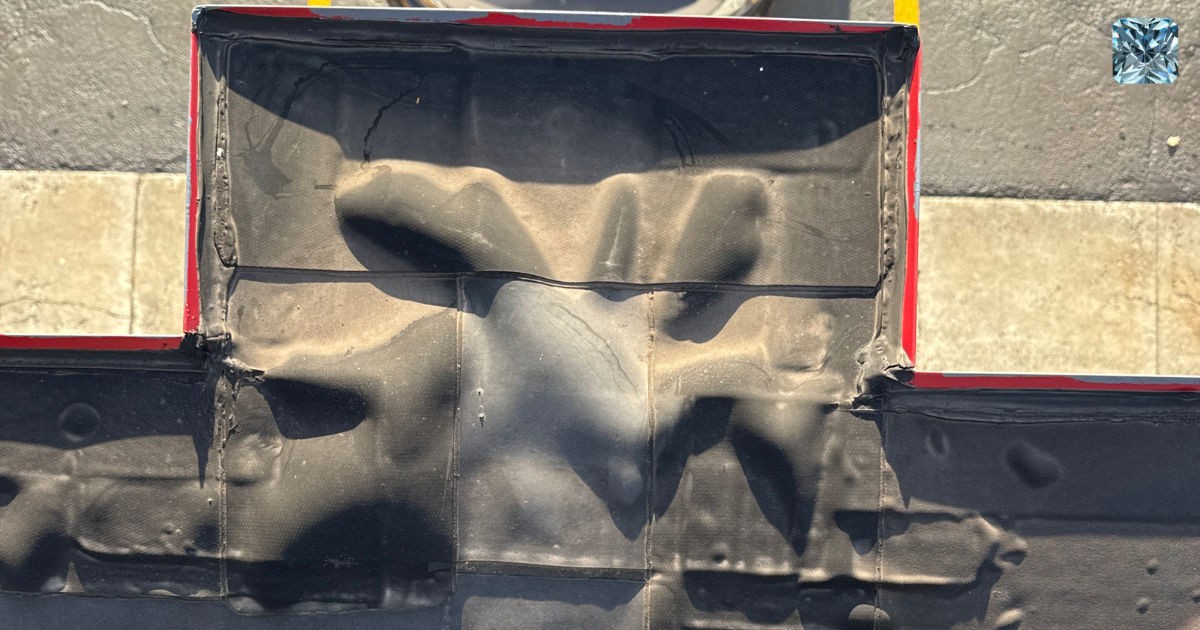
Come back a year later and those band-aids are doing their best impression of bubble wrap on a flat roof. They expand in heat. They contract in cold. They crack in the freeze-thaw cycles that Northwest Indiana specializes in. They were doomed from the chemistry, not from effort.
It is not a workmanship problem. It is a material compatibility problem. Rubber does not want to bond with rubber without specific chemistry in between, and even then the heat finds a way to introduce air. It's a law of physics. Kenny did not invent it.
The Garden Hose Comparison
You remember rubber garden hoses? The ones coiled up by the spigot at grandma's house in the country? You'd drink straight from them as a kid, get that warm rubbery mouthful of well water with a copper aftertaste, and think nothing of it because it was just Tuesday.
You can't buy that hose anymore. Not because it was bad product, but because material science moved forward. Modern hoses are reinforced mesh inside, smooth polymer outside, way more flexible, don't crack at the fittings, don't kink around corners, and they don't taste like a chemistry experiment.
The rubber hose wasn't wrong. It was just first. It did its job for its era.
EPDM is the rubber garden hose of commercial roofing. It was a legitimate advancement in its time. Installed in the 80s, 90s, and early 2000s, it did exactly what it was designed to do. Now it's 2026, it's baked through about fifteen summers, and the seams are telling you it's time.
The good news: you don't have to tear it off. You don't have to start over. You just need to stop putting rubber on rubber and start putting chemistry on rubber.
The Actual Solution
Here's how we fix the aging rubber roof without ripping everything out,
Step one: we slice the existing bubbles. Release the trapped air. Get everything flat. Yes, we literally cut them open. It feels aggressive. It is necessary.
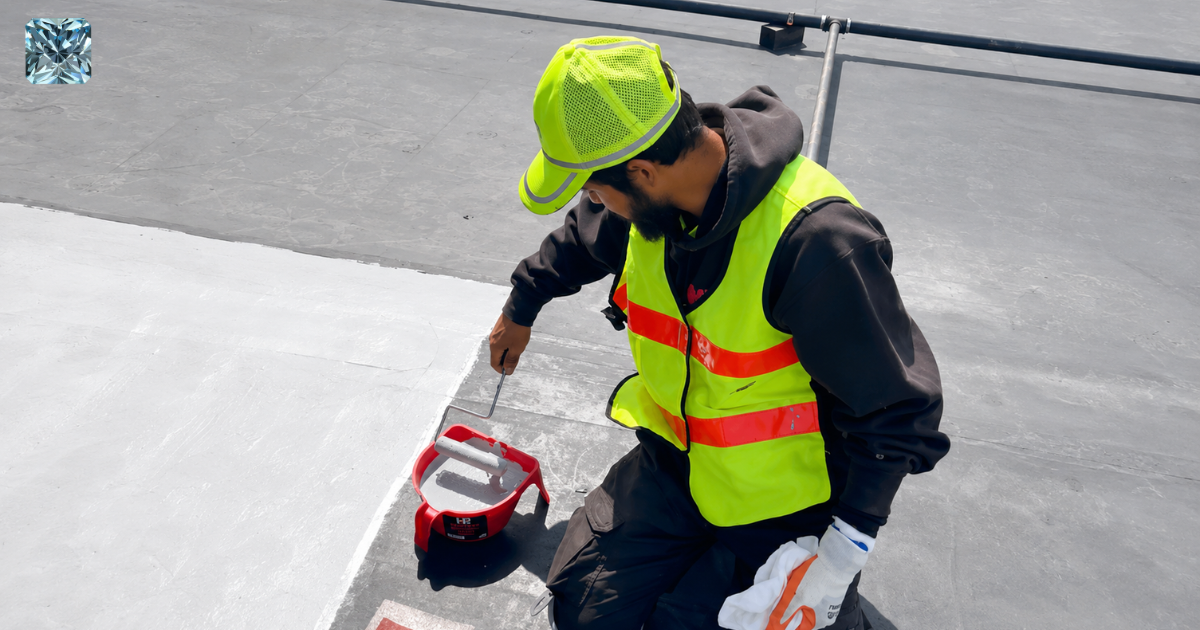
Step two: we apply a product called TACK coat. It's a thick, super-adhesive primer specifically formulated to grip rubber and give the next layers something honest to hold onto. We let that cure for a full day. You cannot rush the cure. The cure does not care about your timeline.
Step three: we apply Benchmark base coat. Battleship gray. Medium-thick acrylic. This is the middle of the sandwich, the structural layer, the muscle. Let that cure a full day.
Step four: white reflective top coat. Brilliant, bright, resilient, bouncy white. Rapid Roof III, which has been waterproofing commercial roofs since 1977. It stretches 300% of its original dimensions. Wind uplift, thermal movement, the full Northwest Indiana four-season experience. It handles it. This is the layer that stops cooking your building.
Total system thickness: approximately 20 to 22 mils. The color changes from near-black to white. The surface temperature drops dramatically. Your NIPSCO bill notices.
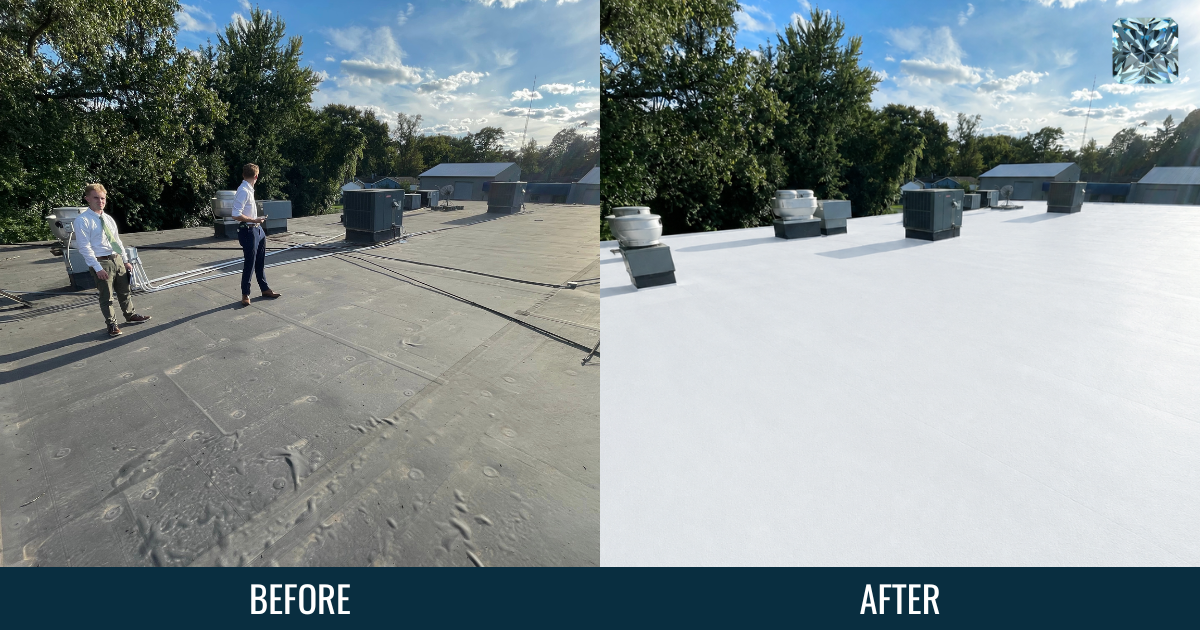
"From 180 degrees to white and reflective. Your building stops being a slow cooker."
One exception, if there's standing water on your roof, ponding that doesn't drain within 48 hours, we shift to a urethane-based system called Affinity. It's about 2.5 times the cost of acrylic, but it's engineered to handle ponding conditions long-term. We use it where we need it and only where we need it. It's still a fraction of the cost of a full tear-off and replacement.
And yes, the old rubber stays. It becomes one of the layers. We're not going backwards. We're going over the top of the past with something built for the future.
Kenny's Corner
Here's the thing about Kenny. He's not the problem. He's the hero of the building, just chronically undersupplied and working with material combinations that weren't designed to work together.
We actually partner with Kenny. We stock his warehouse with wholesale touch-up buckets. When a small area needs attention between visits, Kenny's got the right material to do it correctly. Same chemistry. No more band-aids that bubble.
Kenny doesn't need to be replaced. He needs better material and a roofing partner who's on his side.
We are that partner.
5 Things to Remember Two Weeks From Now
1. Black rubber roofs hit 180 degrees in summer. That's hotter than the parking lot. It's cooking your building from the top down.
2. Rubber does not bond to rubber in those heat conditions. Every band-aid you've seen bubble has this same root cause.
3. The fix is a three-layer liquid coating system: TACK primer, acrylic base, white reflective top coat.
4. The old rubber stays. You're not tearing anything out. You're upgrading over what's already there.
5. The one number to remember: 300%. That's how much the top coat stretches. It doesn't crack. It moves with your building.

Read other blog:


We Love Conversations
 SoHelpful@PristineIndustrialRoofing.com