
Tapered Insulation vs. Flat Roof Decks: The Core Engineering Choice Behind Every Commercial Roof
"It's basically flat" is not an engineering specification. Your current roofer measured nothing. Ordered flat. Called it a day. You're still paying for that meeting.
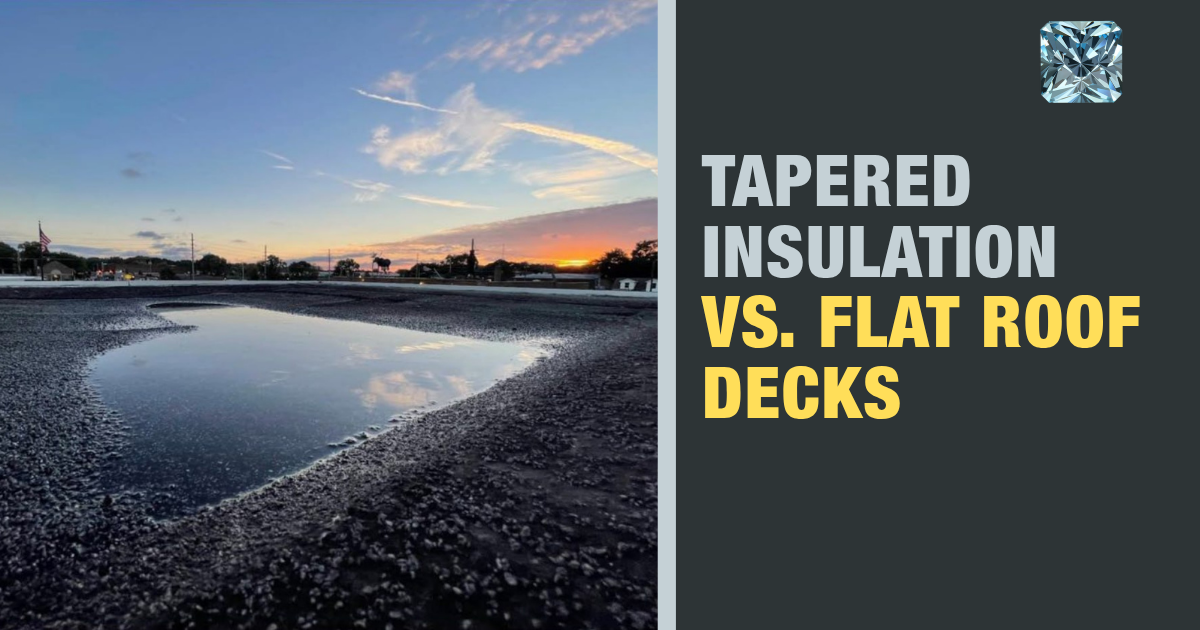
🔲 “Flat” roofs aren’t actually flat and shouldn’t be. Commercial roofs require a minimum slope (typically ¼ inch per foot) to properly drain water. A truly flat roof leads to ponding, which accelerates damage and shortens the roof’s lifespan.
🔲 Tapered insulation is the critical (and often skipped) solution. Instead of modifying the structural deck, tapered insulation creates slope using angled boards. It’s the standard, cost-effective method for proper drainage, yet many contractors skip it to cut costs.
🔲 The 2 to 3 foot perimeter zone is where most failures start. Poor taper design often causes water to collect near the roof edge. This leads to membrane breakdown, insulation saturation, fastener corrosion, and parapet damage, usually within a few years.
🔲 Skipping taper saves thousands upfront, but costs tens of thousands later. Tapered insulation may add $6K to $16K to a project, but poor drainage can trigger early roof replacement costing $90K+. The real risk isn’t installation, it’s the engineering decision made at the start.
Every flat roof is a promise to move water off the building. Some roofs keep that promise. Most don't, and the ones that don't usually failed at the engineering stage, not the installation stage.
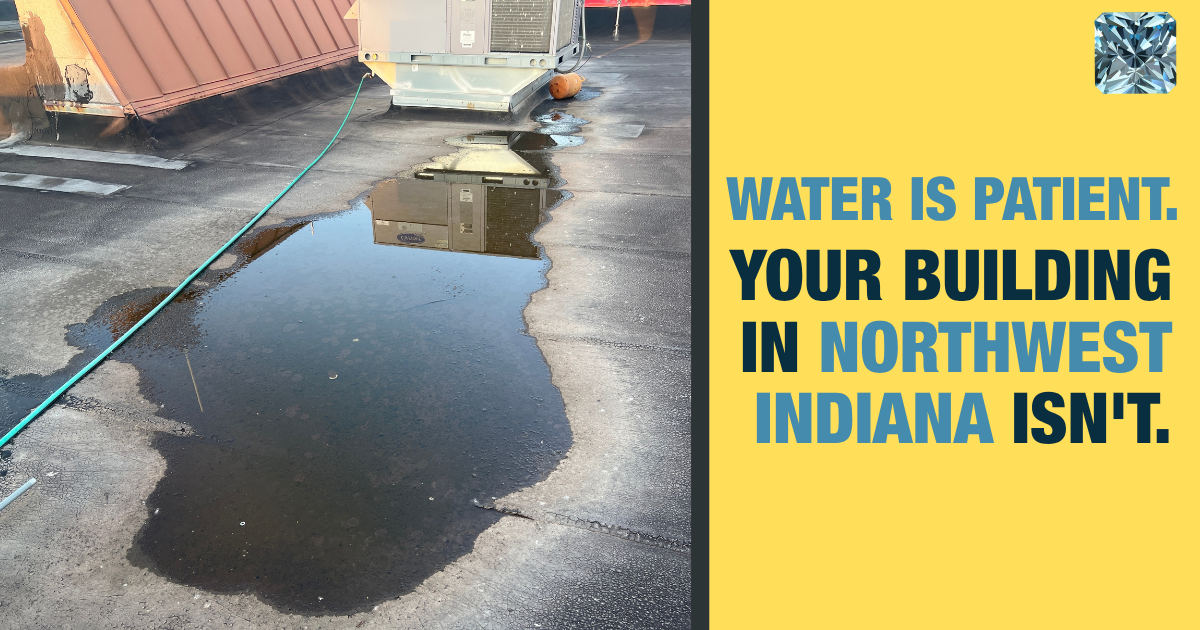
That distinction matters because it changes who is responsible. If your roof is ponding, and it has been ponding since year one, your original contractor made a decision, or avoided making one, that you are now paying for. The insulation wasn't tapered. The deck wasn't engineered for slope. Water sits, UV and freeze-thaw cycles do their work on the membrane, and the damage begins.
This is the article that explains why. What tapered insulation actually is, what it costs you to skip it, and why the 2-3 foot gutter line is the specific place where most roofs are quietly failing right now.
What "Flat" Actually Means? Why the Name Is a Lie

Commercial roofs are not flat. They shouldn't be flat. A truly flat roof is a water collection system. Code requires a minimum slope of ¼ inch per foot on most low-slope assemblies, that's not aggressive, but it is enough to keep water moving toward drains or scuppers rather than pooling in the center.
The problem is that a new concrete or steel deck is flat. It comes off the structural drawings flat. Getting slope into that assembly is a separate engineering decision that has to happen before the membrane goes down.
There are two ways to create slope on a commercial roof.
Option 1: Taper it into the structural deck. The concrete is poured or the steel is framed with the slope already built in. This works. It is also expensive, structural in nature, and not retroactively possible without a full re-deck.
Option 2: Taper it into the insulation. Insulation boards are manufactured or cut in wedge profiles, thicker at the high point, thinner at the drain. Stack them correctly and you create slope across the surface of the insulation without touching the deck below. This is the standard approach on most re-roof projects.
Option 2 is what most commercial roofs should have, and what most don't.
The Engineering Behind Taper Insulation
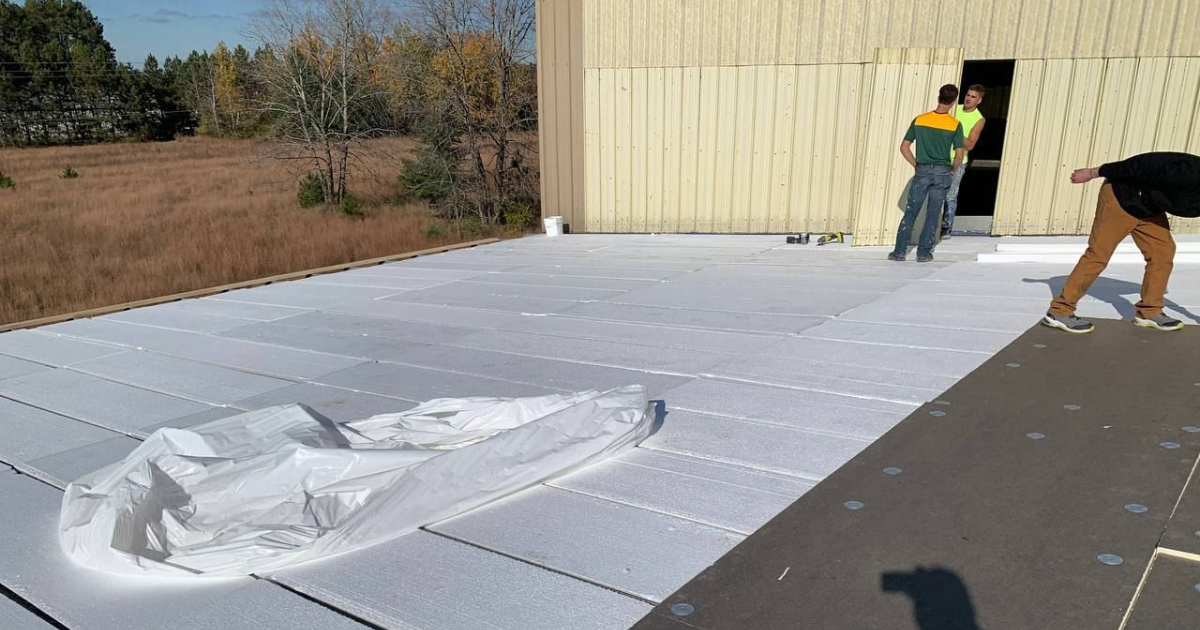
Tapered insulation systems are not complicated, but they require actual layout design. You can't order boards and figure it out on the roof. A proper taper system starts with a drain location map, where the drains are, how many, and what the tributary area of each drain looks like.
From there, an insulation layout is built that,
- Starts at the drain at its minimum thickness (typically ½ inch)
- Rises at a calibrated rate per foot (¼" per foot is the minimum, 3/16" is used on longer runs)
- Accounts for saddles, crickets, and transitions between sections
- Keeps the high point at a thickness that satisfies the thermal R-value requirements
On a simple square roof with a center drain, this is a straightforward four-quadrant taper that any competent supplier can design. On a complex roof with multiple drains, offset sections, curbs, and equipment penetrations, it requires real engineering, isometric drawings, board-by-board layouts, and phased installation.
Most contractors don't do this work. They order flat insulation, mechanically fasten it, and hand the membrane crew a flat substrate. The roof looks fine from the street. The water finds the low spots and stays there.
The 2-3 Foot Gutter Line Problem

Here is the specific failure most common on commercial flat roofs: the perimeter zone, roughly 2 to 3 feet from the edge, where insulation ends and the parapet or edge detail begins.
This zone is where water collects. It is also where the insulation is thinnest, or, more accurately, where the taper should be running away from but often isn't.
On an improperly designed system, the roof surface actually slopes toward the perimeter because the taper runs from the center outward without a compensating edge rise. Water migrates to the edge, sits in a perimeter channel, and stands there through every rain cycle.
The consequences are specific,
- Membrane degradation: Standing water in this zone softens adhesives, works under lap seams, and creates UV-amplified oxidation on the surface. The perimeter sees more abuse than any other section of the roof.
- Insulation saturation: Wet insulation is not insulation. A 2-inch polyiso board soaked with water has an effective R-value that approaches zero. That perimeter strip is costing you heating and cooling year-round.
- Fastener corrosion: Mechanical fasteners near the edge, sitting in pooled water, corrode. That's a membrane attachment failure waiting to happen.
- Parapet and wall damage: Water that stands at the base of a parapet works through cracks, migrates into masonry, and creates freeze-thaw spalling that looks like a structural problem but started with drainage geometry.
None of this is dramatic. It happens slowly, invisibly, and expensively. The repair bill arrives 3-5 years after the installation decision that caused it.
Cost vs. Benefit: What Taper Insulation Actually Adds
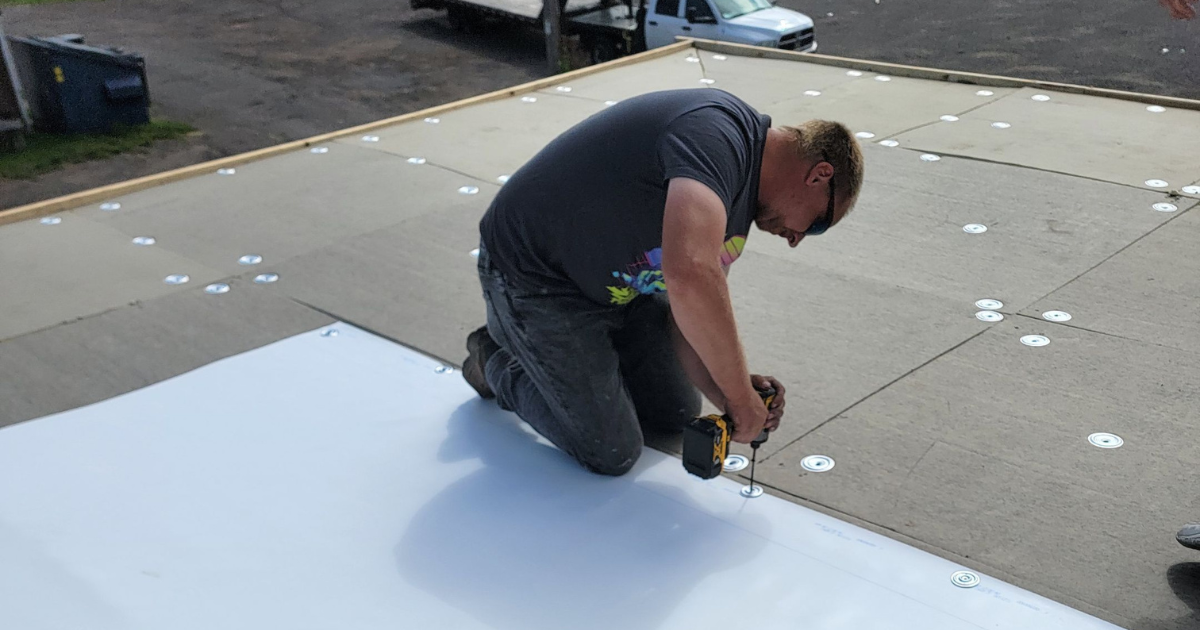
The most common reason taper insulation gets skipped is cost. It is more expensive than flat insulation. Let's put real numbers on what "more expensive" means.
On a 20,000 square foot commercial roof, a properly engineered tapered insulation system typically adds $0.30 to $0.80 per square foot over flat insulation at equivalent R-value. On that roof, that's $6,000 to $16,000 in additional upfront cost.
Here is what that buys,
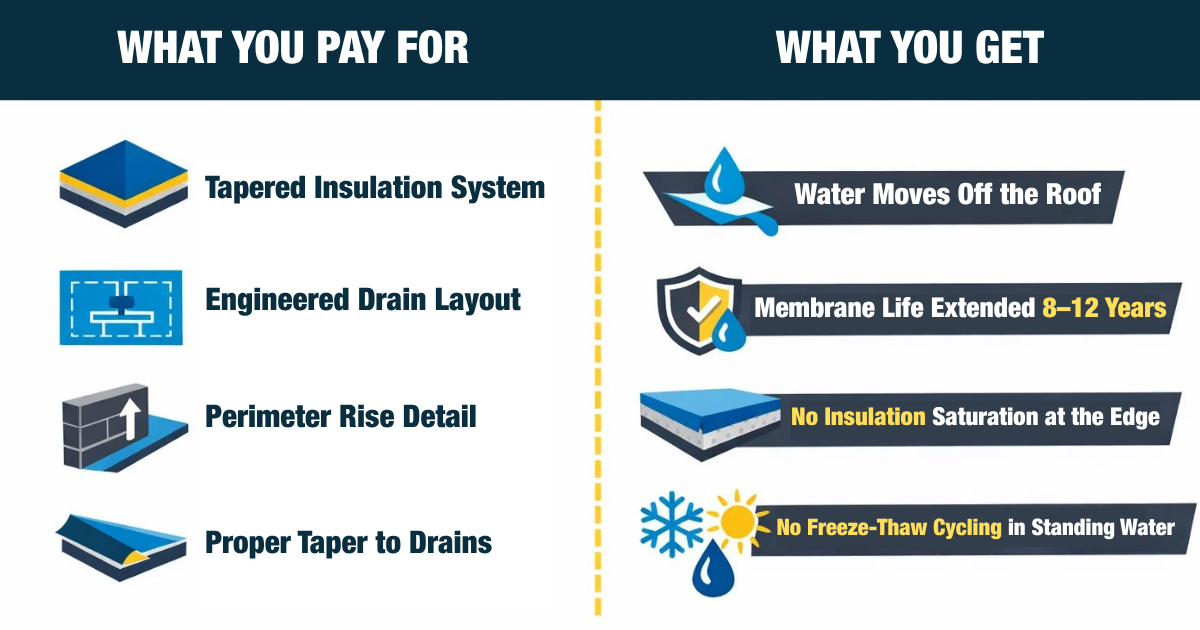
Now look at what you avoid,
A membrane replacement on a 20,000 sq ft roof runs $4.50 to $8.00 per square foot. Call it $90,000 to $160,000. If poor drainage cuts membrane life from 20 years to 11 years, you're funding a $90,000+ project 9 years early. That is not a worst-case scenario. That is the statistical outcome for commercial roofs with chronic ponding.
The taper insulation pays for itself in avoided early replacement. That's before accounting for the energy penalty from saturated perimeter insulation and the liability exposure from water intrusion.
Where the Decision Gets Made And Where It Gets Lost

The engineering decision about taper insulation happens, or should happen, at the proposal stage. A contractor who is not asking about your drain locations, your current ponding zones, and your deck slope is not scoping the job correctly. They are scoping it cheaply.
This is the conversation that separates a roofing contractor from a roofing engineer. The difference is not license or title. It's whether anyone stood on your roof with a level, looked at the drain locations, and built a drainage plan before the insulation order went in.
Most building owners don't know to ask for this. Most property managers can't demand it because they don't have the vocabulary. That's why roofs get installed flat and nobody discovers the problem until the ceiling tile is wet.
✉️ Is your roof draining or just sitting?
If you've noticed standing water after a rain, soft spots at the perimeter, or insulation that feels spongy near the edge, the engineering decision may have already been made for you.
Subject Property Address: ___________________________
Drop the address and we'll take a look. We’ll send you a FREE drainage assessment. NO obligation.
[ Email address ] → [ Send Me the Real Stuff ]
Conklin Systems and the Taper Question

When we install a Conklin liquid-applied coating system on a commercial roof, we are applying a seamless, spray-applied coating over the existing substrate. Conklin's acrylic and urethane systems are exceptional at encapsulating an existing membrane and adding 10-20 years of service life, but they are not drainage engineers. A Conklin coating over a ponding roof is a better-protected ponding roof.
This is why our pre-installation assessment always includes drainage. If the existing roof has active ponding zones, we address the taper before the coating goes down. In some cases, that means installing tapered crickets or saddles over the existing insulation. In others, it means a targeted insulation replacement at the drain field before the coating application.
The coating is the last step, not the fix.
Tapered Insulation FAQ
What is tapered insulation on a commercial roof? Tapered insulation is a system of insulation boards manufactured or cut in wedge profiles, thicker at the high point, thinner at the drain, to create a positive slope across a flat or low-slope roof deck without modifying the structural deck below.
How much slope does a commercial flat roof need? Building code requires a minimum of ¼ inch per foot on most low-slope commercial roof assemblies. A properly engineered taper system achieves this across the full tributary area of each drain.
What does ponding water actually do to a flat roof? Standing water accelerates UV degradation, softens membrane adhesives, works under lap seams, saturates insulation (destroying R-value), corrodes mechanical fasteners, and creates freeze-thaw cycling that damages both the membrane and adjacent masonry. Ponding that persists for more than 48 hours after a rain event is a code-defined defect on most assemblies.
Is taper insulation required on a commercial re-roof? Most jurisdictions require that re-roofing projects achieve the minimum ¼" per foot slope. How you achieve it, deck modification vs. tapered insulation, depends on the project. Tapered insulation is the standard approach for re-roof work because it doesn't require structural changes.
What is the 2 to 3 foot gutter line problem? The 2 to 3 foot perimeter zone is where water most commonly collects on improperly designed flat roofs. When taper runs from center to edge without a compensating perimeter rise, water pools against the parapet or edge detail. This zone sees accelerated membrane wear, insulation saturation, and fastener corrosion.
Can a Conklin coating fix a drainage problem? No. A liquid-applied coating system like Conklin's encapsulates and protects the existing membrane, it does not correct slope or drainage. Active ponding zones must be addressed before coating application, typically through tapered crickets, saddles, or targeted insulation replacement.
How much does tapered insulation add to a re-roof project? On most commercial re-roof projects in the Hammond, Portage, and Merrillville area, a properly engineered tapered insulation system adds approximately $0.30 to $0.80 per square foot over flat insulation at equivalent R-value. On a 20,000 square foot roof, that's $6,000 to $16,000, a fraction of the cost of an early membrane replacement driven by chronic drainage failure.
What is a taper insulation layout and who designs it? A taper layout is a board-by-board engineered drawing showing insulation board placement, thickness transitions, drain field geometry, and high-point locations. It should be produced by the insulation supplier or roofing contractor before any material is ordered. If your contractor isn't presenting one, ask why.
What This Roof Needs
Every commercial roof is making a choice about water. The best roofs move it. The most common roofs collect it. The difference, in most cases, is a decision made at the proposal stage about whether to engineer the drainage or skip it.
Tapered insulation is not exotic technology. It is standard practice that has been skipped for decades on commercial buildings across Northwest Indiana because it costs a little more upfront and the consequences take years to appear. By the time the building owner sees a problem, the contractor is long gone.
Pristine's job is to show up before the problem, catch what was missed, and install systems that still work in 20 years. That means taper. It means drain layout. It means asking the questions that most contractors don't ask because asking them costs time.
If your roof has standing water, even a little, even just after heavy rain, that is information. It is telling you what was not done when the roof was installed. The question now is whether you act on it before the membrane does.
✉️ If you have a commercial property with drainage questions, flat spots, or a coating that was applied over an existing ponding problem, we want to see it.
Subject Property Address: ___________________________
Drop the address and we'll take a look. We’ll send you a FREE drainage assessment. NO obligation. No friction.
[ Email address ] → [ Send Me the Real Stuff ]
Pristine Industrial Roofing — Hammond, IN | Conklin Authorized Applicator | FLEXION Vinyl 300 Installer
Read other blog:
We Love Conversations
 SoHelpful@PristineIndustrialRoofing.com