
Solving Ponding Water Problems on Commercial Flat Roofs: Engineering vs. Band-Aid Fixes
And the roofer who told you "a little standing water is normal" just talked you into a replacement you didn't need yet, or one you'll need way sooner than you should.
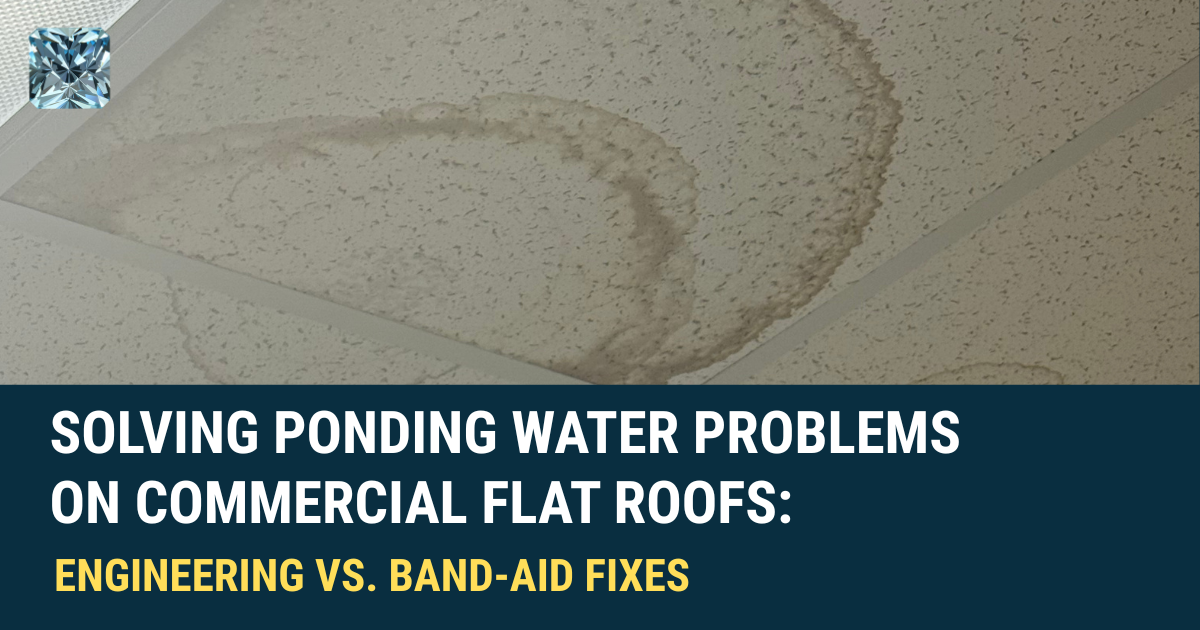
🔲 Ponding Isn’t Normal. Water sitting longer than 48 hours signals a slope or insulation failure, not just a “flat roof thing.”
🔲 The Damage Is Quiet but Costly. Standing water adds weight, compresses insulation, weakens seams, and shortens roof life long before leaks appear.
🔲 Replacement Isn’t the Only Option. Engineered fixes like localized leveling, taper insulation, and reinforced coatings restore drainage without tearing off a viable roof.
🔲 Most Roofers Don’t Engineer Drainage. Proper re-sloping takes design work. Many skip it, and you pay for it later.
Somewhere on your roof right now, there is a puddle. It has been there for 72 hours. It is not evaporating. It is not draining. It is just sitting there, doing slow, expensive, invisible damage to the insulation underneath it while you sign checks for other things.
Your current roofer looked at it last Spring and said something along the lines of "yeah, flat roofs do that." He said it with confidence. He said it like a man who has been saying it for twenty years without anyone pushing back.
Nobody pushed back.
Here is what he did not say: ponding water on a flat roof is not a weather event. It is a structural failure. It is your roof telling you that something underneath it has moved, compressed, or was never right to begin with. The water is the symptom. The insulation is usually the problem. And the fix is not caulk.
Let's talk about what is actually happening under those puddles, and what you can do about it that does not involve replacing a roof that still has years left in it.
Why Flat Roofs Pond in the First Place
A flat roof is not actually flat. If it were perfectly flat, every drop of rain that ever landed on it would stay there forever. What you have, or what you are supposed to have, is a rooftop with a minimum quarter-inch-per-foot slope toward drain points, scuppers, or gutters.
When that slope disappears, water pools. The question is why the slope disappeared.
Three reasons. Pick your adventure.
Reason one: It was never there. Some buildings, particularly those built in an era when roofing codes were more of a suggestion, were put up with inadequate slope from day one. The installer eyeballed it. The inspector was having a long week. The building owner never got on the roof. Twenty years later, you bought it, and the ponding was baked in before you signed the papers.
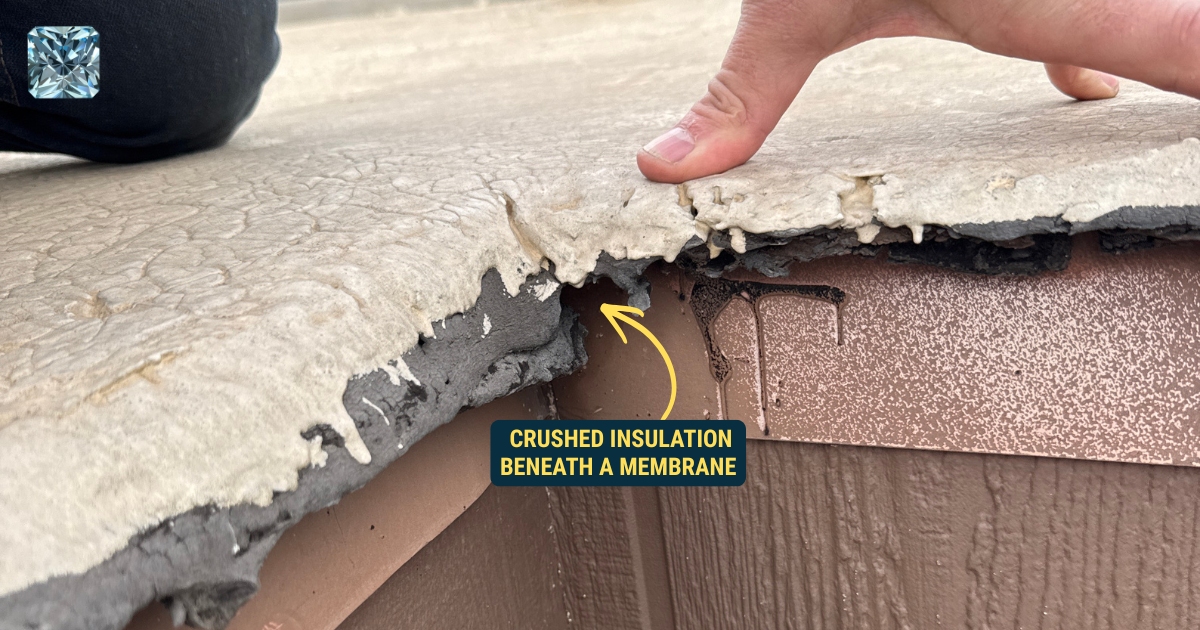
Reason two: Insulation compression. This is the one that gets people. Commercial flat roofs have insulation boards layered beneath the membrane. Over years, sometimes over just a few hard Indiana winters, those boards compress. They compact under foot traffic, under equipment weight, under the simple physics of a few inches of wet snow sitting on them repeatedly. When the board compresses, the surface above it drops. And that two-to-three-foot zone along the gutter line, the low point where water already wants to go, compresses the fastest. The slope that existed on install day quietly disappears.
Reason three: Structural movement. The deck itself shifts. HVAC equipment gets added or repositioned. Building sections settle unevenly. None of this is dramatic. None of it happens overnight. But the roof surface moves with the structure, and when the structure moves in the wrong direction, water finds a new home.
The common denominator in all three cases is this: the water is not the problem. The geometry is the problem. Treating the symptom, sealing the membrane around the puddle, does nothing for the geometry. The puddle comes back. Every single time.
What Ponding Water Actually Does to Your Building

Before we get to solutions, let's spend thirty seconds on consequences. Not to scare you. To clarify what you are choosing between.
Water weighs 8.34 pounds per gallon. A modest ponding area, say, ten feet by twelve feet, two inches deep, is sitting on your roof at just over 1,000 pounds. Every rain event. The insulation underneath is compressing further. The slope is getting worse. The puddle is getting larger. The weight is increasing.
Meanwhile, any membrane seam within that pond is under constant hydrostatic pressure. The membrane was designed to shed water, not to contain it. Seams that would have lasted another decade in a normal drainage environment begin to fail in three to five years under standing water.
Underneath the insulation, vapor is moving. Moisture finds its way through failed seams into the insulation layer, into the deck, and eventually into the building interior. By the time you see a ceiling stain, the insulation has been wet for months. Wet insulation has roughly the thermal performance of a wet newspaper. Your HVAC system is working harder. Your utility bills are climbing. And none of your team connects it to the puddle on the roof because nobody is thinking about it that way.
The roofer who told you a little standing water is normal? He did not mention any of this.
The Solutions Tier, From Elegant to Absolutely Nuclear

Here is where most roofing articles stop being useful. They describe the problem at length, then vaguely gesture at "solutions" before pivoting to a phone number. We are going to actually tell you what the options are, what each one costs in rough terms, and who it is right for.
Tier One: Pond-Be-Gone Rooftop Leveler
This is the newest tool in the kit and the one most roofers have never heard of because most roofers stopped reading trade journals sometime during the Obama administration.
Pond-Be-Gone is a rooftop leveling compound. It is applied directly into the depression, the low spot where water collects, and it bonds molecularly to the existing substrate. It self-levels. It fills the void. It effectively raises the floor of the puddle area so water has somewhere to go again.
This is not a patch. It is not foam from a can. It is an engineered leveling system designed specifically for this application, and when applied correctly over a substrate in otherwise acceptable condition, it restores drainage geometry without tearing off the roof.
Who is this right for? A building owner with a localized ponding problem, one or two zones, on a roof that is otherwise performing. The membrane is intact, the insulation is serviceable in most areas, and the ponding is a geometry problem more than a systemic failure. Pond-Be-Gone addresses the geometry. Add urethane reinforcement under and around the treated area for waterproofing integrity, and you have a complete solution at a fraction of replacement cost.
Tier Two: Taper Insulation Systems

Taper insulation has been around for roughly the last decade in meaningful commercial use, and it remains the solution that most building owners have never been offered because it requires the roofer to actually engineer the roof rather than just cover it.
Here is the concept. Instead of installing insulation boards of uniform thickness across the entire roof deck, a taper system uses boards of varying thickness, cut and arranged so that the thickest boards are at the high points and the thinnest are at the drains. The result is a built-in slope, manufactured into the insulation layer itself, that directs water exactly where it needs to go regardless of what the deck beneath it is doing.
Taper insulation is typically installed during a recovery or replacement, though it can be incorporated into a partial teardown of problem zones. It is more expensive than flat insulation. Considerably more expensive. The design requires actual engineering, drain locations, slope calculations, board layout. Most roofers will not offer it because it takes time to spec and requires a level of product knowledge they do not have. Their quote is simpler without it. So they leave it off the table.
The irony is that building owners who spend the extra money on taper insulation stop having ponding conversations entirely. The roof drains. That is what it was supposed to do the whole time.
Tier Three: Urethane Reinforcement for Active Pond Areas

Regardless of which solution addresses the geometry, any area that has been ponding needs waterproofing reinforcement underneath. This is where urethane systems earn their place.
Urethane is a fluid-applied coating that penetrates, seals, and reinforces the substrate beneath a problem area. It is not a surface treatment. Applied under a repaired or re-leveled zone, it provides a waterproofing layer that protects the deck from moisture that has already been working its way through for years. Think of it as the last line of defense between your deck and your ceiling.
This is also where Conklin's liquid systems are relevant. Conklin coatings applied over a properly prepped and re-sloped surface extend the life of the existing membrane, add reflectivity, and create a seamless waterproofing layer that handles what the original system no longer can. The Conklin system does not require a tear-off in most cases. The roof stays. The problems get addressed. The clock resets.
Tier Four: Re-Sloping with Full Engineering

Sometimes the problem is systemic enough that you need to go back to first principles. The entire roof is a drainage problem. Multiple zones are ponding. The insulation is compromised across large areas. The deck has moved.
In this case, re-sloping with a proper engineered drainage plan is the honest answer. New drains. New drain placement. A full taper insulation system. A Conklin liquid coating or FLEXION vinyl 300 membrane over the top, depending on the substrate and what the engineering calls for. This is not cheap. It is also not a replacement. The deck stays. The structure stays. What you are buying is a roof that was designed correctly the second time, by someone who actually ran the calculations.
✉️ Is there a roof in your portfolio sitting on a drainage problem right now?
Subject Property Address: ___________________________
Drop it here. We will take a look, tell you what we see, and give you an honest picture of what tier of solution makes sense before it becomes a ceiling stain conversation.
No pitch deck. No pressure. Just someone who actually knows what they are looking at.
[ Email address ] → [ Send Me the Real Stuff ]
Why Your Current Roofer Hasn't Offered You Any of This

There are a few reasons, and none of them are flattering.
The first is economics. A taper insulation system takes longer to design and longer to install. A Pond-Be-Gone application requires a trained hand and product knowledge. Re-sloping with engineering requires actual engineering. None of this fits cleanly into the "show up, roll it out, collect the check" model that drives most commercial roofing operations. The simpler the job, the faster the truck turns.
The second is product familiarity. Most commercial roofers work with two or three systems their whole career. They install what they were trained on. If taper insulation was not in their training, it does not exist in their proposals. They are not hiding it from you. They genuinely do not think of it as an option.
The third reason is the most uncomfortable one. A roofer who solves your ponding problem with a $28,000 re-slope and a Conklin coating does not get to sell you a $180,000 replacement in three years when the ponding has finally destroyed the deck. The problem-solving approach and the replacement approach are not equally profitable. The math is obvious once you see it.
Superior menu options exist.
The Proof Is in the Drainage
Here is the test. After a rainfall of one inch or more, get someone on your roof within 48 hours. Document where water is standing. Note the dimensions. Note the depth. Take photos with a timestamp.
If water is still present at 48 hours, you have a ponding problem by any reasonable definition, including most warranty terms and most insurance carrier interpretations. That documentation matters. Because when the day comes that you need to make a claim on moisture damage, the carrier will want to know what you knew and when you knew it. Documented ponding with no documented corrective action is a claim denial waiting to happen.
The same documentation, when you do address it, becomes your proof that the problem was identified and resolved. It is your paper trail. Build it now, regardless of where you land on solutions.
Flat Roof Ponding, Engineering, and Your Options
Q: How long can water pond on a flat roof before it causes damage?
A: Most industry standards consider water standing longer than 48 hours after rainfall to be a ponding problem. Membrane seam failure, insulation compression, and deck deterioration all accelerate significantly under sustained standing water. Eighteen months of ignored ponding can turn a $22,000 re-slope into a $140,000 replacement.
Q: Is ponding water covered by commercial roof warranties?
A: Usually not. Most membrane warranties explicitly exclude damage caused by inadequate drainage or standing water. If your roof ponds and you have a warranty, read the exclusions before assuming you are covered.
Q: What is taper insulation and why doesn't my roofer use it?
A: Taper insulation uses boards of varying thickness to create a built-in slope toward drains. It requires design time, engineering knowledge, and product-specific training. Most commercial roofers default to flat insulation because it is simpler to install and quote. The result is that the drainage problem is never engineered out of the system.
Q: Can a Conklin coating fix ponding water?
A: A coating addresses the membrane surface. It does not fix the geometry underneath. If the slope is wrong, a coating will seal over a puddle that will continue to grow. The correct sequence is, fix the geometry first, with taper insulation, Pond-Be-Gone, or re-sloping, then apply the Conklin coating over a properly draining surface.
Q: What is Pond-Be-Gone?
A: It is a molecular-bonding rooftop leveling compound applied directly into low spots on commercial flat roofs. It self-levels, bonds to the substrate, and restores the slope geometry without requiring a tear-off or full replacement. It is one of the most underused tools in commercial roofing and one of the most effective for localized ponding problems.
Q: How do I know if my ponding is a geometry problem or a membrane problem?
A: Geometry problem: the water ponds in the same place every time, the membrane in the area is otherwise intact, and there are no active leaks in the interior below the pond. Membrane problem: you are seeing interior staining, the membrane shows cracking or seam separation within or near the pond, and the insulation is visibly wet when probed. Most ponding situations are geometry problems with a membrane problem developing on a timer.
What Pristine Does Differently Here
We do not have one answer for ponding. We have a process.
We get on the roof. We document where the water is sitting and why. We look at the insulation condition in the pond zone. We look at drain locations relative to the low points. We assess whether the geometry can be corrected short of replacement and what the corrected geometry needs to perform for the next decade.
Then we tell you what tier of solution fits your building, honestly, and we build a proposal around it. Sometimes that is a Pond-Be-Gone application with a Conklin coating over the top. Sometimes it is a taper insulation system on a re-cover. Sometimes it is a full engineered re-slope with FLEXION vinyl 300 on top for 25 years of documented warranty protection.
We are not going to hand you a replacement quote on a building that does not need one. We are also not going to sell you a band-aid on a building that has earned an honest solution.
The difference is the engineering. The difference is knowing what the options are before you walk up to the building.
The puddle is not going anywhere on its own. The insulation underneath it is compressing right now. The membrane seams are under pressure that they were not designed to handle.
The roofer who told you flat roofs do that is still out there telling somebody else the same thing today. He is busy. He is not wrong that it happens. He just left out the part where it did not have to.
✉️ You read this far because there is a building you are thinking about. You know which one.
Subject Property Address: ___________________________
[ Email address ] → [ Send Me the Real Stuff ]
Pristine Industrial Roofing — Serving commercial and industrial property owners across Lake County and Porter County.
Liquid-applied Conklin coating systems. FLEXION vinyl membranes. Proactive maintenance programs.
Valparaiso | Hammond | Portage | Merrillville | Hobart | Gary
Read other blog:



We Love Conversations
 SoHelpful@PristineIndustrialRoofing.com