
Commercial Roof Welding Safety | Because Falling + Fire Is a Bold Combo
The Welding-on-Heights Paradox: Why Gravity and Sparks Do Not Mix Well And What Smart Facility Managers Do About It. In which the roof, the welder, and the fire all compete to win.
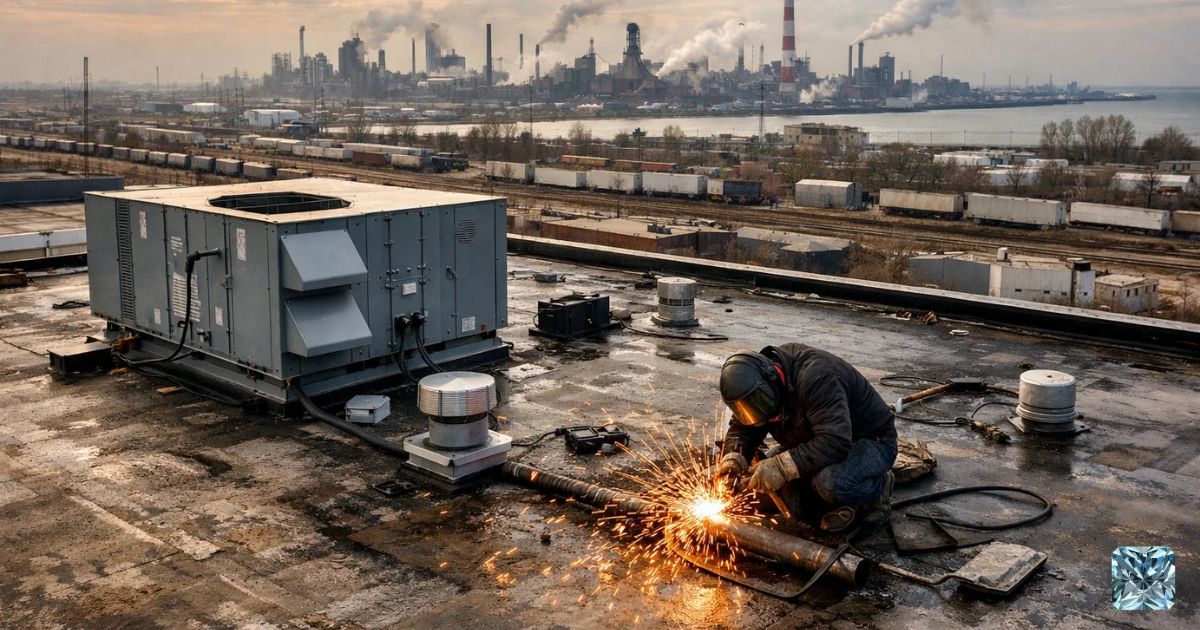
Skim this. Forward the rest to your risk manager or Kenny.
🔲 Hot work permits cost $0 to issue. $127,000 when skipped.
🔲 Disposable plastic wrap TPO ignites at 750°F. Welding sparks hit 6,300°F. Anyone see the problem?
🔲 40% of welding fires start AFTER welding stops. The 30-minute fire watch is not optional.
🔲 Alternative attachment methods cost 30-50% less than welding AND eliminate fire risk.
🔲 One denied insurance claim pays for 25+ years of proper safety protocols.
⚠️ This Is Not Just "Welding, But Higher Up"
Most facility managers think commercial roof welding is just welding, but on a roof. It is not.
It is welding on a combustible surface, 40 feet in the air, with limited escape routes, while wearing fall protection that restricts movement.
The physics are unforgiving. The consequences are permanent.
This is not about becoming a welding expert. This is about not losing $127,000 on a Tuesday afternoon.
💡 A note before we dive in: This article covers some heavy material. Nobody expects you to memorize all of it. Skim the headers. Find the parts that pertain to your building. Forward the rest to the person who handles safety on your team. That is what a leader does. You are already doing the right thing by being here.
⚡ Three Hazards That Rarely Happen Together
Except on Your Roof
Commercial roof welding combines three distinct dangers that rarely show up together anywhere else in construction. Understanding why this combination is uniquely dangerous starts with understanding what you are actually welding on top of.
🔥 Hazard #1: Open Flame on a Flammable Surface
Modern commercial roofing systems are engineered for waterproofing, UV resistance, and flexibility. They are explicitly not designed to withstand direct contact with 6,300°F arc welding temperatures or 2,500°F flying sparks.
Here is where things get real. Let us look at what happens when sparks meet your roof material.
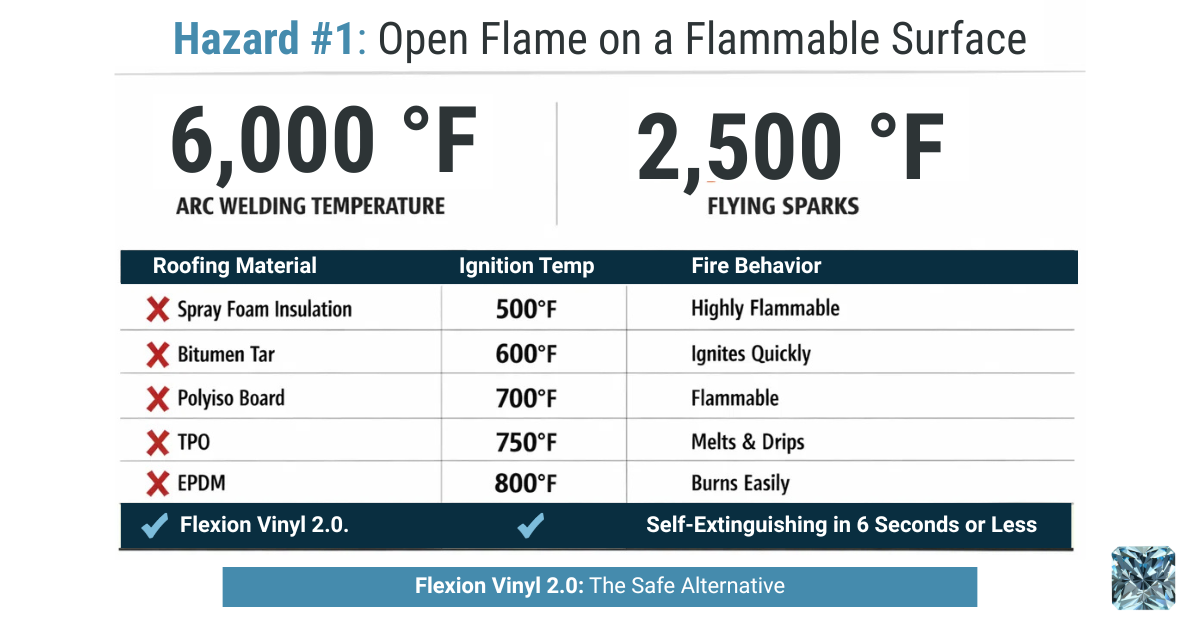
Welding sparks travel 35 feet in calm conditions and stay hot enough to ignite these materials for 8 to 12 seconds after they land. Wind over 15 mph? Sparks travel 100+ feet.
Notice the last row. Our Flexion Vinyl 2.0 smoulders and puts itself out in six seconds or less. Disposable plastic wrap TPO? It carries the flame forward across the entire roof and does not self-extinguish. Expired rubber EPDM does the same. That is not a safety feature. That is a liability.
Here is what actually happens. A spark lands on UV-damaged disposable plastic wrap TPO that is already brittle from 15 years of Hammond sun exposure. Within 3 to 8 seconds, ignition occurs. Because TPO is thermoplastic, it does not just burn. It melts. And drips. Spreading fire rapidly.
The real danger happens in the spaces you cannot see. The fire spreads sideways underneath the membrane, burning through insulation where nobody can spot it and conventional sprinkler systems cannot reach it. By the time you see smoke coming through the roof surface, the fire has typically been spreading for 10 to 15 minutes.
🧗 Hazard #2: Fall Protection vs. Freedom of Movement
OSHA requires fall protection on any roof above six feet. Typically that means a full-body harness, shock-absorbing lanyard, and rated anchor points.
The problem? Welding requires freedom of movement. Fall protection restricts movement.
Standard setups limit the welder to a six-foot circle from each anchor point. To access all sides of a typical HVAC unit that needs flashing work, the welder has to detach and reattach their lanyard 15 to 20 times during the job. Each detachment is a moment of fall exposure. And the awkward positioning at the edge of the protected zone often leads to poor weld quality, which means return visits. More fire exposure. More risk.
You need a helper up there. An extra pair of eyes. An extra pair of hands. Because the cable can get caught. Things can go wrong fast. Welding on a roof cannot be a one-person operation.
💨 Hazard #3: Invisible Fumes That Do Not Float Away
Most people assume outdoor work provides adequate ventilation. You would be wrong.
If you have a dark or nearly black roof surface, point a thermometer at it in July. It will read about 170°F. That is hotter than the tar on the street.
That extreme surface heat creates thermal inversions. Low-pressure zones form around HVAC equipment and parapet walls where welding fumes concentrate instead of dissipating. Welders positioned close to the work surface, often kneeling or leaning for stability, place their breathing zones directly in the fume plume.
Without mechanical ventilation or fume extraction equipment, exposure levels routinely exceed OSHA limits by factors of two to five times.
🔥 Heat + ⬆️ Height = Wow. Not safe.
These three hazards do not just add together. They multiply. Fall protection restricts the welder's ability to move away from fumes. Fire watch personnel watching for sparks may miss signs of heat stress in welders wearing respirators in 95°F heat. Emergency evacuation procedures designed for fire conflict with fall protection protocols that require controlled descent.
This is why rooftop welding requires serious safety management. You cannot just apply ground-level welding rules at elevation and hope for the best.
📝 The Hot Work Permit: Your $127,000 Insurance Policy

It Costs $0 to Issue
The hot work permit is the single most important piece of paper in any commercial roof welding operation. And it is skipped more often than any other safety requirement.
Contractors claim they "handle all the safety stuff" or that permits are "just bureaucracy." Insurance adjusters have a different perspective entirely. When they investigate welding-related roof fires, the first question is always: "Do you have the hot work permit on file?" If the answer is no, the claim is denied. That simple.
💚 Thankfully, Pristine Industrial Roofing does not install ancient or hot material.
We use modern roof chemistry: 1) Liquid urethane. 2) Liquid acrylic. 3) Thick 60-mil rollout Flexion Vinyl sheets. No torch. No flame. No fire risk. That is the whole point of modern chemistry.
What Is a Hot Work Permit?
A documented authorization process that confirms:
🔍 AREA has been inspected for fire hazards
🔥 COMBUSTIBLES have been removed or protected
🧯 EXTINGUISHERS are on-site and accessible
👁️ WATCH is assigned. Someone whose only job is watching for fire.
🚨 PROCEDURES are communicated to all personnel on the roof
The permit process takes 15 to 30 minutes. The materials cost $0. Maybe $50 in labor time.
Without a hot work permit: OSHA fines of $7,000 to $14,502 per incident. Insurance claim denial if fire occurs. Criminal liability if fatality occurs. Civil lawsuit exposure.
With a hot work permit: None of the bad stuff. Your evidence that you took reasonable precautions. Claim approved. Violation dismissed.
The 15 minutes you spend on paperwork can save you $100,000+ in denied claims and fines.
I know. Nobody loves paperwork. Nobody loves insurance adjusters. But you are the responsible party. At least 10% responsible for preventing this from happening. This is the part that protects you.
👁️ The Fire Watch: 30 Minutes That Prevent 40% of Roof Fires

Here is the part that will surprise you.
40% of welding-related roof fires start AFTER the welding has stopped.
The average delay between welding completion and fire discovery is 23 minutes. Why? Because roofing materials and insulation smoulder without visible flames, burning sideways through concealed spaces before producing enough smoke to alert anyone.
This is why OSHA requires fire watch for a minimum of 30 minutes after all welding operations stop. Best practice extends it to 60 minutes for commercial rooftop work.
Fire Watch Responsibilities
- DEDICATED observer. Cannot be doing other tasks.
- Access to fire extinguisher rated for Class A, B, and C fires
- Direct communication to facility management and 911
- Visual inspection of welding area and 35-foot radius around work zone
- Minimum 30 minutes post-weld observation. 60 minutes recommended.
📧 Download Your Rooftop Welding Safety Checklist
We respect your inbox. No sales pressure. No spam. Just genuinely helpful information about protecting your commercial property. Unsubscribe anytime.
Your Name or Company Name (optional): ___________________________________
Your Email: _______________________________________________
Building Address (for a free roof assessment): ______________________________
Number of Buildings You Manage: _________
[ ] Yes, send me helpful roofing insights and maintenance tips
[ ] Yes, I would like someone to take a look at my building
🔍 Pre-Welding Roof Inspection
Know What You Are Welding On Before Someone Lights Up
Most welders do not perform structural assessments before they start work. They assume the roof deck is solid, the membrane is stable, and everything can handle the heat and weight. Sometimes those assumptions are catastrophically wrong.
Welding on commercial roofs? Most people do not even know that happens. Where does it occur? Around edges. Chimney patches. Ductwork. Soldering. Joining metal to metal. Edge cap upgrades from clay to thick metal wrap that gets bonded and mechanically fastened. Sometimes it gets spot-welded on site.
A proper pre-welding inspection catches these problems before they become emergencies. Print this out. Hand it to Kenny. Or Rick the risk manager. Check the boxes.
☑️ Printable Pre-Welding Inspection Checklist
🏗️ STRUCTURAL Integrity
- Is the decking steel, concrete, or wood?
- Are there soft spots indicating rot or corrosion?
- Can the deck support welder + equipment + materials? (300 to 500 lbs concentrated in a 4x4 foot area)
🧤 MEMBRANE Condition
- Is the membrane aged and brittle? (Higher ignition risk)
- Are there existing cracks or seam failures? (Fire spreads faster)
- Is there standing water? (Steam explosion hazard when heated)
💨 INSULATION Type
- Polyiso, spray foam, or fiberglass?
- Is insulation exposed anywhere? (Direct ignition risk)
- Is insulation wet? (Releases steam when heated. Membrane damage.)
🔥 PROXIMITY to Combustibles
Animal fats and grease hoods, HVAC units with plastic fan blades or wiring, rooftop equipment with flammable lubricants or fuel lines, adjacent walls with combustible siding, skylights and vents that could funnel fire into the building interior
🌬️ WIND Conditions and Spark Trajectory
Which direction is the wind blowing? Where will sparks travel? Are there lower roof sections downwind that could catch sparks?
💧 Welding + Standing Water = Steam Explosion

Standing water on a commercial roof is a disqualifying condition for welding. When you apply welding heat to water-saturated insulation, you create steam under pressure. This can cause explosive blowouts where steam ruptures the membrane or sends boiling water spraying upward, potentially injuring the welder.
Even after standing water evaporates, the underlying insulation stays wet. It must dry completely before welding occurs in that area. Any exposed insulation where membrane has been previously removed for repairs represents immediate ignition risk and should absolutely disqualify the roof for welding until properly covered.
This is the part where you just have Pristine Industrial Roofing come out and take a look at it. We will tell you what is safe and what is not. Free assessment.
🧲 Fall Protection That Does Not Kill Productivity
Fall protection is required. Nobody is debating that. But poorly designed fall protection creates its own problems.
The Productivity Problem
Welder needs to move freely to access all sides of an HVAC unit. Fall protection limits range to a six-foot circle from the anchor point. Welder detaches and reattaches lanyard 15+ times during the job. Each detachment is a moment of fall risk. The whole job takes 3x longer than the ground-level equivalent.
Better Approach: Horizontal Lifeline Systems
Instead of a single anchor point requiring constant repositioning, install a horizontal lifeline system or anchor track. A cable or rail runs the length of the work area. The welder's lanyard slides along it. Constant protection. No detachment required. Covers 50 to 150 feet of work area with a single setup.

Value: $800 to $1,500 for temporary system rental. Job completes in half the time.
☑️ Fall Protection Checklist for Roof Welding
- Anchor points rated for 5,000 lbs minimum
- Anchor inspection performed within 30 days of use
- Full-body harness (not waist belt, those are prohibited)
- Shock-absorbing lanyard (limits fall arrest force to 900 lbs)
- Rescue plan documented (how to retrieve a fallen worker)
Most contractors use compliant equipment. The problem is in the implementation. Fall protection is not just about preventing falls. It is about enabling safe, quality work.
🤔 Contractor Qualification: The Questions You Must Ask
Assumption Costs Money
Before authorizing any rooftop welding, verify contractor qualifications. Here are the questions that separate the professionals from the liabilities.

Question #1: Do you have a documented hot work program?
✅ Good answer: "Yes, here is a copy of our written program and sample permits."
🚩 Red flag: "We follow OSHA guidelines." (OSHA requires a WRITTEN program, not general vibes.)
Question #2: What certifications do your welders hold?
✅ Good answer: AWS D1.1 structural welding certification. Bonus: OSHA 30-hour construction safety certification.
🚩 Red flag: "They have been welding for 20 years, they know what they are doing." (Experience does not equal certification.)
Question #3: What is your fall protection anchor system?
✅ Good answer: "We install horizontal lifeline or use engineered anchor points rated for 5,000 lbs."
🚩 Red flag: "We tie off to the HVAC unit." (HVAC units are NOT rated for fall arrest loads. OSHA violation.)
Question #4: Describe your fire watch procedure.
✅ Good answer: "Dedicated observer with extinguisher, 60-minute post-weld monitoring, documented sign-off."
🚩 Red flag: "The welder keeps an eye on things." (The welder cannot be the fire watch. OSHA requires a SEPARATE observer.)
Question #5: What insurance coverage do you carry?
✅ Good answer: General Liability $2M aggregate, Workers Comp statutory limits, certificate naming your facility as Additional Insured.
🚩 Red flag: "We are insured, do not worry about it. I have the letter somewhere on my desk. I will bring it next week." (Get the certificate BEFORE work begins.)
Question #6: What alternative methods did you consider before choosing welding?
✅ Good answer: "We evaluated mechanical fasteners, adhesive systems, and compression fittings. Welding is necessary because of [specific technical reason]."
🚩 Red flag: "Welding is just how we do it." (Their limitation. Not a technical requirement.)
💰 Do We Even Need to Be Welding?
The Real Cost Comparison
This is the question most facility managers never ask. And it might be the most important question in this entire article.
Welding is not always the best solution for commercial roof pipe and equipment attachment. Here is a comparison for a typical HVAC curb flashing installation (standard 4x6 foot curb).
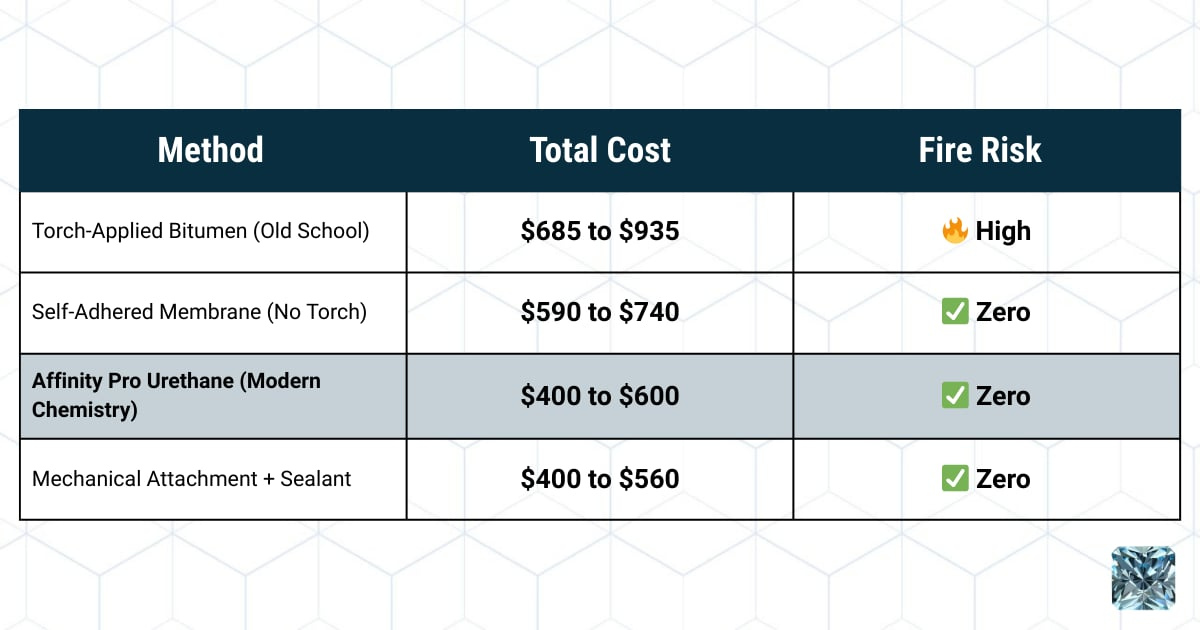
The "faster" welding method costs more AND carries all the fire risk. Why are we welding at all?
About That Affinity Pro Urethane Row
Instead of torching ancient materials onto your existing roof surface, we apply Affinity Pro urethane directly. It includes a gripper primer, a base layer, and a top layer. This is not the stuff you grab at Menards. This is serious. For professionals only.
No glue. No adhesive required. No open flame anywhere near your building.
You can go drop $500 worth of junk to get some buckets of slop at Home Depot. But that is what you did last time. And here we are again. Stop buying garbage. "AMES" is not pro-grade for significant structures.
When Welding Might Actually Be Necessary
There are legitimate reasons welding is sometimes required: structural attachment needing continuous load transfer, specific building code requirements, or manufacturer warranty stipulations. We are not saying welding is always wrong. We are saying it should be the last option, not the default.
The illegitimate reasons contractors push welding: "It is faster" (faster for them, riskier for you). "It is what we know" (their limitation, not a technical need). "It is stronger" (often not true; mechanical systems can exceed weld strength).
🏆 If you have read this far, you are in the top 5% of building owners who actually care about this stuff. That is not flattery. That is a fact. The other 95% are hoping nothing goes wrong. You are making sure it does not. That is the difference.
🌬️ The Invisible Safety Equipment: Ventilation
Welding fumes are heavier than air. They settle at breathing level. On a commercial rooftop with no walls and "unlimited fresh air," you would think ventilation is not a concern.
You would be wrong.
That 170°F roof surface (hotter than the tar on the street in Munster) creates a thermal inversion layer. Fumes get trapped in low-pressure zones around HVAC units. Parapet walls block the breeze. Stagnant air pockets form. The welder, kneeling or leaning close to the work surface, puts their face directly in the fume plume.
This is the invisible hazard. You cannot see it. You cannot smell most of it until it is too late. But the OSHA exposure limits exist for a reason, and typical rooftop welding without proper ventilation exceeds those limits by two to five times.
Portable fume extractors, strategic positioning relative to wind direction, and respiratory protection are not optional. They are the difference between a welder who goes home healthy and one who does not.
🚀 Your Roof Does Not Need a Torch
It Needs Modern Chemistry
Torch-down roofing kind of petered out around 1988. It is silly to have open flame or a torch for anything on your roof when modern alternatives exist that are safer, cheaper, and more effective.

Our Flexion Vinyl 2.0 self-extinguishes in six seconds. Disposable plastic wrap TPO and expired rubber EPDM carry the flame forward across the entire roof surface and do not stop burning.
That is not a minor difference. That is a fundamentally different approach to building safety.
Before you approve another welding operation on your commercial roof, ask the question nobody asks:
"What alternatives exist that eliminate the fire risk entirely?"
Because the only thing worse than a roof fire is a roof fire you could have prevented by choosing a better method in the first place.
We use modern chemistry. Urethane. Acrylic. Vinyl. No torch. No flame. No fire risk. No horror stories. Just a properly protected building and a facility manager who sleeps soundly.
📧 Get the Safety Checklist + Free Roof Assessment
We respect your inbox. No sales pressure. No spam. Just genuinely helpful information about protecting your commercial property. Unsubscribe anytime.
Your Name or Company Name (optional): ___________________________________
Your Email: _______________________________________________
Building Address (for a free roof assessment): ______________________________
Number of Buildings You Manage: _________
[ ] Yes, send me helpful roofing insights and maintenance tips
[ ] Yes, I would like someone to take a look at my building
🫧 Explore What Interests You
Tap into the topic that matters most to your building right now.
🧪 Modern Roof Chemistry Explained → ModernRoofChemistry.com
🛠️ Patching & Repair Options → RoofServiceMenu.com
💰 Transparent Pricing Guide → BigBeautifulRoofBill.com
📄 Warranty Loopholes You Should Know → YourWarrantySaysWhat.com
🧴 We Wash Flat Roofs (Beyond Washing) → WeWashFlatRoofs.com
🤝 Before You Fix the Roof, Fix the Conversation → RelationshipRoofing.com

Read other blog:
.png)

We Love Conversations
 SoHelpful@PristineIndustrialRoofing.com